Note
The Identity of the Scandinavian
Odin and Adon of Babylon
1. Nimrod, or Adon, or Adonis, of
Babylon, was the great war-god. Odin, as is well known, was the
same. 2 Nimrod, in the character of Bacchus, was regarded as the god
of wine; Odin is represented as taking no food but wine. For thus we
read in the Edda: As to himself he [Odin] stands in no need of
food; wine is to him instead of every other aliment, according to
what is said in these verses: The illustrious father of armies, with
his own hand, fattens his two wolves; but the victorious Odin takes
no other nourishment to himself than what arises from the
unintermitted quaffing of wine (MALLET, 20th Fable). 3. The name of
one of Odin's sons indicates the meaning of Odin's own name. Balder,
for whose death such lamentations were made, seems evidently just
the Chaldee form of Baal-zer, The seed of Baal; for the Hebrew z,
as is well known, frequently, in the later Chaldee, becomes d. Now,
Baal and Adon both alike signify Lord; and, therefore, if Balder
be admitted to be the seed or son of Baal, that is as much as to say
that he is the son of Adon; and, consequently, Adon and Odin must be
the same. This, of course, puts Odin a step back; makes his son to
be the object of lamentation and not himself; but the same was the
case also in Egypt; for there Horus the child was sometimes
represented as torn in pieces, as Osiris had been. Clemens
Alexandrinus says (Cohortatio), they 03 lament an infant torn in
pieces by the Titans. The lamentations for Balder are very plainly
the counterpart of the lamentations for Adonis; and, of course, if
Balder was, as the lamentations prove him to have been, the
favourite form of the Scandinavian Messiah, he was Adon, or Lord,
as well as his father. 4. Then, lastly, the name of the other son of
Odin, the mighty and warlike Thor, strengthens all the foregoing
conclusions. Ninyas, the son of Ninus or Nimrod, on his father's
death, when idolatry rose again, was, of course, from the nature of
the mystic system, set up as Adon, the Lord. Now, as Odin had a
son called Thor, so the second Assyrian Adon had a son called
Thouros. The name Thouros seems just to be another form of Zoro, or
Doro, the seed; for Photius tells us that among the Greeks Thoros
signified Seed. The D is often pronounced as Th,--Adon, in the
pointed Hebrew, being pronounced Athon.
Chapter IV
Section II
Justification by Works
The worshippers of Nimrod and his
queen were looked upon as regenerated and purged from sin by
baptism, which baptism received its virtue from the sufferings of
these two great Babylonian divinities. But yet in regard to
justification, the Chaldean doctrine was that it was by works and
merits of men themselves that they must be justified and accepted of
God. The following remarks of Christie in his observations appended
to Ouvaroff's Eleusinian Mysteries, show that such was the case:
Mr. Ouvaroff has suggested that one of the great objects of the
Mysteries was the presenting to fallen man the means of his return
to God. These means were the cathartic virtues--(i.e., the virtues
by which sin is removed), by the exercise of which a corporeal life
was to be vanquished. Accordingly the Mysteries were termed Teletae,
'perfections,' because they were supposed to induce a perfectness of
life. Those who were purified by them were styled Teloumenoi and
Tetelesmenoi, that is, 'brought...to perfection,' which depended on
the exertions of the individual. In the Metamorphosis of Apuleius,
who was himself initiated in the mysteries of Isis, we find this
same doctrine of human merits distinctly set forth. Thus the goddess
is herself represented as addressing the hero of his tale: If you
shall be found to DESERVE the protection of my divinity by sedulous
obedience, religious devotion and inviolable chastity, you shall be
sensible that it is possible for me, and me alone, to extend your
life beyond the limits that have been appointed to it by your
destiny. When the same individual has received a proof of the
supposed favour of the divinity, thus do the onlookers express their
congratulations: Happy, by Hercules! and thrice blessed he to have
MERITED, by the innocence and probity of his past life, such special
patronage of heaven. Thus was it in life. At death, also, the grand
passport into the unseen world was still through the merits of men
themselves, although the name of Osiris was, as we shall by-and-by
see, given to those who departed in the faith. When the bodies of
persons of distinction [in Egypt], says Wilkinson, quoting
Porphyry, were embalmed, they took out the intestines and put them
into a vessel, over which (after some other rites had been performed
for the dead) one of the embalmers pronounced an invocation to the
sun in behalf of the deceased. The formula, according to Euphantus,
who translated it from the original into Greek, was as follows: O
thou Sun, our sovereign lord! and all ye Deities who have given life
to man, receive me, and grant me an abode with the eternal gods.
During the whole course of my life I have scrupulously worshipped
the gods my father taught me to adore; I have ever honoured my
parents, who begat this body; I have killed no one; I have not
defrauded any, nor have I done any injury to any man. Thus the
merits, the obedience, or the innocence of man was the grand plea.
The doctrine of Rome in regard to the vital article of a sinner's
justification is the very same. Of course this of itself would prove
little in regard to the affiliation of the two systems, the
Babylonian and the Roman; for, from the days of Cain downward, the
doctrine of human merit and of self-justification has everywhere
been indigenous in the heart of depraved humanity. But, what is
worthy of notice in regard to this subject is, that in the two
systems, it was symbolised in precisely the same way. In the Papal
legends it is taught that St. Michael the Archangel has committed to
him the balance of God's justice, and that in the two opposite
scales of that balance the merits and the demerits of the departed
are put that they may be fairly weighed, the one over against the
other, and that as the scale turns to the favourable or unfavourable
side they may be justified or condemned as the case may be. Now, the
Chaldean doctrine of justification, as we get light on it from the
monuments of Egypt, is symbolised in precisely the same way, except
that in the land of Ham the scales of justice were committed to the
charge of the god Anubis instead of St. Michael the Archangel, and
that the good deeds and the bad seem to have been weighed
separately, and a distinct record made of each, so that when both
were summed up and the balance struck, judgment was pronounced
accordingly. Wilkinson states that Anubis and his scales are often
represented; and that in some cases there is some difference in the
details. But it is evident from his statements, that the principle
in all is the same. The following is the account which he gives of
one of these judgment scenes, previous to the admission of the dead
to Paradise: Cerberus is present as the guardian of the gates, near
which the scales of justice are erected; and Anubis, the director of
the weight, having placed a vase representing the good actions of
the deceased in one scale, and the figure or emblem of truth in the
other, proceeds to ascertain his claims for admission. If, on being
weighed, he is found wanting, he is rejected, and Osiris, the judge
of the dead, inclining his sceptre in token of condemnation,
pronounces judgment upon him, and condemns his soul to return to
earth under the form of a pig or some unclean animal...But if, when
the SUM of his deeds are recorded by Thoth [who stands by to mark
the results of the different weighings of Anubis], his virtues so
far PREDOMINATE as to entitle him to admission to the mansions of
the blessed, Horus, taking in his hand the tablet of Thoth,
introduces him to the presence of Osiris, who, in his palace,
attended by Isis and Nepthys, sits on his throne in the midst of the
waters, from which rises the lotus, bearing upon its expanded
flowers the four Genii of Amenti. The same mode of symbolising the
justification by works had evidently been in use in Babylon itself;
and, therefore, there was great force in the Divine handwriting on
the wall, when the doom of Belshazzar went forth: Tekel, Thou art
weighed in the balances, and art found wanting. In the Parsee
system, which has largely borrowed from Chaldea, the principle of
weighing the good deeds over against the bad deeds is fully
developed. For three days after dissolution, says Vaux, in his
Nineveh and Persepolis, giving an account of Parsee doctrines in
regard to the dead, the soul is supposed to flit round its tenement
of clay, in hopes of reunion; on the fourth, the Angel Seroch
appears, and conducts it to the bridge of Chinevad. On this
structure, which they assert connects heaven and earth, sits the
Angel of Justice, to weigh the actions of mortals; when the good
deeds prevail, the soul is met on the bridge by a dazzling figure,
which says, 'I am thy good angel, I was pure originally, but thy
good deeds have rendered me purer'; and passing his hand over the
neck of the blessed soul, leads it to Paradise. If iniquities
preponderate, the soul is meet by a hideous spectre, which howls
out, 'I am thy evil genius; I was impure from the first, but thy
misdeeds have made me fouler; through thee we shall remain miserable
until the resurrection'; the sinning soul is then dragged away to
hell, where Ahriman sits to taunt it with its crimes. Such is the
doctrine of Parseeism. The same is the case in China, where Bishop
Hurd, giving an account of the Chinese descriptions of the infernal
regions, and of the figures that refer to them, says, One of them
always represents a sinner in a pair of scales, with his iniquities
in the one, and his good works in another. We meet with several
such representations, he adds, in the Grecian mythology. Thus
does Sir J. F. Davis describe the operation of the principle in
China: In a work of some note on morals, called Merits and Demerits
Examined, a man is directed to keep a debtor and creditor account
with himself of the acts of each day, and at the end of the year to
wind it up. If the balance is in his favour, it serves as the
foundation of a stock of merits for the ensuing year: and if against
him, it must be liquidated by future good deeds. Various lists and
comparative tables are given of both good and bad actions in the
several relations of life; and benevolence is strongly inculcated in
regard first to man, and, secondly, to the brute creation. To cause
another's death is reckoned at one hundred on the side of demerit;
while a single act of charitable relief counts as one on the other
side...To save a person's life ranks in the above work as an exact
set-off to the opposite act of taking it away; and it is said that
this deed of merit will prolong a person's life twelve years.
While such a mode of justification
is, on the one hand, in the very nature of the case, utterly
demoralising, there never could by means of it, on the other, be in
the bosom of any man whose conscience is aroused, any solid feeling
of comfort, or assurance as to his prospects in the eternal world.
Who could ever tell, however good he might suppose himself to be,
whether the sum of his good actions would or would not
counterbalance the amount of sins and transgressions that his
conscience might charge against him. How very different the
Scriptural, the god-like plan of justification by faith, and
faith alone, without the deeds of the law, absolutely irrespective
of human merits, simply and solely through the righteousness of
Christ, that is unto all and upon all them that believe, that
delivers at once and for ever from all condemnation, those who
accept of the offered Saviour, and by faith are vitally united to
Him. It is not the will of our Father in heaven, that His children
in this world should be ever in doubt and darkness as to the vital
point of their eternal salvation. Even a genuine saint, no doubt,
may for a season, if need be, be in heaviness through manifold
temptations, but such is not the natural, the normal state of a
healthful Christian, of one who knows the fulness and the freeness
of the blessings of the Gospel of peace. God has laid the most solid
foundation for all His people to say, with John, We have KNOWN and
believed the love which God hath to us (1 John 4:16); or with Paul,
I am PERSUADED that neither death, nor life, nor angels, nor
principalities, nor powers, nor things present, nor things to come,
nor height, nor depth, nor any other creature, shall be able to
separate us from the love of God, which is in Christ Jesus (Rom
8:38,39). But this no man can every say, who goes about to
establish his own righteousness (Rom 10:3), who seeks, in any
shape, to be justified by works. Such assurance, such comfort, can
come only from a simple and believing reliance on the free,
unmerited grace of God, given in and along with Christ, the
unspeakable gift of the Father's love. It was this that made
Luther's spirit to be, as he himself declared, as free as a flower
of the field, when, single and alone, he went up to the Diet of
Worms, to confront all the prelates and potentates there convened to
condemn the doctrine which he held. It was this that in every age
made the martyrs go with such sublime heroism not only to prison but
to death. It is this that emancipates the soul, restores the true
dignity of humanity, and cuts up by the roots all the imposing
pretensions of priestcraft. It is this only that can produce a life
of loving, filial, hearty obedience to the law and commandments of
God; and that, when nature fails, and when the king of terrors is at
hand, can enable poor, guilty sons of men, with the deepest sense of
unworthiness, yet to say, O death, where is thy sting? O grave,
where is thy victory? Thanks be unto God, who giveth us the victory
through Jesus Christ our Lord (1 Cor 15:55,57).
Now, to all such confidence in God,
such assurance of salvation, spiritual despotism in every age, both
Pagan and Papal, has ever shown itself unfriendly. Its grand object
has always been to keep the souls of its votaries away from direct
and immediate intercourse with a living and merciful Saviour, and
consequently from assurance of His favour, to inspire a sense of the
necessity of human mediation, and so to establish itself on the
ruins of the hopes and the happiness of the world. Considering the
pretensions which the Papacy makes to absolute infallibility, and
the supernatural powers which it attributes to the functions of its
priests, in regard to regeneration and the forgiveness of sins, it
might have been supposed, as a matter of course, that all its
adherents would have been encouraged to rejoice in the continual
assurance of their personal salvation. But the very contrary is the
fact. After all its boastings and high pretensions, perpetual doubt
on the subject of a man's salvation, to his life's end, is
inculcated as a duty; it being peremptorily decreed as an article of
faith by the Council of Trent, That no man can know with infallible
assurance of faith that he HAS OBTAINED the grace of God. This very
decree of Rome, while directly opposed to the Word of God, stamps
its own lofty claims with the brand of imposture; for if no man who
has been regenerated by its baptism, and who has received its
absolution from sin, can yet have any certain assurance after all
that the grace of God has been conferred upon him, what can be the
worth of its opus operatum? Yet, in seeking to keep its devotees in
continual doubt and uncertainty as to their final state, it is wise
after its generation. In the Pagan system, it was the priest alone
who could at all pretend to anticipate the operation of the scales
of Anubis; and, in the confessional, there was from time to time,
after a sort, a mimic rehearsal of the dread weighing that was to
take place at last in the judgment scene before the tribunal of
Osiris. There the priest sat in judgment on the good deeds and bad
deeds of his penitents; and, as his power and influence were founded
to a large extent on the mere principle of slavish dread, he took
care that the scale should generally turn in the wrong direction,
that they might be more subservient to his will in casting in a due
amount of good works into the opposite scale. As he was the grand
judge of what these works should be, it was his interest to appoint
what should be most for the selfish aggrandisement of himself, or
the glory of his order; and yet so to weigh and counterweigh merits
and demerits, that there should always be left a large balance to be
settled, not only by the man himself, but by his heirs. If any man
had been allowed to believe himself beforehand absolutely sure of
glory, the priests might have been in danger of being robbed of
their dues after death--an issue by all means to be guarded against.
Now, the priests of Rome have in every respect copied after the
priests of Anubis, the god of the scales. In the confessional, when
they have an object to gain, they make the sins and transgressions
good weight; and then, when they have a man of influence, or power,
or wealth to deal with, they will not give him the slightest hope
till round sums of money, or the founding of an abbey, or some other
object on which they have set their heart, be cast into the other
scale. In the famous letter of Pere La Chaise, the confessor of
Louis XIV of France, giving an account of the method which he
adopted to gain the consent of that licentious monarch to the
revocation of the Edict of Nantes, by which such cruelties were
inflicted on his innocent Huguenot subjects, we see how the fear of
the scales of St. Michael operated in bringing about the desired
result: Many a time since, says the accomplished Jesuit, referring
to an atrocious sin of which the king had been guilty, many a time
since, when I have had him at confession, I have shook hell about
his ears, and made him sigh, fear and tremble, before I would give
him absolution. By this I saw that he had still an inclination to
me, and was willing to be under my government; so I set the baseness
of the action before him by telling the whole story, and how wicked
it was, and that it could not be forgiven till he had done some good
action to BALANCE that, and expiate the crime. Whereupon he at last
asked me what he must do. I told him that he must root out all
heretics from his kingdom. This was the good action to be cast
into the scale of St. Michael the Archangel, to BALANCE his crime.
The king, wicked as he was--sore against his will-consented; the
good action was cast in, the heretics were extirpated; and the
king was absolved. But yet the absolution was not such but that,
when he went the way of all the earth, there was still much to be
cast in before the scales could be fairly adjusted. Thus Paganism
and Popery alike make merchandise of the souls of men (Rev 18:13).
Thus the one with the scales of Anubis, the other with the scales of
St. Michael, exactly answer to the Divine description of Ephraim in
his apostacy: Ephraim is a merchant, the balances of deceit are in
his hand (Hosea 12:7). The Anubis of the Egyptians was precisely
the same as the Mercury of the Greeks--the god of thieves. St.
Michael, in the hands of Rome, answers exactly to the same
character. By means of him and his scales, and their doctrine of
human merits, they have made what they call the house of God to be
nothing else than a den of thieves. To rob men of their money is
bad, but infinitely worse to cheat them also of their souls.
Into the scales of Anubis, the
ancient Pagans, by way of securing their justification, were
required to put not merely good deeds, properly so called, but deeds
of austerity and self-mortification inflicted on their own persons,
for averting the wrath of the gods. The scales of St. Michael
inflexibly required to be balanced in the very same way. The priests
of Rome teach that when sin is forgiven, the punishment is not
thereby fully taken away. However perfect may be the pardon that
God, through the priests, may bestow, yet punishment, greater or
less, still remains behind, which men must endure, and that to
satisfy the justice of God. Again and again has it been shown that
man cannot do anything to satisfy the justice of God, that to that
justice he is hopelessly indebted, that he has absolutely nothing
to pay; and more than that, that there is no need that he should
attempt to pay one farthing; for that, in behalf of all who believe,
Christ has finished transgression, made an end of sin, and made all
the satisfaction to the broken law that that law could possibly
demand. Still Rome insists that every man must be punished for his
own sins, and that God cannot be satisfied * without groans and
sighs, lacerations of the flesh, tortures of the body, and penances
without number, on the part of the offender, however broken in
heart, however contrite that offender may be.
* Bishop HAY'S Sincere
Christian. The words of Bishop Hay are: But He absolutely
demands that, by penitential works, we PUNISH ourselves for our
shocking ingratitude, and satisfy the Divine justice for the
abuse of His mercy. The established modes of punishment, as
is well known, are just such as are described in the text.
Now, looking simply at the
Scripture, this perverse demand for self-torture on the part of
those for whom Christ has made a complete and perfect atonement,
might seem exceedingly strange; but, looking at the real character
of the god whom the Papacy has set up for the worship of its deluded
devotees, there is nothing in the least strange about it. That god
is Moloch, the god of barbarity and blood. Moloch signifies king;
and Nimrod was the first after the flood that violated the
patriarchal system, and set up as king over his fellows. At first
he was worshipped as the revealer of goodness and truth, but
by-and-by his worship was made to correspond with his dark and
forbidding countenance and complexion. The name Moloch originally
suggested nothing of cruelty or terror; but now the well known rites
associated with that name have made it for ages a synonym for all
that is most revolting to the heart of humanity, and amply justify
the description of Milton (Paradise Lost):
First Moloch, horrid king,
besmeared with blood
Of human sacrifice, and parents' tears,
Though, for the noise of drums and timbrels loud,
Their children's cries unheard, that passed through fire
To his grim idol.
In almost every land the bloody
worship prevailed; horrid cruelty, hand in hand with abject
superstition, filled not only the dark places of the earth, but
also regions that boasted of their enlightenment. Greece, Rome,
Egypt, Phoenicia, Assyria, and our own land under the savage Druids,
at one period or other in their history, worshipped the same god and
in the same way. Human victims were his most acceptable offerings;
human groans and wailings were the sweetest music in his ears; human
tortures were believed to delight his heart. His image bore, as the
symbol of majesty, a whip, and with whips his worshippers, at some
of his festivals, were required unmercifully to scourge themselves.
After the ceremonies of sacrifice, says Herodotus, speaking of the
feast of Isis at Busiris, the whole assembly, to the amount of many
thousands, scourge themselves; but in whose honour they do this I am
not at liberty to disclose. This reserve Herodotus generally uses,
out of respect to his oath as an initiated man; but subsequent
researches leave no doubt as to the god in whose honour the
scourgings took place. In Pagan Rome the worshippers of Isis
observed the same practice in honour of Osiris. In Greece, Apollo,
the Delian god, who was identical with Osiris, * was propitiated
with similar penances by the sailors who visited his shrine, as we
learn from the following lines of Callimachus in his hymn to Delos:
Soon as they reach thy soundings,
down at once
They drop slack sails and all the naval gear.
The ship is moored; nor do the crew presume
To quit thy sacred limits, till they've passed
A fearful penance; with the galling whip
Lashed thrice around thine altar.
* We have seen already, that
the Egyptian Horus was just a new incarnation of Osiris or
Nimrod. Now, Herodotus calls Horus by the name of Apollo.
Diodorus Siculus, also, says that Horus, the son of Isis, is
interpreted to be Apollo. Wilkinson seems, on one occasion, to
call this identity of Horus and Apollo in question; but he
elsewhere admits that the story of Apollo's combat with the
serpent Pytho is evidently derived from the Egyptian mythology,
where the allusion is to the representation of Horus piercing
the snake with a spear. From divers considerations, it may be
shown that this conclusion is correct: 1. Horus, or Osiris, was
the sun-god, so was Apollo. 2. Osiris, whom Horus represented,
was the great Revealer; the Pythian Apollo was the god of
oracles. 3. Osiris, in the character of Horus, was born when his
mother was said to be persecuted by the malice of her enemies.
Latona, the mother of Apollo, was a fugitive for a similar
reason when Apollo was born. 4. Horus, according to one version
of the myth, was said, like Osiris, to have been cut in pieces
(PLUTARCH, De Iside). In the classic story of Greece, this part
of the myth of Apollo was generally kept in the background; and
he was represented as victor in the conflict with the serpent;
but even there it was sometimes admitted that he had suffered a
violent death, for by Porphyry he is said to have been slain by
the serpent, and Pythagoras affirmed that he had seen his tomb
at Tripos in Delphi (BRYANT). 5. Horus was the war-god. Apollo
was represented in the same way as the great god represented in
Layard, with the bow and arrow, who was evidently the Babylonian
war-god, Apollo's well known title of Arcitenens,--the bearer
of the bow, having evidently been borrowed from that source.
Fuss tells us that Apollo was regarded as the inventor of the
art of shooting with the bow, which identifies him with
Sagittarius, whose origin we have already seen. 6. Lastly, from
Ovid (Metam.) we learn that, before engaging with Python, Apollo
had used his arrows only on fallow-deer, stags, c. All which
sufficiently proves his substantial identification with the
mighty Hunter of Babel.
Over and above the scourgings,
there were also slashings and cuttings of the flesh required as
propitiatory rites on the part of his worshippers. In the solemn
celebration of the Mysteries, says Julius Firmicus, all things in
order had to be done, which the youth either did or suffered at his
death. Osiris was cut in pieces; therefore, to imitate his fate, so
far as living men might do so, they were required to cut and wound
their own bodies. Therefore, when the priests of Baal contended with
Elijah, to gain the favour of their god, and induce him to work the
desired miracle in their behalf, they cried aloud and cut
themselves, after their manner, with knives and with lancets, till
the blood gushed out upon them (1 Kings 18:28). In Egypt, the
natives in general, though liberal in the use of the whip, seem to
have been sparing of the knife; but even there, there were men also
who mimicked on their own persons the dismemberment of Osiris. The
Carians of Egypt, says Herodotus, in the place already quoted,
treat themselves at this solemnity with still more severity, for
they cut themselves in the face with swords (HERODOTUS). To this
practice, there can be no doubt, there is a direct allusion in the
command in the Mosaic law, Ye shall make no cuttings in your flesh
for the dead (Lev 19:28). * These cuttings in the flesh are largely
practised in the worship of the Hindoo divinities, as propitiatory
rites or meritorious penances. They are well known to have been
practised in the rites of Bellona, ** the sister or wife of the
Roman war-god Mars, whose name, The lamenter of Bel, clearly
proves the original of her husband to whom the Romans were so fond
of tracing back their pedigree.
* Every person who died in the
faith was believed to be identified with Osiris, and called by
his name. (WILKINSON)
** The priests of Bellona,
says Lactantius, sacrificed not with any other men's blood but
their own, their shoulders being lanced, and with both hands
brandishing naked swords, they ran and leaped up and down like
mad men.
They were practised also in the
most savage form in the gladiatorial shows, in which the Roman
people, with all their boasted civilis ation, so much delighted. The
miserable men who were doomed to engage in these bloody exhibitions
did not do so generally of their own free will. But yet, the
principle on which these shows were conducted was the very same as
that which influenced the priests of Baal. They were celebrated as
propitiatory sacrifices. From Fuss we learn that gladiatorial shows
were sacred to Saturn; and in Ausonius we read that the
amphitheatre claims its gladiators for itself, when at the end of
December they PROPITIATE with their blood the sickle-bearing Son of
Heaven. On this passage, Justus Lipsius, who quotes it, thus
comments: Where you will observe two things, both, that the
gladiators fought on the Saturnalia, and that they did so for the
purpose of appeasing and PROPITIATING Saturn. The reason of this,
he adds, I should suppose to be, that Saturn is not among the
celestial but the infernal gods. Plutarch, in his book of
'Summaries,' says that 'the Romans looked upon Kronos as a
subterranean and infernal God.' There can be no doubt that this is
so far true, for the name of Pluto is only a synonym for Saturn,
The Hidden One. *
* The name Pluto is evidently
from Lut, to hide, which with the Egyptian definite article
prefixed, becomes P'Lut. The Greek wealth, the hidden
thing, is obviously formed in the same way. Hades is just
another synonym of the same name.
But yet, in the light of the real
history of the historical Saturn, we find a more satisfactory reason
for the barbarous custom that so much disgraced the escutcheon of
Rome in all its glory, when mistress of the world, when such
multitudes of men were
Butchered to make a Roman
holiday.
When it is remembered that Saturn
himself was cut in pieces, it is easy to see how the idea would
arise of offering a welcome sacrifice to him by setting men to cut
one another in pieces on his birthday, by way of propitiating his
favour.
The practice of such penances,
then, on the part of those of the Pagans who cut and slashed
themselves, was intended to propitiate and please their god, and so
to lay up a stock of merit that might tell in their behalf in the
scales of Anubis. In the Papacy, the penances are not only intended
to answer the same end, but, to a large extent,they are identical. I
do not know, indeed, that they use the knife as the priests of Baal
did; but it is certain that they look upon the shedding of their own
blood as a most meritorious penance, that gains them high favour
with God, and wipes away many sins. Let the reader look at the
pilgrims at Lough Dergh, in Ireland, crawling on their bare knees
over the sharp rocks, and leaving the bloody tracks behind them, and
say what substantial difference there is between that and cutting
themselves with knives. In the matter of scourging themselves,
however, the adherents of the Papacy have literally borrowed the
lash of Osiris. Everyone has heard of the Flagellants, who publicly
scourge themselves on the festivals of the Roman Church, and who are
regarded as saints of the first water. In the early ages of
Christianity such flagellations were regarded as purely and entirely
Pagan. Athenagoras, one of the early Christian Apologists, holds up
the Pagans to ridicule for thinking that sin could be atoned for, or
God propitiated, by any such means. But now, in the high places of
the Papal Church, such practices are regarded as the grand means of
gaining the favour of God. On Good Friday, at Rome and Madrid, and
other chief seats of Roman idolatry, multitudes flock together to
witness the performances of the saintly whippers, who lash
themselves till the blood gushes in streams from every part of their
body. They pretend to do this in honour of Christ, on the festival
set apart professedly to commemorate His death, just as the
worshippers of Osiris did the same on the festival when they
lamented for his loss. *
* The priests of Cybele at Rome
observed the same practice.
But can any man of the least
Christian enlightenment believe that the exalted Saviour can look on
such rites as doing honour to Him, which pour contempt on His
all-perfect atonement, and represent His most precious blood as
needing to have its virtue supplemented by that of blood drawn from
the backs of wretched and misguided sinners? Such offerings were
altogether fit for the worship of Moloch; but they are the very
opposite of being fit for the service of Christ.
It is not in one point only, but in
manifold respects, that the ceremonies of Holy Week at Rome, as it
is termed, recall to memory the rites of the great Babylonian god.
The more we look at these rites, the more we shall be struck with
the wonderful resemblance that subsists between them and those
observed at the Egyptian festival of burning lamps and the other
ceremonies of the fire-worshippers in different countries. In Egypt
the grand illumination took place beside the sepulchre of Osiris at
Sais. In Rome in Holy Week, a sepulchre of Christ also figures in
connection with a brilliant illumination of burning tapers. In
Crete, where the tomb of Jupiter was exhibited, that tomb was an
object of worship to the Cretans. In Rome, if the devotees do not
worship the so-called sepulchre of Christ, they worship what is
entombed within it. As there is reason to believe that the Pagan
festival of burning lamps was observed in commemoration of the
ancient fire-worship, so there is a ceremony at Rome in the Easter
week, which is an unmistakable act of fire-worship, when a cross of
fire is the grand object of worship. This ceremony is thus
graphically described by the authoress of Rome in the 19th Century:
The effect of the blazing cross of fire suspended from the dome
above the confession or tomb of St. Peter's, was strikingly
brilliant at night. It is covered with innumerable lamps, which have
the effect of one blaze of fire...The whole church was thronged with
a vast multitude of all classes and countries, from royalty to the
meanest beggar, all gazing upon this one object. In a few minutes
the Pope and all his Cardinals descended into St. Peter's, and room
being kept for them by the Swiss guards, the aged
Pontiff...prostrated himself in silent adoration before the CROSS OF
FIRE. A long train of Cardinals knelt before him, whose splendid
robes and attendant train-bearers, formed a striking contrast to the
humility of their attitude. What could be a more clear and
unequivocal act of fire-worship than this? Now, view this in
connection with the fact stated in the following extract from the
same work, and how does the one cast light on the other: With Holy
Thursday our miseries began [that is, from crowding]. On this
dis astrous day we went before nine to the Sistine chapel...and
beheld a procession led by the inferior orders of clergy, followed
up by the Cardinals in superb dresses, bearing long wax tapers in
their hands, and ending with the Pope himself, who walked beneath a
crimson canopy, with his head uncovered, bearing the Host in a box;
and this being, as you know, the real flesh and blood of Christ, was
carried from the Sistine chapel through the intermediate hall to the
Paulina chapel, where it was deposited in the sepulchre prepared to
receive it beneath the altar...I never could learn why Christ was to
be buried before He was dead, for, as the crucifixion did not take
place till Good Friday, it seems odd to inter Him on Thursday. His
body, however, is laid in the sepulchre, in all the churches of
Rome, where this rite is practised, on Thursday forenoon, and it
remains there till Saturday at mid-day, when, for some reason best
known to themselves, He is supposed to rise from the grave amidst
the firing of cannon, and blowing of trumpets, and jingling of
bells, which have been carefully tied up ever since the dawn of Holy
Thursday, lest the devil should get into them. The worship of the
cross of fire on Good Friday explains at once the anomaly otherwise
so perplexing, that Christ should be buried on Thursday, and rise
from the dead on Saturday. If the festival of Holy Week be really,
as its rites declare, one of the old festivals of Saturn, the
Babylonian fire-god, who, though an infernal god, was yet Phoroneus,
the great Deliverer, it is altogether natural that the god of the
Papal idolatry, though called by Christ's name, should rise from the
dead on his own day--the Dies Saturni, or Saturn's day. *
* The above account referred to
the ceremonies as witnessed by the authoress in 1817 and 1818.
It would seem that some change has taken place since then,
caused probably by the very attention called by her to the gross
anomaly mentioned above; for Count Vlodaisky, formerly a Roman
Catholic priest, who visited Rome in 1845, has informed me that
in that year the resurrection took place, not at mid-day, but at
nine o'clock on the evening of Saturday. This may have been
intended to make the inconsistency between Roman practice and
Scriptural fact appear somewhat less glaring. Still the fact
remains, that the resurrection of Christ, as celebrated at Rome,
takes place, not on His own day--The Lord's day--but--on the
day of Saturn, the god of fire!
On the day before the Miserere is
sung with such overwhelming pathos, that few can listen to it
unmoved, and many even swoon with the emotions that are excited.
What if this be at bottom only the old song of Linus, of whose very
touching and melancholy character Herodotus speaks so strikingly?
Certain it is, that much of the pathos of that Miserere depends on
the part borne in singing it by the sopranos; and equally certain it
is that Semiramis, the wife of him who, historically, was the
original of that god whose tragic death was so pathetically
celebrated in many countries, enjoys the fame, such as it is, of
having been the inventress of the practice from which soprano
singing took its rise.
Now, the flagellations which form
an important part of the penances that take place at Rome on the
evening of Good Friday, formed an equally important part in the
rites of that fire-god, from which, as we have seen, the Papacy has
borrowed so much. These flagellations, then, of Passion Week,
taken in connection with the other ceremonies of that period, bear
their additional testimony to the real character of that god whose
death and resurrection Rome then celebrates. Wonderful it is to
consider that, in the very high place of what is called Catholic
Christendom, the essential rites at this day are seen to be the very
rites of the old Chaldean fire-worshippers.
Chapter IV
Section III
The Sacrifice of the Mass
If baptismal regeneration, the
initiating ordinance of Rome, and justification by works, be both
Chaldean, the principle embodied in the unbloody sacrifice of the
mass is not less so. We have evidence that goes to show the
Babylonian origin of the idea of that unbloody sacrifice very
distinctly. From Tacitus we learn that no blood was allowed to be
offered on the altars of Paphian Venus. Victims were used for the
purposes of the Haruspex, that presages of the issues of events
might be drawn from the inspection of the entrails of these victims;
but the altars of the Paphian goddess were required to be kept pure
from blood. Tacitus shows that the Haruspex of the temple of the
Paphian Venus was brought from Cilicia, for his knowledge of her
rites, that they might be duly performed according to the supposed
will of the goddess, the Cilicians having peculiar knowledge of her
rites. Now, Tarsus, the capital of Cilicia, was built by Sennacerib,
the Assyrian king, in express imitation of Babylon. Its religion
would naturally correspond; and when we find unbloody sacrifice in
Cyprus, whose priest came from Cilicia, that, in the circumstances,
is itself a strong presumption that the unbloody sacrifice came to
it through Cilicia from Babylon. This presumption is greatly
strengthened when we find from Herodotus that the peculiar and
abominable institution of Babylon in prostituting virgins in honour
of Mylitta, was observed also in Cyprus in honour of Venus. But the
positive testimony of Pausanias brings this presumption to a
certainty. Near this, says that historian, speaking of the temple
of Vulcan at Athens, is the temple of Celestial Venus, who was
first worshipped by the Assyrians, and after these by the Paphians
in Cyprus, and the Phoenicians who inhabited the city of Ascalon in
Palestine. But the Cythereans venerated this goddess in consequence
of learning her sacred rites from the Phoenicians. The Assyrian
Venus, then--that is, the great goddess of Babylon--and the Cyprian
Venus were one and the same, and consequently the bloodless altars
of the Paphian goddess show the character of the worship peculiar to
the Babylonian goddess, from whom she was derived. In this respect
the goddess-queen of Chaldea differed from her son, who was
worshipped in her arms. He was, as we have seen, represented as
delighting in blood. But she, as the mother of grace and mercy, as
the celestial Dove, as the hope of the whole world, (BRYANT) was
averse to blood, and was represented in a benign and gentle
character. Accordingly, in Babylon she bore the name of
Mylitta--that is, The Mediatrix. *
* Mylitta is the same as
Melitta, the feminine of Melitz, a mediator, which in Chaldee
becomes Melitt. Melitz is the word used in Job 33:23, 24: If
there be a messenger with him, an interpreter (Heb. Melitz, a
mediator), one among a thous and, to show unto man his
uprightness, then he is gracious unto him, and saith, Deliver
him from going down to the pit; I have found a ransom.
Every one who reads the Bible, and
sees how expressly it declares that, as there is only one God, so
there is only one Mediator between God and man (1 Tim 2:5), must
marvel how it could ever have entered the mind of any one to bestow
on Mary, as is done by the Church of Rome, the character of the
Mediatrix. But the character ascribed to the Babylonian goddess as
Mylitta sufficiently accounts for this. In accordance with this
character of Mediatrix, she was called Aphrodite--that is, the
wrath-subduer *--who by her charms could soothe the breast of angry
Jove, and soften the most rugged spirits of gods or mortal-men. In
Athens she was called Amarusia (PAUSANIAS)--that is, The Mother of
gracious acceptance. **
* From Chaldee aph, wrath,
and radah, to subdue; radite is the feminine emphatic.
** From Ama, mother, and
Retza, to accept graciously, which in the participle active
is Rutza. Pausanias expresses his perplexity as to the meaning
of the name Amarusia as applied to Diana, saying, Concerning
which appellation I never could find any one able to give a
satisfactory account. The sacred tongue plainly shows the
meaning of it.
In Rome she was called Bona Dea,
the good goddess, the mysteries of this goddess being celebrated
by women with peculiar secrecy. In India the goddess Lakshmi, the
Mother of the Universe, the consort of Vishnu, is represented also
as possessing the most gracious and genial disposition; and that
disposition is indicated in the same way as in the case of the
Babylonian goddess. In the festivals of Lakshmi, says Coleman, no
sanguinary sacrifices are offered. In China, the great gods, on
whom the final destinies of mankind depend, are held up to the
popular mind as objects of dread; but the goddess Kuanyin, the
goddess of mercy, whom the Chinese of Canton recognise as bearing
an analogy to the Virgin or Rome, is described as looking with an
eye of compassion on the guilty, and interposing to save miserable
souls even from torments to which in the world of spirits they have
been doomed. Therefore she is regarded with peculiar favour by the
Chinese. This character of the goddess-mother has evidently radiated
in all directions from Chaldea. Now, thus we see how it comes that
Rome represents Christ, the Lamb of God, meek and lowly in heart,
who never brake the bruised reed, nor quenched the smoking flax--who
spake words of sweetest encouragement to every mourning
penitent--who wept over Jerusalem--who prayed for His murderers--as
a stern and inexorable judge, before whom the sinner might grovel
in the dust, and still never be sure that his prayers would be
heard, while Mary is set off in the most winning and engaging
light, as the hope of the guilty, as the grand refuge of sinners;
how it is that the former is said to have reserved justice and
judgment to Himself, but to have committed the exercise of all
mercy to His Mother! The most standard devotional works of Rome are
pervaded by this very principle, exalting the compassion and
gentleness of the mother at the expense of the loving character of
the Son. Thus, St. Alphonsus Liguori tells his readers that the
sinner that ventures to come directly to Christ may come with dread
and apprehension of His wrath; but let him only employ the mediation
of the Virgin with her Son, and she has only to show that Son the
breasts that gave him suck, (Catholic Layman, July, 1856) and His
wrath will immediately be appeased. But where in the Word of God
could such an idea have been found? Not surely in the answer of the
Lord Jesus to the woman who exclaimed, Blessed is the womb that
bare thee, and the paps that thou hast sucked! Jesus answered and
said unto her, Yea, rather, blessed are they that hear the Word of
God and keep it (Luke 11:27,28). There cannot be a doubt that this
answer was given by the prescient Saviour, to check in the very bud
every idea akin to that expressed by Liguori. Yet this idea, which
is not to be found in Scripture, which the Scripture expressly
repudiates, was widely diffused in the realms of Paganism. Thus we
find an exactly parallel representation in the Hindoo mythology in
regard to the god Siva and his wife Kali, when that god appeared as
a little child. Siva, says the Lainga Puran, appeared as an
infant in a cemetery, surrounded by ghosts, and on beholding him,
Kali (his wife) took him up, and, caressing him, gave him her
breast. He sucked the nectareous fluid; but becoming ANGRY, in order
to divert and PACIFY him, Kali clasping him to her bosom, danced
with her attendant goblins and demons amongst the dead, until he was
pleased and delighted; while Vishnu, Brahma, Indra, and all the
gods, bowing themselves, praised with laudatory strains the god of
gods, Kal and Parvati. Kali, in India, is the goddess of
destruction; but even into the myth that concerns this goddess of
destruction, the power of the goddess mother, in appeasing an
offended god, by means only suited to PACIFY a peevish child, has
found an introduction. If the Hindoo story exhibits its god of
gods in such a degrading light, how much more honouring is the
Papal story to the Son of the Blessed, when it represents Him as
needing to be pacified by His mother exposing to Him the breasts
that He has sucked. All this is done only to exalt the Mother, as
more gracious and more compassionate than her glorious Son. Now,
this was the very case in Babylon: and to this character of the
goddess queen her favourite offerings exactly corresponded.
Therefore, we find the women of Judah represented as simply burning
incense, pouring out drink-offerings, and offering cakes to the
queen of heaven (Jer 44:19). The cakes were the unbloody
sacrifice she required. That unbloody sacrifice her votaries not
only offered, but when admitted to the higher mysteries, they
partook of, swearing anew fidelity to her. In the fourth century,
when the queen of heaven, under the name of Mary, was beginning to
be worshipped in the Christian Church, this unbloody sacrifice
also was brought in. Epiphanius states that the practice of offering
and eating it began among the women of Arabia; and at that time it
was well known to have been adopted from the Pagans. The very shape
of the unbloody sacrifice of Rome may indicate whence it came. It is
a small thin, round wafer; and on its roundness the Church of Rome
lays so much stress, to use the pithy language of John Knox in
regard to the wafer-god, If, in making the roundness the ring be
broken, then must another of his fellow-cakes receive that honour to
be made a god, and the crazed or cracked miserable cake, that once
was in hope to be made a god, must be given to a baby to play
withal. What could have induced the Papacy to insist so much on the
roundness of its unbloody sacrifice? Clearly not any reference
to the Divine institution of the Supper of our Lord; for in all the
accounts that are given of it, no reference whatever is made to the
form of the bread which our Lord took, when He blessed and break it,
and gave it to His disciples, saying, Take, eat; this is My body:
this do in remembrance of Me. As little can it be taken from any
regard to injunctions about the form of the Jewish Paschal bread;
for no injunctions on that subject are given in the books of Moses.
The importance, however, which Rome attaches to the roundness of the
wafer, must have a reason; and that reason will be found, if we look
at the altars of Egypt. The thin, round cake, says Wilkinson,
occurs on all altars. Almost every jot or tittle in the Egyptian
worship had a symbolical meaning. The round disk, so frequent in the
sacred emblems of Egypt, symbolised the sun. Now, when Osiris, the
sun-divinity, became incarnate, and was born, it was not merely that
he should give his life as a sacrifice for men, but that he might
also be the life and nourishment of the souls of men. It is
universally admitted that Isis was the original of the Greek and
Roman Ceres. But Ceres, be it observed, was worshipped not simply as
the discoverer of corn; she was worshipped as the MOTHER of Corn.
The child she brought forth was He-Siri, the Seed, or, as he was
most frequently called in Assyria, Bar, which signifies at once
the Son and the Corn.
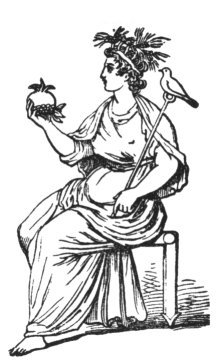
 |
Ceres, Mother of Bar,
the Son, and of Bar, the Corn.
The ear of corn
in the above medal from BRYANT (vol. v. p. 383),
is alongside of Ceres; but usually it is held in
her hand. The god on the reverse is the same as
that ear. (See Deification of the Child, in
regard to Beltis and the Shining Bar.
|
The uninitiated might reverence
Ceres for the gift of material corn to nourish their bodies, but the
initiated adored her for a higher gift--for food to nourish their
souls--for giving them that bread of God that cometh down from
heaven--for the life of the world, of which, if a man eat, he shall
never die. Does any one imagine that it is a mere New Testament
doctrine, that Christ is the bread of life? There never was, there
never could be, spiritual life in any soul, since the world began,
at least since the expulsion from Eden, that was not nourished and
supported by a continual feeding by faith on the Son of God, in
whom it hath pleased the Father that all fulness should dwell (Col
1:19), that out of His fulness we might receive, and grace for
grace (John 1:16). Paul tells us that the manna of which the
Israelites ate in the wilderness was to them a type and lively
symbol of the bread of life; (1 Cor 10:3), They did all eat the
same spiritual meat--i.e., meat which was intended not only to
support their natural lives, but to point them to Him who was the
life of their souls. Now, Clement of Alexandria, to whom we are
largely indebted for all the discoveries that, in modern times, have
been made in Egypt, expressly assures us that, in their hidden
character, the enigmas of the Egyptians were VERY SIMILAR TO THOSE
OF THE JEWS. That the initiated Pagans actually believed that the
Corn which Ceres bestowed on the world was not the Corn of this
earth, but the Divine Son, through whom alone spiritual and
eternal life could be enjoyed, we have clear and decisive proof. The
Druids were devoted worshippers of Ceres, and as such they were
celebrated in their mystic poems as bearers of the ears of corn.
Now, the following is the account which the Druids give of their
great divinity, under the form of Corn. That divinity was
represented as having, in the first instance, incurred, for some
reason or other, the displeasure of Ceres, and was fleeing in terror
from her. In his terror, he took the form of a bird, and mounted
into the air. That element afforded him no refuge: for The Lady, in
the form of a sparrow-hawk, was gaining upon him--she was just in
the act of pouncing upon him. Shuddering with dread, he perceived a
heap of clean wheat upon a floor, dropped into the midst of it, and
assumed the form of a single grain. Ceridwen [i.e., the British
Ceres] took the form of a black high-crested hen, descended into the
wheat, scratched him out, distinguished, and swallowed him. And, as
the history relates, she was pregnant of him nine months, and when
delivered of him, she found him so lovely a babe, that she had not
resolution to put him to death (Song of Taliesin, DAVIES'S
British Druids). Here it is evident that the grain of corn, is
expressly identified with the lovely babe; from which it is still
further evident that Ceres, who, to the profane vulgar was known
only as the Mother of Bar, the Corn, was known to the initiated
as the Mother of Bar, the Son. And now, the reader will be
prepared to understand the full significance of the representation
in the Celestial sphere of the Virgin with the ear of wheat in her
hand. That ear of wheat in the Virgin's hand is just another symbol
for the child in the arms of the Virgin Mother.
Now, this Son, who was symbolised
as Corn, was the SUN-divinity incarnate, according to the sacred
oracle of the great goddess of Egypt: No mortal hath lifted my
veil. The fruit which I have brought forth is the SUN (BUNSEN'S
Egypt). What more natural then, if this incarnate divinity is
symbolised as the bread of God, than that he should be represented
as a round wafer, to identify him with the Sun? Is this a mere
fancy? Let the reader peruse the following extract from Hurd, in
which he describes the embellishments of the Romish altar, on which
the sacrament or consecrated wafer is deposited, and then he will be
able to judge: A plate of silver, in the form of a SUN, is fixed
opposite to the SACRAMENT on the altar; which, with the light of the
tapers, makes a most brilliant appearance. What has that
brilliant Sun to do there, on the altar, over against the
sacrament, or round wafer? In Egypt, the disk of the Sun was
represented in the temples, and the sovereign and his wife and
children were represented as adoring it. Near the small town of
Babin, in Upper Egypt, there still exists in a grotto, a
representation of a sacrifice to the sun, where two priests are seen
worshipping the sun's image. In the great temple of Babylon, the
golden image of the Sun was exhibited for the worship of the
Babylonians. In the temple of Cuzco, in Peru, the disk of the sun
was fixed up in flaming gold upon the wall, that all who entered
might bow down before it. The Paeonians of Thrace were
sun-worshippers; and in their worship they adored an image of the
sun in the form of a disk at the top of a long pole. In the worship
of Baal, as practised by the idolatrous Israelites in the days of
their apostacy, the worship of the sun's image was equally observed;
and it is striking to find that the image of the sun, which apostate
Israel worshipped, was erected above the altar. When the good king
Josiah set about the work of reformation, we read that his servants
in carrying out the work, proceeded thus (2 Chron 34:4): And they
brake down the altars of Baalim in his presence, and the images
(margin, SUN-IMAGES) that were on high above them, he cut down.
Benjamin of Tudela, the great Jewish traveller, gives a striking
account of sun-worship even in comparatively modern times, as
subsisting among the Cushites of the East, from which we find that
the image of the sun was, even in his day, worshipped on the altar.
There is a temple, says he, of the posterity of Chus, addicted to
the contemplation of the stars. They worship the sun as a god, and
the whole country, for half-a-mile round their town, is filled with
great altars dedicated to him. By the dawn of morn they get up and
run out of town, to wait the rising sun, to whom, on every altar,
there is a consecrated image, not in the likeness of a man, but of
the solar orb, framed by magic art. These orbs, as soon as the sun
rises, take fire, and resound with a great noise, while everybody
there, men and women, hold censers in their hands, and all burn
incense to the sun. From all this, it is manifest that the image of
the sun above, or on the altar, was one of the recognised symbols of
those who worshipped Baal or the sun. And here, in a so-called
Christian Church, a brilliant plate of silver, in the form of a
SUN, is so placed on the altar, that every one who adores at that
altar must bow down in lowly reverence before that image of the
Sun. Whence, I ask, could that have come, but from the ancient
sun-worship, or the worship of Baal? And when the wafer is so placed
that the silver SUN is fronting the round wafer, whose
roundness is so important an element in the Romish Mystery, what
can be the meaning of it, but just to show to those who have eyes to
see, that the Wafer itself is only another symbol of Baal, or the
Sun. If the sun-divinity was worshipped in Egypt as the Seed, or
in Babylon as the Corn, precisely so is the wafer adored in Rome.
Bread-corn of the elect, have mercy upon us, is one of the
appointed prayers of the Roman Litany, addressed to the wafer, in
the celebration of the mass. And one at least of the imperative
requirements as to the way in which that wafer is to be partaken of,
is the very same as was enforced in the old worship of the
Babylonian divinity. Those who partake of it are required to partake
absolutely fasting. This is very stringently laid down. Bishop Hay,
laying down the law on the subject, says that it is indispensable,
that we be fasting from midnight, so as to have taken nothing into
our stomach from twelve o'clock at night before we receive, neither
food, nor drink, nor medicine. Considering that our Lord Jesus
Christ instituted the Holy Communion immediately after His disciples
had partaken of the paschal feast, such a strict requirement of
fasting might seem very unaccountable. But look at this provision in
regard to the unbloody sacrifice of the mass in the light of the
Eleusinian Mysteries, and it is accounted for at once; for there the
first question put to those who sought initiation was, Are you
fasting? (POTTER, Eleusiania) and unless that question was answered
in the affirmative, no initiation could take place. There is no
question that fasting is in certain circumstances a Christian duty;
but while neither the letter nor the spirit of the Divine
institution requires any such stringent regulation as the above, the
regulations in regard to the Babylonian Mysteries make it evident
whence this requirement has really come.
Although the god whom Isis or Ceres
brought forth, and who was offered to her under the symbol of the
wafer or thin round cake, as the bread of life, was in reality the
fierce, scorching Sun, or terrible Moloch, yet in that offering all
his terror was veiled, and everything repulsive was cast into the
shade. In the appointed symbol he is offered up to the benignant
Mother, who tempers judgment with mercy, and to whom all spiritual
blessings are ultimately referred; and blessed by that mother, he is
given back to be feasted upon, as the staff of life, as the
nourishment of her worshippers' souls. Thus the Mother was held up
as the favourite divinity. And thus, also, and for an entirely
similar reason, does the Madonna of Rome entirely eclipse her son as
the Mother of grace and mercy.
In regard to the Pagan character of
the unbloody sacrifice of the mass, we have seen not little
already. But there is something yet to be considered, in which the
working of the mystery of iniquity will still further appear. There
are letters on the wafer that are worth reading. These letters are
I. H. S. What mean these mystical letters? To a Christian these
letters are represented as signifying, Iesus Hominum Salvator,
Jesus the Saviour of men. But let a Roman worshipper of Isis (for
in the age of the emperors there were innumerable worshippers of
Isis in Rome) cast his eyes upon them, and how will he read them? He
will read them, of course, according to his own well known system of
idolatry: Isis, Horus, Seb, that is, The Mother, the Child, and
the Father of the gods,--in other words, The Egyptian Trinity.
Can the reader imagine that this double sense is accidental? Surely
not. The very same spirit that converted the festival of the Pagan
Oannes into the feast of the Christian Joannes, retaining at the
same time all its ancient Paganism, has skilfully planned the
initials I. H. S. to pay the semblance of a tribute to Christianity,
while Paganism in reality has all the substance of the homage
bestowed upon it.
When the women of Arabia began to
adopt this wafer and offer the unbloody sacrifice, all genuine
Christians saw at once the real character of their sacrifice. They
were treated as heretics, and branded with the name of Collyridians,
from the Greek name for the cake which they employed. But Rome saw
that the heresy might be turned to account; and therefore, though
condemned by the sound portion of the Church, the practice of
offering and eating this unbloody sacrifice was patronised by the
Papacy; and now, throughout the whole bounds of the Romish
communion, it has superseded the simple but most precious sacrament
of the Supper instituted by our Lord Himself.
Intimately connected with the
sacrifice of the mass is the subject of transubstantiation; but the
consideration of it will come more conveniently at a subsequent
stage of this inquiry.
Chapter IV
Section IV
Extreme Unction
The last office which Popery
performs for living men is to give them extreme unction, to anoint
them in the name of the Lord, after they have been shriven and
absolved, and thus to prepare them for their last and unseen
journey. The pretence for this unction of dying men is professedly
taken from a command of James in regard to the visitation of the
sick; but when the passage in question is fairly quoted it will be
seen that such a practice could never have arisen from the apostolic
direction--that it must have come from an entirely different source.
Is any sick among you? says James (v 14,15), let him call for the
elders of the church; and let them pray over him, anointing him with
oil in the name of the Lord: and the prayer of faith shall save the
sick, and the Lord shall RAISE HIM UP. Now, it is evident that this
prayer and anointing were intended for the recovery of the sick.
Apostolic men, for the laying of the foundations of the Christian
Church, were, by their great King and Head, invested with miraculous
powers--powers which were intended only for a time, and were
destined, as the apostles themselves declared, while exercising
them, to vanish away (1 Cor 13:8). These powers were every day
exercised by the elders of the Church, when James wrote his
epistle, and that for healing the bodies of men, even as our Lord
Himself did. The extreme unction of Rome, as the very expression
itself declares, is not intended for any such purpose. It is not
intended for healing the sick, or raising them up; for it is not
on any account to be administered till all hope of recovery is gone,
and death is visibly at the very doors. As the object of this
anointing is the very opposite of the Scriptural anointing, it must
have come from a quite different quarter. That quarter is the very
same from which the Papacy has imported so much heathenism, as we
have seen already, into its own foul bosom. From the Chaldean
Mysteries, extreme unction has obviously come. Among the many names
of the Babylonian god was the name Beel-samen, Lord of Heaven,
which is the name of the sun, but also of course of the sun-god. But
Beel-samen also properly signifies Lord of Oil, and was evidently
intended as a synonym of the Divine name, The Messiah. In
Herodotus we find a statement made which this name alone can fully
explain. There an individual is represented as having dreamt that
the sun had anointed her father. That the sun should anoint any one
is certainly not an idea that could naturally have presented itself;
but when the name Beel-samen, Lord of Heaven, is seen also to
signify Lord of Oil, it is easy to see how that idea would be
suggested. This also accounts for the fact that the body of the
Babylonian Belus was represented as having been preserved in his
sepulchre in Babylon till the time of Xerxes, floating in oil
(CLERICUS, Philosoph. Orient.). And for the same reason, no doubt,
it was that at Rome the statue of Saturn was made hollow, and
filled with oil (SMITH'S Classical Dictionary).
The olive branch, which we have
already seen to have been one of the symbols of the Chaldean god,
had evidently the same hieroglyphical meaning; for, as the olive was
the oil-tree, so an olive branch emblematically signified a son of
oil, or an anointed one (Zech 4:12-14). Hence the reason that the
Greeks, in coming before their gods in the attitude of suppliants
deprecating their wrath and entreating their favour, came to the
temple on many occasions bearing an olive branch in their hands. As
the olive branch was one of the recognised symbols of their Messiah,
whose great mission it was to make peace between God and man, so, in
bearing this branch of the anointed one, they thereby testified that
in the name of that anointed one they came seeking peace. Now, the
worshippers of this Beel-samen, Lord of Heaven, and Lord of Oil,
were anointed in the name of their god. It was not enough that they
were anointed with spittle; they were also anointed with magical
ointments of the most powerful kind; and these ointments were the
means of introducing into their bodily systems such drugs as tended
to excite their imaginations and add to the power of the magical
drinks they received, that they might be prepared for the visions
and revelations that were to be made to them in the Mysteries. These
unctions, says Salverte, were exceedingly frequent in the ancient
ceremonies...Before consulting the oracle of Trophonius, they were
rubbed with oil over the whole body. This preparation certainly
concurred to produce the desired vision. Before being admitted to
the Mysteries of the Indian sages, Apollonius and his companion were
rubbed with an oil so powerful that they felt as if bathed with
fire. This was professedly an unction in the name of the Lord of
Heaven, to fit and prepare them for being admitted in vision into
his awful presence. The very same reason that suggested such an
unction before initiation on this present scene of things, would
naturally plead more powerfully still for a special unction when
the individual was called, not in vision, but in reality, to face
the Mystery of mysteries, his personal introduction into the world
unseen and eternal. Thus the Pagan system naturally developed itself
into extreme unction (Quarterly Journal of Prophecy, January,
1853). Its votaries were anointed for their last journey, that by
the double influence of superstition and powerful stimulants
introduced into the frame by the only way in which it might then be
possible, their minds might be fortified at once against the sense
of guilt and the assaults of the king of terrors. From this source,
and this alone, there can be no doubt came the extreme unction of
the Papacy, which was entirely unknown among Christians till
corruption was far advanced in the Church. *
* Bishop GIBSON says that it
was not known in the Church for a thous and years. (Preservative
against Popery)
Chapter IV
Section V
Purgatory and Prayers for the Dead
Extreme unction, however, to a
burdened soul, was but a miserable resource, after all, in the
prospect of death. No wonder, therefore, that something else was
found to be needed by those who had received all that priestly
assumption could pretend to confer, to comfort them in the prospect
of eternity. In every system, therefore, except that of the Bible,
the doctrine of a purgatory after death, and prayers for the dead,
has always been found to occupy a place. Go wherever we may, in
ancient or modern times, we shall find that Paganism leaves hope
after death for sinners, who, at the time of their departure, were
consciously unfit for the abodes of the blest. For this purpose a
middle state has been feigned, in which, by means of purgatorial
pains, guilt unremoved in time may in a future world be purged away,
and the soul be made meet for final beatitude. In Greece the
doctrine of a purgatory was inculcated by the very chief of the
philosophers. Thus Plato, speaking of the future judgment of the
dead, holds out the hope of final deliverance for all, but maintains
that, of those who are judged, some must first proceed to a
subterranean place of judgment, where they shall sustain the
punishment they have deserved; while others, in consequence of a
favourable judgment, being elevated at once into a certain celestial
place, shall pass their time in a manner becoming the life they
have lived in a human shape. In Pagan Rome, purgatory was equally
held up before the minds of men; but there, there seems to have been
no hope held out to any of exemption from its pains. Therefore,
Virgil, describing its different tortures, thus speaks:
Nor can the grovelling mind,
In the dark dungeon of the limbs confined,
Assert the native skies, or own its heavenly kind.
Nor death itself can wholly wash their stains;
But long-contracted filth, even in the soul, remains
The relics of inveterate vice they wear,
And spots of sin obscene in every face appear.
For this are various penances enjoined;
And some are hung to bleach upon the wind,
Some plunged in water, others purged in fires,
Till all the dregs are drained, and all the rust expires.
All have their Manes, and those Manes bear.
The few so cleansed to these abodes repair,
And breathe in ample fields the soft Elysian air,
Then are they happy, when by length of time
The scurf is worn away of each committed crime.
No speck is left of their habitual stains,
But the pure ether of the soul remains.
In Egypt, substantially the same
doctrine of purgatory was inculcated. But when once this doctrine of
purgatory was admitted into the popular mind, then the door was
opened for all manner of priestly extortions. Prayers for the dead
ever go hand in hand with purgatory; but no prayers can be
completely efficacious without the interposition of the priests; and
no priestly functions can be rendered unless there be special pay
for them. Therefore, in every land we find the Pagan priesthood
devouring widows' houses, and making merchandise of the tender
feelings of sorrowing relatives, sensitively alive to the immortal
happiness of the beloved dead. From all quarters there is one
universal testimony as to the burdensome character and the expense
of these posthumous devotions. One of the oppressions under which
the poor Romanists in Ireland groan, is the periodical special
devotions, for which they are required to pay, when death has
carried away one of the inmates of their dwelling. Not only are
there funeral services and funeral dues for the repose of the
departed, at the time of burial, but the priest pays repeated visits
to the family for the same purpose, which entail heavy expense,
beginning with what is called the month's mind, that is, a service
in behalf of the deceased when a month after death has elapsed.
Something entirely similar to this had evidently been the case in
ancient Greece; for, says Muller in his History of the Dorians, the
Argives sacrificed on the thirtieth day [after death] to Mercury as
the conductor of the dead. In India many and burdensome are the
services of the Sradd'ha, or funeral obsequies for the repose of the
dead; and for securing the due efficacy of these, it is inculcated
that donations of cattle, land, gold, silver, and other things,
should be made by the man himself at the approach of death; or, if
he be too weak, by another in his name (Asiatic Researches).
Wherever we look, the case is nearly the same. In Tartary, The
Gurjumi, or prayers for the dead, says the Asiatic Journal, are
very expensive. In Greece, says Suidas, the greatest and most
expensive sacrifice was the mysterious sacrifice called the Telete,
a sacrifice which, according to Plato, was offered for the living
and the dead, and was supposed to free them from all the evils to
which the wicked are liable when they have left this world. In
Egypt the exactions of the priests for funeral dues and masses for
the dead were far from being trifling. The priests, says
Wilkinson, induced the people to expend large sums on the
celebration of funeral rites; and many who had barely sufficient to
obtain the necessaries of life were anxious to save something for
the expenses of their death. For, beside the embalming process,
which sometimes cost a talent of silver, or about 250 pounds English
money, the tomb itself was purchased at an immense expense; and
numerous demands were made upon the estate of the deceased, for the
celebration of prayer and other services for the soul. The
ceremonies, we find him elsewhere saying, consisted of a sacrifice
similar to those offered in the temples, vowed for the deceased to
one or more gods (as Osisris, Anubis, and others connected with
Amenti); incense and libation were also presented; and a prayer was
sometimes read, the relations and friends being present as mourners.
They even joined their prayers to those of the priest. The priest
who officiated at the burial service was selected from the grade of
Pontiffs, who wore the leopard skin; but various other rites were
performed by one of the minor priests to the mummies, previous to
their being lowered into the pit of the tomb after that ceremony.
Indeed, they continued to be administered at intervals, as long as
the family paid for their performance. Such was the operation of
the doctrine of purgatory and prayers for the dead among avowed and
acknowledged Pagans; and in what essential respect does it differ
from the operation of the same doctrine in Papal Rome? There are the
same extortions in the one as there were in the other. The doctrine
of purgatory is purely Pagan, and cannot for a moment stand in the
light of Scripture. For those who die in Christ no purgatory is, or
can be, needed; for the blood of Jesus Christ, God's Son, cleanseth
from ALL sin. If this be true, where can there be the need for any
other cleansing? On the other hand, for those who die without
personal union to Christ, and consequently unwashed, unjustified,
unsaved, there can be no other cleansing; for, while he that hath
the son hath life, he that hath not the Son hath not life, and
never can have it. Search the Scripture through, and it will be
found that, in regard to all who die in their sins, the decree of
God is irreversible: Let him that is unjust be unjust still, and
let him that is filthy be filthy still. Thus the whole doctrine of
purgatory is a system of pure bare-faced Pagan imposture,
dishonouring to God, deluding men who live in sin with the hope of
atoning for it after death, and cheating them at once out of their
property and their salvation. In the Pagan purgatory, fire, water,
wind, were represented (as may be seen from the lines of Virgil) as
combining to purge away the stain of sin. In the purgatory of the
Papacy, ever since the days of Pope Gregory, FIRE itself has been
the grand means of purgation (Catechismus Romanus). Thus, while the
purgatorial fires of the future world are just the carrying out of
the principle embodied in the blazing and purifying Baal-fires of
the eve of St. John, they form another link in identifying the
system of Rome with the system of Tammuz or Zoroaster, the great God
of the ancient fire-worshippers.
Now, if baptismal regeneration,
justification by works, penance as a satisfaction to God's justice,
the unbloody sacrifice of the mass, extreme unction, purgatory, and
prayers for the dead, were all derived from Babylon, how justly may
the general system of Rome be styled Babylonian? And if the account
already given be true, what thanks ought we to render to God, that,
from a system such as this, we were set free at the blessed
Reformation! How great a boon is it to be delivered from trusting in
such refuges of lies as could no more take away sin than the blood
of bulls or of goats! How blessed to feel that the blood of the
Lamb, applied by the Spirit of God to the most defiled conscience,
completely purges it from dead works and from sin! How fervent ought
our gratitude to be, when we know that, in all our trials and
distresses, we may come boldly unto the throne of grace, in the name
of no creature, but of God's eternal and well-beloved Son; and that
that Son is exhibited as a most tender and compassionate high
priest, who is TOUCHED with a feeling of our infirmities, having
been in all points tempted like as we are, yet without sin. Surely
the thought of all this, while inspiring tender compassion for the
deluded slaves of Papal tyranny, ought to make us ourselves stand
fast in the liberty wherewith Christ has made us free, and quit
ourselves like men, that neither we nor our children may ever again
be entangled in the yoke of bondage.
Chapter 5
Rites and Ceremonies
Section I
Idol Processions
Those who have read the account of
the last idol procession in the capital of Scotland, in John Knox's
History of the Reformation, cannot easily have forgot the
tragi-comedy with which it ended. The light of the Gospel had widely
spread, the Popish idols had lost their fascination, and popular
antipathy was everywhere rising against them. The images, says the
historian, were stolen away in all parts of the country; and in
Edinburgh was that great idol called Sanct Geyle [the patron saint
of the capital], first drowned in the North Loch, after burnt, which
raised no small trouble in the town. The bishops demanded of the
Town Council either to get them again the old Sanct Geyle, or else,
upon their (own) expenses, to make a new image. The Town Council
could not do the one, and the other they absolutely refused to do;
for they were now convinced of the sin of idolatry. The bishops and
priests, however, were still made upon their idols; and, as the
anniversary of the feast of St. Giles was approaching, when the
saint used to be carried in procession through the town, they
determined to do their best, that the accustomed procession should
take place with as much pomp as possible. For this purpose, a
marmouset idole was borrowed from the Grey friars, which the
people, in derision, called Young Sanct Geyle, and which was made
to do service instead of the old one. On the appointed day, says
Know, there assembled priests, friars, canons...with taborns and
trumpets, banners, and bagpipes; and who was there to lead the ring
but the Queen Regent herself, with all her shavelings, for honour of
that feast. West about goes it, and comes down the High Street, and
down to the Canno Cross. As long as the Queen was present, all went
to the heart's content of the priests and their partis ans. But no
sooner had majesty retired to dine, than some in the crowd, who had
viewed the whole concern with an evil eye, drew nigh to the idol,
as willing to help to bear him, and getting the fertour (or barrow)
on their shoulders, began to shudder, thinking that thereby the idol
should have fallen. But that was provided and prevented by the iron
nails [with which it was fastened to the fertour]; and so began one
to cry, 'Down with the idol, down with it'; and so without delay it
was pulled down. Some brag made the priests' patrons at the first;
but when they saw the feebleness of their god, for one took him by
the heels, and dadding [knocking] his head to the calsay [pavement],
left Dagon without head or hands, and said, 'Fye upon thee, thou
young Sanct Geyle, thy father would have tarried [withstood] four
such [blows]'; this considered, we say, the priests and friars fled
faster than they did at Pinkey Cleuch. There might have been seen so
sudden a fray as seldom has been seen amongst that sort of men
within this realm; for down goes the crosses, off goes the surplice,
round caps corner with the crowns. The Grey friars gaped, the Black
friars blew, the priests panted and fled, and happy was he that
first gat the house; for such ane sudden fray came never amongst the
generation of Antichrist within this realm before.
Such an idol procession among a
people who had begun to study and relish the Word of God, elicited
nothing but indignation and scorn. But in Popish lands, among a
people studiously kept in the dark, such processions are among the
favourite means which the Romish Church employs to bind its votaries
to itself. The long processions with images borne on men's
shoulders, with the gorgeous dresses of the priests, and the various
habits of different orders of monks and nuns, with the aids of
flying banners and the thrilling strains of instrumental music, if
not too closely scanned, are well fitted plausibly to amuse the
worldly mind, to gratify the love for the picturesque, and when the
emotions thereby called forth are dignified with the names of piety
and religion, to minister to the purposes of spiritual despotism.
Accordingly, Popery has ever largely availed itself of such
pageants. On joyous occasions, it has sought to consecrate the
hilarity and excitement created by such processions to the service
of its idols; and in seasons of sorrow, it has made use of the same
means to draw forth the deeper wail of distress from the multitudes
that throng the procession, as if the mere loudness of the cry would
avert the displeasure of a justly offended God. Gregory, commonly
called the Great, seems to have been the first who, on a large
scale, introduced those religious processions into the Roman Church.
In 590, when Rome was suffering under the heavy hand of God from the
pestilence, he exhorted the people to unite publicly in supplication
to God, appointing that they should meet at daybreak in SEVEN
DIFFERENT COMPANIES, according to their respective ages, SEXES, and
stations, and walk in seven different processions, reciting litanies
or supplications, till they all met at one place. They did so, and
proceeded singing and uttering the words, Lord, have mercy upon
us, carrying along with them, as Baronius relates, by Gregory's
express command, an image of the Virgin. The very idea of such
processions was an affront to the majesty of heaven; it implied that
God who is a Spirit saw with eyes of flesh, and might be moved by
the imposing picturesqueness of such a spectacle, just as sensuous
mortals might. As an experiment it had but slender success. In the
space of one hour, while thus engaged, eighty persons fell to the
ground, and breathed their last. Yet this is now held up to Britons
as the more excellent way for deprecating the wrath of God in a
season of national distress. Had this calamity, says Dr. Wiseman,
referring to the Indian dis asters, had this calamity fallen upon
our forefathers in Catholic days, one would have seen the streets of
this city [London] trodden in every direction by penitential
processions, crying out, like David, when pestilence had struck the
people. If this allusion to David has any pertinence or meaning, it
must imply that David, in the time of pestilence, headed some such
penitential procession. But Dr. Wiseman knows, or ought to know,
that David did nothing of the sort, that his penitence was expressed
in no such way as by processions, and far less by idol processions,
as in the Catholic days of our forefathers, to which we are
invited to turn back. This reference to David, then, is a mere
blind, intended to mislead those who are not given to Bible reading,
as if such penitential processions had something of Scripture
warrant to rest upon. The Times, commenting on this recommendation
of the Papal dignitary, has hit the nail on the head. The historic
idea, says that journal, is simple enough, and as old as old can
be. We have it in Homer--the procession of Hecuba and the ladies of
Troy to the shrine of Minerva, in the Acropolis of that city. It
was a time of terror and dismay in Troy, when Diomede, with
resistless might, was driving everything before him, and the
overthrow of the proud city seemed at hand. To avert the apparently
inevitable doom, the Trojan Queen was divinely directed.
To lead the assembled train
Of Troy's chief matron's to Minerva's fane.
And she did so:--
Herself...the long procession
leads;
The train majestically slow proceeds.
Soon as to Ilion's topmost tower they come,
And awful reach the high Palladian dome,
Antenor's consort, fair Theano, waits
As Pallas' priestess, and unbars the gates.
With hands uplifted and imploring eyes,
They fill the dome with supplicating cries.
Here is a precedent for
penitential processions in connection with idolatry entirely to
the point, such as will be sought for in vain in the history of
David, or any of the Old Testament saints. Religious processions,
and especially processions with images, whether of a jubilant or
sorrowful description, are purely Pagan. In the Word of God we find
two instances in which there were processions practised with Divine
sanction; but when the object of these processions is compared with
the avowed object and character of Romish processions, it will be
seen that there is no analogy between them and the processions of
Rome. The two cases to which I refer are the seven days'
encompassing of Jericho, and the procession at the bringing up of
the ark of God from Kirjath-jearim to the city of David. The
processions, in the first case, though attended with the symbols of
Divine worship, were not intended as acts of religious worship, but
were a miraculous mode of conducting war, when a signal
interposition of Divine power was to be vouchsafed. In the other,
there was simply the removing of the ark, the symbol of Jehovah's
presence, from the place where, for a long period, it had been
allowed to lie in obscurity, to the place which the Lord Himself had
chosen for its abode; and on such an occasion it was entirely
fitting and proper that the transference should be made with all
religious solemnity. But these were simply occasional things, and
have nothing at all in common with Romish processions, which form a
regular part of the Papal ceremonial. But, though Scripture speaks
nothing of religious processions in the approved worship of God, it
refers once and again to Pagan processions, and these, too,
accompanied with images; and it vividly exposes the folly of those
who can expect any good from gods that cannot move from one place to
another, unless they are carried. Speaking of the gods of Babylon,
thus saith the prophet Isaiah (46:6), They lavish gold out of the
bag, and weigh silver in the balance, and hire a goldsmith; and he
maketh it a god: they fall down, yea, they worship. They bear him
upon the shoulder, they carry him, and set him in his place, and he
standeth; from his place he shall not remove. In the sculptures of
Nineveh these processions of idols, borne on men's shoulders, are
forcibly represented, and form at once a striking illustration of
the prophetic language, and of the real origin of the Popish
processions. In Egypt, the same practice was observed. In the
procession of shrines, says Wilkinson, it was usual to carry the
statue of the principal deity, in whose honour the procession took
place, together with that of the king, and the figures of his
ancestors, borne in the same manner, on men's shoulders. But not
only are the processions in general identified with the Babylonian
system. We have evidence that these processions trace their origin
to that very dis astrous event in the history of Nimrod, which has
already occupied so much of our attention. Wilkinson says that
Diodorus speaks of an Ethiopian festival of Jupiter, when his statue
was carried in procession, probably to commemorate the supposed
refuge of the gods in that country, which, says he, may have been
a memorial of the flight of the Egyptians with their gods. The
passage of Diodorus, to which Wilkinson refers, is not very decisive
as to the object for which the statues of Jupiter and Juno (for
Diodorus mentions the shrine of Juno as well as of Jupiter) were
annually carried into the land of Ethiopia, and then, after a
certain period of sojourn there, were brought back to Egypt again.
But, on comparing it with other passages of antiquity, its object
very clearly appears. Eustathius says, that at the festival in
question, according to some, the Ethiopians used to fetch the
images of Zeus, and other gods from the great temple of Zeus at
Thebes. With these images they went about at a certain period in
Libya, and celebrated a splendid festival for twelve gods. As the
festival was called an Ethiopian festival; and as it was Ethiopians
that both carried away the idols and brought them back again, this
indicates that the idols must have been Ethiopian idols; and as we
have seen that Egypt was under the power of Nimrod, and consequently
of the Cushites or Ethiopians, when idolatry was for a time put down
in Egypt, what would this carrying of the idols into Ethiopia, the
land of the Cushites, that was solemnly commemorated every year, be,
but just the natural result of the temporary suppression of the
idol-worship inaugurated by Nimrod. In Mexico, we have an account of
an exact counterpart of this Ethiopian festival. There, at a certain
period, the images of the gods were carried out of the country in a
mourning procession, as if taking their leave of it, and then, after
a time, they were brought back to it again with every demonstration
of joy. In Greece, we find a festival of an entirely similar kind,
which, while it connects itself with the Ethiopian festival of Egypt
on the one hand, brings that festival, on the other, into the
closest relation to the penitential procession of Pope Gregory. Thus
we find Potter referring first to a Delphian festival in memory of
a JOURNEY of Apollo; and then under the head of the festival called
Apollonia, we thus read: To Apollo, at Aegialea on this account:
Apollo having obtained a victory over Python, went to Aegialea,
accompanied with his sister Diana; but, being frightened from
thence, fled into Crete. After this, the Aegialeans were infected
with an epidemical distemper; and, being advised by the prophets to
appease the two offended deities, sent SEVEN boys and as many
virgins to entreat them to return. [Here is the typical germ of 'The
Sevenfold Litany' of Pope Gregory.] Apollo and Diana accepted their
piety,...and it became a custom to appoint chosen boys and virgins,
to make a solemn procession, in show, as if they designed to bring
back Apollo and Diana, which continued till Pausanias' time. The
contest between Python and Apollo, in Greece, is just the
counterpart of that between Typho and Osiris in Egypt; in other
words, between Shem and Nimrod. Thus we see the real meaning and
origin of the Ethiopian festival, when the Ethiopians carried away
the gods from the Egyptian temples. That festival evidently goes
back to the time when Nimrod being cut off, idolatry durst not show
itself except among the devoted adherents of the Mighty hunter
(who were found in his own family--the family of Cush), when, with
great weepings and lamentations, the idolaters fled with their gods
on their shoulders, to hide themselves where they might. In
commemoration of the suppression of idolatry, and the unhappy
consequences that were supposed to flow from that suppression, the
first part of the festival, as we get light upon it both from Mexico
and Greece, had consisted of a procession of mourners; and then the
mourning was turned into joy, in memory of the happy return of these
banished gods to their former exaltation. Truly a worthy origin for
Pope Gregory's Sevenfold Litany and the Popish processions.
Chapter V
Section II
Relic Worship
Nothing is more characteristic of
Rome than the worship of relics. Wherever a chapel is opened, or a
temple consecrated, it cannot be thoroughly complete without some
relic or other of he-saint or she-saint to give sanctity to it. The
relics of the saints and rotten bones of the martyrs form a great
part of the wealth of the Church. The grossest impostures have been
practised in regard to such relics; and the most drivelling tales
have been told of their wonder-working powers, and that too by
Fathers of high name in the records of Christendom. Even Augustine,
with all his philosophical acuteness and zeal against some forms of
false doctrine, was deeply infected with the grovelling spirit that
led to relic worship. Let any one read the stuff with which he
concludes his famous City of God, and he will in no wise wonder
that Rome has made a saint of him, and set him up for the worship of
her devotees. Take only a specimen or two of the stories with which
he bolsters up the prevalent delusions of his day: When the Bishop
Projectius brought the relics of St. Stephen to the town called
Aquae Tibiltinae, the people came in great crowds to honour them.
Amongst these was a blind woman, who entreated the people to lead
her to the bishop who had the HOLY RELICS. They did so, and the
bishop gave her some flowers which he had in his hand. She took
them, and put them to her eyes, and immediately her sight was
restored, so that she passed speedily on before all the others, no
longer requiring to be guided. In Augustine's day, the formal
worship of the relics was not yet established; but the martyrs to
whom they were supposed to have belonged were already invoked with
prayers and supplications, and that with the high approval of the
Bishop of Hippo, as the following story will abundantly show: Here,
in Hippo, says he, there was a poor and holy old man, by name
Florentius, who obtained a living by tailoring. This man once lost
his coat, and not being able to purchase another to replace it, he
came to the shrine of the Twenty Martyrs, in this city, and prayed
aloud to them, beseeching that they would enable him to get another
garment. A crowd of silly boys who overheard him, followed him at
his departure, scoff in g at him, and asking him whether he had begged
fifty pence from the martyrs to buy a coat. The poor man went
silently on towards home, and as he passed near the sea, he saw a
large fish which had been cast up on the sand, and was still
panting. The other persons who were present allowed him to take up
this fish, which he brought to one Catosus, a cook, and a good
Christian, who bought it from him for three hundred pence. With this
he meant to purchase wool, which his wife might spin, and make into
a garment for him. When the cook cut up the fish, he found within
its belly a ring of gold, which his conscience persuaded him to give
to the poor man from whom he bought the fish. He did so, saying, at
the same time, Behold how the Twenty Martyrs have clothed you! *
* De Civitate. The story of the
fish and the ring is an old Egyptian story. (WILKINSON) Catosus,
the good Christian, was evidently a tool of the priests, who
could afford to give him a ring to put into the fish's belly.
The miracle would draw worshippers to the shrine of the Twenty
Martyrs, and thus bring grist to their mill, and amply repay
them.
Thus did the great Augustine
inculcate the worship of dead men, and the honouring of their
wonder-working relics. The silly children who scoffed at the
tailor's prayer seem to have had more sense than either the holy
old tailor or the bishop. Now, if men professing Christianity were
thus, in the fifth century, paving the way for the worship of all
manner of rags and rotten bones; in the realms of Heathendom the
same worship had flourished for ages before Christian saints or
martyrs had appeared in the world. In Greece, the superstitious
regard to relics, and especially to the bones of the deified heroes,
was a conspicuous part of the popular idolatry. The work of
Pausanias, the learned Grecian antiquary, is full of reference to
this superstition. Thus, of the shoulder-blade of Pelops, we read
that, after passing through divers adventures, being appointed by
the oracle of Delphi, as a divine means of delivering the Eleans
from a pestilence under which they suffered, it was committed, as
a sacred relic, to the custody of the man who had fished it out of
the sea, and of his posterity after him. The bones of the Trojan
Hector were preserved as a precious deposit at Thebes. They [the
Thebans], says Pausanias, say that his [Hector's] bones were
brought hither from Troy, in consequence of the following oracle:
'Thebans, who inhabit the city of Cadmus, if you wish to reside in
your country, blest with the possession of blameless wealth, bring
the bones of Hector, the son of Priam, into your dominions from
Asia, and reverence the hero agreeably to the mandate of Jupiter.'
Many other similar instances from the same author might be adduced.
The bones thus carefully kept and reverenced were all believed to be
miracle-working bones. From the earliest periods, the system of
Buddhism has been propped up by relics, that have wrought miracles
at least as well vouched as those wrought by the relics of St.
Stephen, or by the Twenty Martyrs. In the Mahawanso, one of the
great standards of the Buddhist faith, reference is thus made to the
enshrining of the relics of Buddha: The vanquisher of foes having
perfected the works to be executed within the relic receptacle,
convening an assembly of the priesthood, thus addressed them: 'The
works that were to be executed by me, in the relic receptacle, are
completed. Tomorrow, I shall enshrine the relics. Lords, bear in
mind the relics.' Who has not heard of the Holy Coat of Treves, and
its exhibition to the people? From the following, the reader will
see that there was an exactly similar exhibition of the Holy Coat of
Buddha: Thereupon (the nephew of the Naga Rajah) by his
supernatural gift, springing up into the air to the height of seven
palmyra trees, and stretching out his arm brought to the spot where
he was poised, the Dupathupo (or shrine) in which the DRESS laid
aside by Buddho, as Prince Siddhatto, on his entering the
priesthood, was enshrined...and EXHIBITED IT TO THE PEOPLE. This
Holy Coat of Buddha was no doubt as genuine, and as well entitled
to worship, as the Holy Coat of Treves. The resemblance does not
stop here. It is only a year or two ago since the Pope presented to
his beloved son, Francis Joseph of Austria, a TOOTH of St.
Peter, as a mark of his special favour and regard. The teeth of
Buddha are in equal request among his worshippers. King of Devas,
said a Buddhist missionary, who was sent to one of the principal
courts of Ceylon to demand a relic or two from the Rajah, King of
Devas, thou possessest the right canine tooth relic (of Buddha), as
well as the right collar bone of the divine teacher. Lord of Devas,
demur not in matter involving the salvation of the land of Lanka.
Then the miraculous efficacy of these relics is shown in the
following: The Saviour of the world (Buddha) even after he had
attained to Parinibanan or final emancipation (i.e., after his
death), by means of a corporeal relic, performed infinite acts to
the utmost perfection, for the spiritual comfort and mundane
prosperity of mankind. While the Vanquisher (Jeyus) yet lived, what
must he not have done? Now, in the Asiatic Researches, a statement
is made in regard to these relics of Buddha, which marvellously
reveals to us the real origin of this Buddhist relic worship. The
statement is this: The bones or limbs of Buddha were scattered all
over the world, like those of Osiris and Jupiter Zagreus. To collect
them was the first duty of his descendants and followers, and then
to entomb them. Out of filial piety, the remembrance of this
mournful search was yearly kept up by a fictitious one, with all
possible marks of grief and sorrow till a priest announced that the
sacred relics were at last found. This is practised to this day by
several Tartarian tribes of the religion of Buddha; and the
expression of the bones of the Son of the Spirit of heaven is
peculiar to the Chinese and some tribes in Tartary. Here, then, it
is evident that the worship of relics is just a part of those
ceremonies instituted to commemorate the tragic death of Osiris or
Nimrod, who, as the reader may remember, was divided into fourteen
pieces, which were sent into so many different regions infected by
his apostacy and false worship, to operate in terrorem upon all who
might seek to follow his example. When the apostates regained their
power, the very first thing they did was to seek for these
dismembered relics of the great ringleader in idolatry, and to
entomb them with every mark of devotion. Thus does Plutarch describe
the search: Being acquainted with this even [viz., the
dismemberment of Osiris], Isis set out once more in search of the
scattered members of her husband's body, using a boat made of the
papyrus rush in order more easily to pass through the lower and
fenny parts of the country...And one reason assigned for the
different sepulchres of Osiris shown in Egypt is, that wherever any
one of his scattered limbs was discovered she buried it on the spot;
though others suppose that it was owing to an artifice of the queen,
who presented each of those cities with an image of her husband, in
order that, if Typho should overcome Horus in the approaching
contest, he might be unable to find the real sepulchre. Isis
succeeded in recovering all the different members, with the
exception of one, which had been devoured by the Lepidotus, the
Phagrus, and the Oxyrhynchus, for which reason these fish are held
in abhorrence by the Egyptians. To make amends, she consecrated the
Phallus, and instituted a solemn festival to its memory. Not only
does this show the real origin of relic worship it shows also that
the multiplication of relics can pretend to the most venerable
antiquity. If, therefore, Rome can boast that she has sixteen or
twenty holy coats, seven or eight arms of St. Matthew, two or three
heads of St. Peter, this is nothing more than Egypt could do in
regard to the relics of Osiris. Egypt was covered with sepulchres of
its martyred god; and many a leg and arm and skull, all vouched to
be genuine, were exhibited in the rival burying-places for the
adoration of the Egyptian faithful. Nay, not only were these
Egyptian relics sacred themselves, they CONSECRATED THE VERY GROUND
in which they were entombed. This fact is brought out by Wilkinson,
from a statement of Plutarch: The Temple of this deity at Abydos,
says he, was also particularly honoured, and so holy was the place
considered by the Egyptians, that persons living at some distance
from it sought, and perhaps with difficulty obtained, permission to
possess a sepulchre within its Necropolis, in order that, after
death, they might repose in GROUND HALLOWED BY THE TOMB of this
great and mysterious deity. If the places where the relics of
Osiris were buried were accounted peculiarly holy, it is easy to see
how naturally this would give rise to the pilgrimages so frequent
among the heathen. The reader does not need to be told what merit
Rome attaches to such pilgrimages to the tombs of saints, and how,
in the Middle Ages, one of the most favourite ways of washing away
sin was to undertake a pilgrimage to the shrine of St. Jago di
Compostella in Spain, or the Holy Sepulchre in Jerusalem. Now, in
the Scripture there is not the slightest trace of any such thing as
a pilgrimage to the tomb of saint, martyr, prophet, or apostle. The
very way in which the Lord saw fit to dispose of the body of Moses
in burying it Himself in the plains of Moab, so that no man should
ever known where his sepulchre was, was evidently designed to rebuke
every such feeling as that from which such pilgrimages arise. And
considering whence Israel had come, the Egyptian ideas with which
they were infected, as shown in the matter of the golden calf, and
the high reverence they must have entertained for Moses, the wisdom
of God in so disposing of his body must be apparent. In the land
where Israel had so long sojourned, there were great and pompous
pilgrimages at certain season of the year, and these often attended
with gross excesses. Herodotus tells us, that in his time the
multitude who went annually on pilgrimage to Bubastis amounted to
700,000 individuals, and that then more wine was drunk than at any
other time in the year. Wilkinson thus refers to a similar
pilgrimage to Philae: Besides the celebration of the great
mysteries which took place at Philae, a grand ceremony was performed
at a particular time, when the priests, in solemn procession,
visited his tomb, and crowned it with flowers. Plutarch even
pretends that all access to the island was forbidden at every other
period, and that no bird would fly over it, or fish swim near this
CONSECRATED GROUND. This seems not to have been a procession merely
of the priests in the immediate neighbourhood of the tomb, but a
truly national pilgrimage; for, says Diodorus, the sepulchre of
Osiris at Philae is revered by all the priests throughout Egypt. We
have not the same minute information about the relic worship in
Assyria or Babylon; but we have enough to show that, as it was the
Babylonian god that was worshipped in Egypt under the name of
Osiris, so in his own country there was the same superstitious
reverence paid to his relics. We have seen already, that when the
Babylonian Zoroaster died, he was said voluntarily to have given his
life as a sacrifice, and to have charged his countrymen to preserve
his remains, assuring them that on the observance or neglect of
this dying command, the fate of their empire would hinge. And,
accordingly, we learn from Ovid, that the Busta Nini, or Tomb of
Ninus, long ages thereafter, was one of the monuments of Babylon.
Now, in comparing the death and fabled resurrection of the false
Messiah with the death and resurrection of the true, when he
actually appeared, it will be found that there is a very remarkable
contrast. When the false Messiah died, limb was severed from limb,
and his bones were scattered over the country. When the death of the
true Messiah took place, Providence so arranged it that the body
should be kept entire, and that the prophetic word should be exactly
fulfilled--a bone of Him shall not be broken. When, again, the
false Messiah was pretended to have had a resurrection, that
resurrection was in a new body, while the old body, with all its
members, was left behind, thereby showing that the resurrection was
nothing but a pretence and a sham. When, however, the true Messiah
was declared to be the Son of God with power, by the resurrection
from the dead, the tomb, though jealously watched by the armed
unbelieving soldiery of Rome, was found to be absolutely empty, and
no dead body of the Lord was ever afterwards found, or even
pretended to have been found. The resurrection of Christ, therefore,
stands on a very different footing from the resurrection of Osiris.
Of the body of Christ, of course, in the nature of the case, there
could be no relics. Rome, however to carry out the Babylonian
system, has supplied the deficiency by means of the relics of the
saints; and now the relics of St. Peter and St. Paul, of St. Thomas
A' Beckett and St. Lawrence O'Toole, occupy the very same place in
the worship of the Papacy as the relics of Osiris in Egypt, or of
Zoroaster in Babylon.
Chapter V
Section III
The Clothing and Crowning of Images
In the Church of Rome, the clothing
and crowning of images form no insignificant part of the ceremonial.
The sacred images are not represented, like ordinary statues, with
the garments formed of the same material as themselves, but they
have garments put on them from time to time, like ordinary mortals
of living flesh and blood. Great expense is often lavished on their
drapery; and those who present to them splendid robes are believed
thereby to gain their signal favour, and to lay up a large stock of
merit for themselves. Thus, in September, 1852, we find the duke and
Duchess of Montpensier celebrated in the Tablet, not only for their
charity in giving 3000 reals in alms to the poor, but especially,
and above all, for their piety in presenting the Virgin with a
magnificent dress of tissue of gold, with white lace and a silver
crown. Somewhat about the same time the piety of the dissolute
Queen of Spain was testified by a similar benefaction, when she
deposited at the feet of the Queen of Heaven the homage of the dress
and jewels she wore on a previous occasion of solemn thanksgiving,
as well as the dress in which she was attired when she was stabbed
by the assassin Merino. The mantle, says the Spanish journal
Espana, exhibited the marks of the wound, and its ermine lining was
stained with the precious blood of Her Majesty. In the basket (that
bore the dresses) were likewise the jewels which adorned Her
Majesty's head and breast. Among them was a diamond stomacher, so
exquisitely wrought, and so dazzling, that it appeared to be wrought
of a single stone. This is all sufficiently childish, and presents
human nature in a most humiliating aspect; but it is just copied
from the old Pagan worship. The same clothing and adorning of the
gods went on in Egypt, and there were sacred persons who alone could
be permitted to interfere with so high a function. Thus, in the
Rosetta Stone we find these sacred functionaries distinctly referred
to: The chief priests and prophets, and those who have access to
the adytum to clothe the gods,...assembled in the temple at Memphis,
established the following decree. The clothing of the gods
occupied an equally important place in the sacred ceremonial of
ancient Greece. Thus, we find Pausanias referring to a present made
to Minerva: In after times Laodice, the daughter of Agapenor, sent
a veil to Tegea, to Minerva Alea. The epigram [inscription] on this
offering indicates, at the same time, the origin of Laodice:--
Laodice, from Cyprus, the divine,
To her paternal wide-extended land,
This veil--an offering to Minerva--sent.
Thus, also, when Hecuba, the Trojan
queen, in the instance already referred to, was directed to lead the
penitential procession through the streets of Troy to Minverva's
temple, she was commanded not to go empty-handed, but to carry along
with her, as her most acceptable offering:--
The largest mantle your full
wardrobes hold,
Most prized for art, and laboured o'er with gold.
The royal lady punctually obeyed:--
The Phrygian queen to her rich
wardrobe went,
Where treasured odours breathed a costly scent;
There lay the vestures of no vulgar art;
Sidonian maids embroidered every part,
Whom from soft Sydon youthful Paris bore,
With Helen touching on the Tyrian shore.
Here, as the Queen revolved with careful eyes
The various textures and the various dyes,
She chose a veil that shone superior far,
And glowed refulgent as the morning star.
There is surely a wonderful
resemblance here between the piety of the Queen of Troy and that of
the Queen of Spain. Now, in ancient Paganism there was a mystery
couched under the clothing of the gods. If gods and goddesses were
so much pleased by being clothed, it was because there had once been
a time in their history when they stood greatly in need of clothing.
Yes, it can be distinctly established, as has been already hinted,
that ultimately the great god and great goddess of Heathenism, while
the facts of their own history were interwoven with their idolatrous
system, were worshipped also as incarnations of our great
progenitors, whose dis astrous fall stripped them of their primeval
glory, and made it needful that the hand Divine should cover their
nakedness with clothing specially prepared for them. I cannot enter
here into an elaborate proof of this point; but let the statement of
Herodotus be pondered in regard to the annual ceremony, observed in
Egypt, of slaying a ram, and clothing the FATHER OF THE GODS with
its skin. Compare this statement with the Divine record in Genesis
about the clothing of the Father of Mankind in a coat of
sheepskin; and after all that we have seen of the deification of
dead men, can there be a doubt what it was that was thus annually
commemorated? Nimrod himself, when he was cut in pieces, was
necessarily stripped. That exposure was identified with the
nakedness of Noah, and ultimately with that of Adam. His sufferings
were represented as voluntarily undergone for the good of mankind.
His nakedness, therefore, and the nakedness of the Father of the
gods, of whom he was an incarnation, was held to be a voluntary
humiliation too. When, therefore, his suffering was over, and his
humiliation past, the clothing in which he was invested was regarded
as a meritorious clothing, available not only for himself, but for
all who were initiated in his mysteries. In the sacred rites of the
Babylonian god, both the exposure and the clothing that were
represented as having taken place, in his own history, were repeated
on all his worshippers, in accordance with the statement of
Firmicus, that the initiated underwent what their god had undergone.
First, after being duly prepared by magic rites and ceremonies, they
were ushered, in a state of absolute nudity, into the innermost
recesses of the temple. This appears from the following statement of
Proclus: In the most holy of the mysteries, they say that the
mystics at first meet with the many-shaped genera [i.e., with evil
demons], which are hurled forth before the gods: but on entering the
interior parts of the temple, unmoved and guarded by the mystic
rites, they genuinely receive in their bosom divine illumination,
and, DIVESTED OF THEIR GARMENTS, participate, as they would say, of
a divine nature. When the initiated, thus illuminated and made
partakers of a divine nature, after being divested of their
garments, were clothed anew, the garments with which they were
invested were looked upon as sacred garments, and possessing
distinguished virtues. The coat of skin with which the Father of
mankind was divinely invested after he was made so painfully
sensible of his nakedness, was, as all intelligent theologians
admit, a typical emblem of the glorious righteousness of
Christ--the garment of salvation, which is unto all and upon all
them that believe. The garments put upon the initiated after their
disrobing of their former clothes, were evidently intended as a
counterfeit of the same. The garments of those initiated in the
Eleusinian Mysteries, says Potter, were accounted sacred, and of
no less efficacy to avert evils than charms and incantations. They
were never cast off till completely worn out. And of course, if
possible, in these sacred garments they were buried; for
Herodotus, speaking of Egypt, whence these mysteries were derived,
tells us that religion prescribed the garments of the dead. The
efficacy of sacred garments as a means of salvation and delivering
from evil in the unseen and eternal world, occupies a foremost place
in many religions. Thus the Parsees, the fundamental elements of
whose system came from the Chaldean Zoroaster, believe that the
sadra or sacred vest tends essentially to preserve the departed
soul from the calamities accruing from Ahriman, or the Devil; and
they represent those who neglect the use of this sacred vest as
suffering in their souls, and uttering the most dreadful and
appalling cries, on account of the torments inflicted on them by
all kinds of reptiles and noxious animals, who assail them with
their teeth and stings, and give them not a moment's respite. What
could have ever led mankind to attribute such virtue to a sacred
vest? If it be admitted that it is just a perversion of the sacred
garment put on our first parents, all is clear. This, too, accounts
for the superstitious feeling in the Papacy, otherwise so
unaccountable, that led so many in the dark ages to fortify
themselves against the fears of the judgment to come, by seeking to
be buried in a monk's dress. To be buried in a friar's cast-off
habit, accompanied by letters enrolling the deceased in a monastic
order, was accounted a sure deliverance from eternal condemnation!
In 'Piers the Ploughman's Creed,' a friar is described as wheedling
a poor man out of his money by assuring him that, if he will only
contribute to his monastery,
'St. Francis himself shall fold
thee in his cope,
And present thee to the Trinity, and pray for thy sins.'
In virtue of the same superstitious
belief, King John of England was buried in a monk's cowl; and many a
royal and noble personage besides, before life and immortality
were anew brought to light at the Reformation, could think of no
better way to cover their naked and polluted souls in prospect of
death, than by wrapping themselves in the garment of some monk or
friar as unholy as themselves. Now, all these refuges of lies, in
Popery as well as Paganism, taken in connection with the clothing of
the saints of the one system, and of the gods of the other, when
traced to their source, show that since sin entered the world, man
has ever felt the need of a better righteousness than his own to
cover him, and that the time was when all the tribes of the earth
knew that the only righteousness that could avail for such a purpose
was the righteousness of God, and that of God manifest in the
flesh.
Intimately connected with the
clothing of the images of the saints is also the crowning of
them. For the last two centuries, in the Popish communion, the
festivals for crowning the sacred images have been more and more
celebrated. In Florence, a few years ago, the image of the Madonna
with the child in her arms was crowned with unusual pomp and
solemnity. Now, this too arose out of the facts commemorated in the
history of Bacchus or Osiris. As Nimrod was the first king after the
Flood, so Bacchus was celebrated as the first who wore a crown. *
* PLINY, Hist. Nat. Under the
name of Saturn, also, the same thing was attributed to Nimrod.
When, however, he fell into the
hands of his enemies, as he was stripped of all his glory and power,
he was stripped also of his crown. The Falling of the crown from
the head of Osiris was specially commemorated in Egypt. That crown
at different times was represented in different ways, but in the
most famous myth of Osiris it was represented as a Melilot
garland. Melilot is a species of trefoil; and trefoil in the Pagan
system was one of the emblems of the Trinity. Among the Tractarians
at this day, trefoil is used in the same symbolical sense as it has
long been in the Papacy, from which Puseyism has borrowed it. Thus,
in a blasphemous Popish representation of what is called God the
Father (of the fourteenth century), we find him represented as
wearing a crown with three points, each of which is surmounted with
a leaf of white clover.
 |
Popish Image of God,
with Clover Leaf
From DIDRON's
Iconography, vol. i. p. 296. |
But long before Tractarianism or
Romanism was known, trefoil was a sacred symbol. The clover leaf was
evidently a symbol of high import among the ancient Persians; for
thus we find Herodotus referring to it, in describing the rites of
the Persian Magi--If any (Persian) intends to offer to a god, he
leads the animal to a consecrated spot. Then, dividing the victim
into parts, he boils the flesh, and lays it upon the most tender
herbs, especially TREFOIL. This done, a --without a no
sacrifice can be performed--sings a sacred hymn. In Greece, the
clover, or trefoil, in some form or other, had also occupied an
important place; for the rod of Mercury, the conductor of souls, to
which such potency was ascribed, was called Rabdos Tripetelos, or
the three-leaved rod. Among the British Druids the white clover
leaf was held in high esteem as an emblem of their Triune God, and
was borrowed from the same Babylonian source as the rest of their
religion. The Melilot, or trefoil garland, then, with which the head
of Osiris was bound, was the crown of the Trinity--the crown set on
his head as the representative of the Eternal--The crown of all the
earth, in accordance with the voice divine at his birth, The Lord
of all the earth is born. Now, as that Melilot garland, that
crown of universal dominion, fell from his head before his death,
so, when he rose to new life, the crown must be again set upon his
head, and his universal dominion solemnly avouched. Hence,
therefore, came the solemn crowning of the statues of the great god,
and also the laying of the chaplet on his altar, as a trophy of
his recovered dominion. But if the great god was crowned, it was
needful also that the great goddess should receive a similar honour.
Therefore it was fabled that when Bacchus carried his wife Ariadne
to heaven, in token of the high dignity bestowed upon her, he set a
crown upon her head; and the remembrance of this crowning of the
wife of the Babylonian god is perpetuated to this hour by the
well-known figure in the sphere called Ariadnoea corona, or
Ariadne's crown. This is, beyond question, the real source of the
Popish rite of crowning the image of the Virgin.
From the fact that the Melilot
garland occupied so conspicuous a place in the myth of Osiris, and
that the chaplet was laid on his altar, and his tomb was crowned
with flowers, arose the custom, so prevalent in heathenism, of
adorning the altars of the gods with chaplets of all sorts, and
with a gay profusion of flowers. Side by side with this reason for
decorating the altars with flowers, there was also another. When in
That fair field
Of Enna, Proserpine gathering flowers,
Herself, a fairer flower, by gloom Dis,
Was gathered;
and all the flowers she had stored
up in her lap were lost, the loss thereby sustained by the world not
only drew forth her own tears, but was lamented in the Mysteries as
a loss of no ordinary kind, a loss which not only stripped her of
her own spiritual glory, but blasted the fertility and beauty of the
earth itself. *
* OVID, Metamorphoses. Ovid
speaks of the tears which Proserpine shed when, on her robe
being torn from top to bottom, all the flowers which she had
been gathering up in it fell to the ground, as showing only the
simplicity of a girlish mind. But this is evidently only for the
uninitiated. The lamentations of Ceres, which were intimately
connected with the fall of these flowers, and the curse upon the
ground that immediately followed, indicated something entirely
different. But on that I cannot enter here.
That loss, however, the wife of
Nimrod, under the name of Astarte, or Venus, was believed to have
more than repaired. Therefore, while the sacred chaplet of the
discrowned god was placed in triumph anew on his head and on his
altars, the recovered flowers which Proserpine had lost were also
laid on these altars along with it, in token of gratitude to that
mother of grace and goodness, for the beauty and temporal blessings
that the earth owed to her interposition and love. In Pagan Rome
especially this was the case. The altars were profusely adorned with
flowers. From that source directly the Papacy has borrowed the
custom of adorning the altar with flowers; and from the Papacy,
Puseyism, in Protestant England, is labouring to introduce the
custom among ourselves. But, viewing it in connection with its
source, surely men with the slightest spark of Christian feeling may
well blush to think of such a thing. It is not only opposed to the
genius of the Gospel dispensation, which requires that they who
worship God, who is a Spirit, worship Him in spirit and in truth;
but it is a direct symbolising with those who rejoiced in the
re-establishment of Paganism in opposition to the worship of the one
living and true God.
Chapter V
Section IV
The Rosary and the Worship of the Sacred Heart
Every one knows how thoroughly
Romanist is the use of the rosary; and how the devotees of Rome
mechanically tell their prayers upon their beads. The rosary,
however, is no invention of the Papacy. It is of the highest
antiquity, and almost universally found among Pagan nations. The
rosary was used as a sacred instrument among the ancient Mexicans.
It is commonly employed among the Brahmins of Hindustan; and in the
Hindoo sacred books reference is made to it again and again. Thus,
in an account of the death of Sati, the wife of Shiva, we find the
rosary introduced: On hearing of this event, Shiva fainted from
grief; then, having recovered, he hastened to the banks of the river
of heaven, where he beheld lying the body of his beloved Sati,
arrayed in white garments, holding a rosary in her hand, and glowing
with splendour, bright as burnished gold. In Thibet it has been
used from time immemorial, and among all the millions in the East
that adhere to the Buddhist faith. The following, from Sir John F.
Davis, will show how it is employed in China: From the Tartar
religion of the Lamas, the rosary of 108 beads has become a part of
the ceremonial dress attached to the nine grades of official rank.
It consists of a necklace of stones and coral, nearly as large as a
pigeon's egg, descending to the waist, and distinguished by various
beads, according to the quality of the wearer. There is a small
rosary of eighteen beads, of inferior size, with which the bonzes
count their prayers and ejaculations exactly as in the Romish
ritual. The laity in China sometimes wear this at the wrist,
perfumed with musk, and give it the name of Heang-choo, or fragrant
beads. In Asiatic Greece the rosary was commonly used, as may be
seen from the image of the Ephesian Diana. In Pagan Rome the same
appears to have been the case. The necklaces which the Roman ladies
wore were not merely ornamental bands about the neck, but hung down
the breast, just as the modern rosaries do; and the name by which
they were called indicates the use to which they were applied.
Monile, the ordinary word for a necklace, can have no other
meaning than that of a Remembrancer. Now, whatever might be the
pretence, in the first instance, for the introduction of such
Rosaries or Remembrancers, the very idea of such a thing is
thoroughly Pagan. * It supposes that a certain number of prayers
must be regularly gone over; it overlooks the grand demand which God
makes for the heart, and leads those who use them to believe that
form and routine are everything, and that they must be heard for
their much speaking.
* Rosary itself seems to be
from the Chaldee Ro, thought, and Shareh, director.
In the Church of Rome a new kind of
devotion has of late been largely introduced, in which the beads
play an important part, and which shows what new and additional
strides in the direction of the old Babylonian Paganism the Papacy
every day is steadily making. I refer to the Rosary of the Sacred
Heart. It is not very long since the worship of the Sacred Heart
was first introduced; and now, everywhere it is the favourite
worship. It was so in ancient Babylon, as is evident from the
Babylonian system as it appeared in Egypt. There also a Sacred
Heart was venerated. The Heart was one of the sacred symbols of
Osiris when he was born again, and appeared as Harpocrates, or the
infant divinity, * borne in the arms of his mother Isis.
* The name Harpocrates, as
shown by Bunsen, signifies Horus, the child.
Therefore, the fruit of the
Egyptian Persea was peculiarly sacred to him, from its resemblance
to the HUMAN HEART. Hence this infant divinity was frequently
represented with a heart, or the heart-shaped fruit of the Persea,
in one of his hands.
 |
Cupid, with Symbolic
Heart
Pompeii, vol. ii. p.
177 |
The following extract, from John
Bell's criticism on the antiques in the Picture Gallery of Florence,
will show that the boyish divinity had been represented elsewhere
also in ancient times in the same manner. Speaking of a statue of
Cupid, he says it is a fair, full, fleshy, round boy, in fine and
sportive action, tossing back a heart. Thus the boy-god came to be
regarded as the god of the heart, in other words, as Cupid, or the
god of love. To identify this infant divinity, with his father the
mighty hunter, he was equipped with bow and arrows; and in the
hands of the poets, for the amusement of the profane vulgar, this
sportive boy-god was celebrated as taking aim with his gold-tipped
shafts at the hearts of mankind. His real character, however, as the
above statement shows, and as we have seen reason already to
conclude, was far higher and of a very different kind. He was the
woman's seed. Venus and her son Cupid, then, were none other than
the Madonna and the child. Looking at the subject in this light, the
real force and meaning of the language will appear, which Virgil
puts into the mouth of Venus, when addressing the youthful Cupid:--
My son, my strength, whose mighty
power alone
Controls the thunderer on his awful throne,
To thee thy much afflicted mother flies,
And on thy succour and thy faith relies.
From what we have seen already as
to the power and glory of the Goddess Mother being entirely built on
the divine character attributed to her Son, the reader must see how
exactly this is brought out, when the Son is called THE STRENGTH
of his Mother. As the boy-god, whose symbol was the heart, was
recognised as the god of childhood, this very satisfactorily
accounts for one of the peculiar customs of the Romans. Kennett
tells us, in his Antiquities, that the Roman youths, in their tender
years, used to wear a golden ornament suspended from their necks,
called bulla, which was hollow, and heart-shaped. Barker, in his
work on Cilicia, while admitting that the Roman bulla was
heart-shaped, further states, that it was usual at the birth of a
child to name it after some divine personage, who was supposed to
receive it under his care; but that the name was not retained
beyond infancy, when the bulla was given up. Who so likely to be
the god under whose guardianship the Roman children were put, as the
god under one or other of his many names whose express symbol they
wore, and who, while he was recognised as the great and mighty
war-god, who also exhibited himself in his favourite form as a
little child?
The veneration of the sacred
heart seems also to have extended to India, for there Vishnu, the
Mediatorial god, in one of his forms, with the mark of the wound in
his foot, in consequence of which he died, and for which such
lamentation is annually made, is represented as wearing a heart
suspended on his breast.
 |
Vishnu, with Symbolic
Heart
From MOOR's Pantheon,
Plate 11, Fig. 6. |
It is asked, How came it that the
Heart became the recognised symbol of the Child of the great
Mother? The answer is, The Heart in Chaldee is BEL; and as, at
first, after the check given to idolatry, almost all the most
important elements of the Chaldean system were introduced under a
veil, so under that veil they continued to be shrouded from the gaze
of the uninitiated, after the first reason--the reason of fear--had
long ceased to operate. Now, the worship of the Sacred Heart was
just, under a symbol, the worship of the Sacred Bel, that mighty
one of Babylon, who had died a martyr for idolatry; for Harpocrates,
or Horus, the infant god, was regarded as Bel, born again. That this
was in very deed the case, the following extract from Taylor, in one
of his notes to his translation of the Orphic Hymns, will show.
While Bacchus, says he, was beholding himself with admiration
in a mirror, he was miserably torn to pieces by the Titans, who,
not content with this cruelty, first boiled his members in water,
and afterwards roasted them in the fire; but while they were tasting
his flesh thus dressed, Jupiter, excited by the steam, and
perceiving the cruelty of the deed, hurled his thunder at the
Titans, but committed his members to Apollo, the brother of Bacchus,
that they might be properly interred. And this being performed,
Dionysius [i.e., Bacchus], (whose HEART, during his laceration, was
snatched away by Minerva and preserved) by a new REGENERATION, again
emerged, and he being restored to his pristine life and integrity,
afterwards filled up the number of the gods. This surely shows, in
a striking light, the peculiar sacredness of the heart of Bacchus;
and that the regeneration of his heart has the very meaning I have
attached to it--viz., the new birth or new incarnation of Nimrod or
Bel. When Bel, however was born again as a child, he was, as we have
seen, represented as an incarnation of the sun. Therefore, to
indicate his connection with the fiery and burning sun, the sacred
heart was frequently represented as a heart of flame. So the
Sacred Heart of Rome is actually worshipped as a flaming heart, as
may be seen on the rosaries devoted to that worship. Of what use,
then, is it to say that the Sacred Heart which Rome worships is
called by the name of Jesus, when not only is the devotion given
to a material image borrowed from the worship of the Babylonian
Antichrist, but when the attributes ascribed to that Jesus are not
the attributes of the living and loving Saviour, but the genuine
attributes of the ancient Moloch or Bel?
Chapter V
Section V
Lamps and Wax-Candles
Another peculiarity of the Papal
worship is the use of lamps and wax-candles. If the Madonna and
child are set up in a niche, they must have a lamp to burn before
them; if mass is to be celebrated, though in broad daylight, there
must be wax-candles lighted on the altar; if a grand procession is
to be formed, it cannot be thorough and complete without lighted
tapers to grace the goodly show. The use of these lamps and tapers
comes from the same source as all the rest of the Papal
superstition. That which caused the Heart, when it became an
emblem of the incarnate Son, to be represented as a heart on fire,
required also that burning lamps and lighted candles should form
part of the worship of that Son; for so, according to the
established rites of Zoroaster, was the sun-god worshipped. When
every Egyptian on the same night was required to light a lamp before
his house in the open air, this was an act of homage to the sun,
that had veiled its glory by enshrouding itself in a human form.
When the Yezidis of Koordistan, at this day, once a year celebrate
their festival of burning lamps, that, too, is to the honour of
Sheikh Shems, or the Sun. Now, what on these high occasions was done
on a grand scale was also done on a smaller scale, in the individual
acts of worship to their god, by the lighting of lamps and tapers
before the favourite divinity. In Babylon, this practice had been
exceedingly prevalent, as we learn from the Apocryphal writer of the
Book of Baruch. They (the Babylonians), says he, light up lamps
to their gods, and that in greater numbers, too, than they do for
themselves, although the gods cannot see one of them, and are
senseless as the beams of their houses. In Pagan Rome, the same
practice was observed. Thus we find Licinius, the Pagan Emperor,
before joining battle with Constantine, his rival, calling a council
of his friends in a thick wood, and there offering sacrifices to his
gods, lighting up wax-tapers before them, and at the same time, in
his speech, giving his gods a hint, that if they did not give him
the victory against Constantine, his enemy and theirs, he would be
under the necessity of abandoning their worship, and lighting up no
more wax-tapers to their honour. In the Pagan processions, also,
at Rome, the wax-candles largely figured. At these solemnities,
says Dr. Middleton, referring to Apuleius as his authority, at
these solemnities, the chief magistrate used frequently to assist,
in robes of ceremony, attended by the priests in surplices, with
wax-candles in their hands, carrying upon a pageant or thensa, the
images of their gods, dressed out in their best clothes; these were
usually followed by the principal youth of the place, in white linen
vestments or surplices, singing hymns in honour of the gods whose
festivals they were celebrating, accompanied by crowds of all sorts
that were initiated in the same religion, all with flambeaux or
wax-candles in their hands. Now, so thoroughly and exclusively
Pagan was this custom of lighting up lamps and candles in daylight,
that we find Christian writers, such as Lactantius, in the fourth
century, exposing the absurdity of the practice, and deriding the
Romans for lighting up candles to God, as if He lived in the dark.
Had such a custom at that time gained the least footing among
Christians, Lactantius could never have ridiculed it as he does, as
a practice peculiar to Paganism. But what was unknown to the
Christian Church in the beginning of the fourth century, soon
thereafter began to creep in, and now forms one of the most marked
peculiarities of that community that boasts that it is the Mother
and mistress of all Churches.
While Rome uses both lamps and
wax-candles in her sacred rites, it is evident, however, that she
attributes some pre-eminent virtue to the latter above all other
lights. Up to the time of the Council of Trent, she thus prayed on
Easter Eve, at the blessing of the Easter candles: Calling upon
thee in thy works, this holy Eve of Easter, we offer most humbly
unto thy Majesty this sacrifice; namely, a fire not defiled with the
fat of flesh, nor polluted with unholy oil or ointment, nor attained
with any profane fire; but we offer unto thee with obedience,
proceeding from perfect devotion, a fire of wrought WAX and wick,
kindled and made to burn in honour of thy name. This so great a
MYSTERY therefore, and the marvellous sacrament of this holy eve,
must needs be extolled with due and deserved praises. That there
was some occult Mystery, as is here declared, couched under the
wax-candles, in the original system of idolatry, from which Rome
derived its ritual, may be well believed, when it is observed with
what unanimity nations the most remote have agreed to use
wax-candles in their sacred rites. Among the Tungusians, near the
Lake Baikal in Siberia, wax-tapers are placed before the Burchans,
the gods or idols of that country. In the Molucca Islands,
wax-tapers are used in the worship of Nito, or Devil, whom these
islanders adore. Twenty or thirty persons having assembled, says
Hurd, they summon the Nito, by beating a small consecrated drum,
whilst two or more of the company light up wax-tapers, and pronounce
several mysterious words, which they consider as able to conjure him
up. In the worship of Ceylon, the use of wax-candles is an
indispensable requisite. In Ceylon, says the same author, some
devotees, who are not priests, erect chapels for themselves, but in
each of them they are obliged to have an image of Buddha, and light
up tapers or wax-candles before it, and adorn it with flowers. A
practice thus so general must have come from some primeval source,
and must have originally had some mystic reason at the bottom of it.
The wax-candle was, in fact, a hieroglyphic, like so many other
things which we have already seen, and was intended to exhibit the
Babylonian god in one of the essential characters of the Great
Mediator. The classic reader may remember that one of the gods of
primeval antiquity was called Ouranos, * that is, The Enlightener.
* For Aor or our, light, and
an, to act upon or produce, the same as our English particle
en, to make. Ouranos, then, is The Enlightener. This Ouranos
is, by Sanchuniathon, the Phoenician, called the son of
Elioun--i.e., as he himself, or Philo-Byblius, interprets the
name, The Most High. (SANCH) Ouranos, in the physical sense,
is The Shiner; and by Hesychius it is made equivalent to
Kronos, which also has the same meaning, for Krn, the verb from
which it comes, signifies either to put forth horns, or to
send forth rays of light; and, therefore, while the epithet
Kronos, or The Horned One, had primarily reference to the
physical power of Nimrod as a mighty king; when that king was
deified, and made Lord of Heaven, that name, Kronos, was still
applied to him in his new character as The Shiner or
Lightgiver. The distinction made by Hesiod between Ouranos and
Kronos, is no argument against the real substantial identity of
these divinities originally as Pagan divinities; for Herodotus
states that Hesiod had a hand in inventing a theogony for the
Greeks, which implies that some at least of the details of that
theogony must have come from his own fancy; and, on examination,
it will be found, when the veil of allegory is removed, that
Hesiod's Ouranos, though introduced as one of the Pagan gods,
was really at bottom the God of Heaven, the living and true
God.
In this very character was Nimrod
worshipped when he was deified. As the Sun-god he was regarded not
only as the illuminator of the material world, but as the
enlightener of the souls of men, for he was recognised as the
revealer of goodness and truth. It is evident, from the Old
Testament, not less than the New, that the proper and personal name
of our Lord Jesus Christ is, The Word of God, as the Revealer of
the heart and counsels of the Godhead. Now, to identify the Sun-god
with the Great Revealer of the Godhead, while under the name of
Mithra, he was exhibited in sculpture as a Lion; that Lion had a Bee
represented between his lips.
 |
Lion of Mithra, with
Bee in its Mouth
From HYDE, De Vetere
Religione Persarum, p. 133. |
The bee between the lips of the
sun-god was intended to point him out as the Word; for Dabar, the
expression which signifies in Chaldee a Bee, signifies also a
Word; and the position of that bee in the mouth leaves no doubt as
to the idea intended to be conveyed. It was intended to impress the
belief that Mithra (who, says Plutarch, was worshipped as Mesites,
The Mediator), in his character as Ouranos, The Enlightener, was
no other than that glorious one of whom the Evangelist John says,
In the beginning was the Word, and the Word was with God, and the
Word was God. The same was in the beginning with God...In Him was
life; and the life was THE LIGHT OF MEN. The Lord Jesus Christ ever
was the revealer of the Godhead, and must have been known to the
patriarchs as such; for the same Evangelist says, No man hath seen
God at any time: the only-begotten Son, which is in the bosom of the
Father, He hath declared, that is, He hath revealed Him. Before
the Saviour came, the ancient Jews commonly spoke of the Messiah, or
the Son of God, under the name of Dabar, or the Word. This will
appear from a consideration of what is stated in the 3rd chapter of
1st Samuel. In the first verse of that chapter it is said, The WORD
of the Lord was precious in those days; there was no open vision,
that is, in consequence of the sin of Eli, the Lord had not, for a
long time, revealed Himself in vision to him, as He did to the
prophets. When the Lord had called Samuel, this vision of the God
of Israel was restored (though not to Eli), for it is said in the
last verse (v 21), And the Lord APPEARED again in Shiloh; for the
Lord revealed Himself to Samuel by the WORD of the Lord. Although
the Lord spake to Samuel, this language implies more than speech,
for it is said, The LORD appeared--i.e., was seen. When the Lord
revealed Himself, or was seen by Samuel, it is said that it was by
(Dabar) the Word of the Lord. The Word of the Lord to be visible,
must have been the personal Word of God, that is, Christ. *
* After the Babylonish
captivity, as the Chaldee Targums or Paraphrases of the Old
Testament show, Christ was commonly called by the title The
Word of the Lord. In these Targums of later Chaldee, the term
for The Word is Mimra; but this word, though a synonym for
that which is used in the Hebrew Scriptures, is never used
there. Dabar is the word employed. This is so well recognised
that, in the Hebrew translation of John's Gospel in Bagster's
Polyglott, the first verse runs thus: In the beginning was the
Word (Dabar).
This had evidently been a primitive
name by which He was known; and therefore it is not wonderful that
Plato should speak of the second person of his Trinity under the
name of the Logos, which is just a translation of Dabar, or the
Word. Now, the light of the wax-candle, as the light from Dabar,
the Bee, was set up as the substitute of the light of Dabar, the
Word. Thus the apostates turned away from the True Light, and set
up a shadow in His stead. That this was really the case is plain;
for, says Crabb, speaking of Saturn, on his altars were placed
wax-tapers lighted, because by Saturn men were reduced from the
darkness of error to the light of truth. In Asiatic Greece, the
Babylonian god was evidently recognised as the Light-giving Word,
for there we find the Bee occupying such a position as makes it very
clear that it was a symbol of the great Revealer. Thus we find
Muller referring to the symbols connected with the worship of the
Ephesian Diana: Her constant symbol is the bee, which is not
otherwise attributed to Diana...The chief priest himself was called
Essen, or the king-bee. The character of the chief priest shows the
character of the god he represented. The contemplar divinity of
Diana, the tower-bearing goddess, was of course the same divinity as
invariably accompanied the Babylonian goddess: and this title of the
priest shows that the Bee which appeared on her medals was just
another symbol for her child, as the Seed of the Woman, in his
assumed character, as Dabar, The Word that enlightened the souls
of men. That this is the precise Mystery couched under the
wax-candles burning on the altars of the Papacy, we have very
remarkable evidence from its own formularies; for, in the very same
place in which the Mystery of the wax-candle is spoken of, thus
does Rome refer to the Bee, by which the wax is produced: Forasmuch
as we do marvellously wonder, in considering the first beginning of
this substance, to wit, wax-tapers, then must we of necessity
greatly extol the original of Bees, for...they gather the flowers
with their feet, yet the flowers are not injured thereby; they bring
forth no young ones, but deliver their young swarms through their
mouths, like as Christ (for a wonderful example) is proceeded from
His Father's MOUTH. *
* Review of Epistle of DR.
GENTIANUS HARVET of Louvaine. This work, which is commonly
called The Beehive of the Roman Church, contains the original
Latin of the passage translated above. The passage in question
is to be found in at least two Roman Missals, which, however,
are now very rare--viz., one printed at Vienna in 1506, with
which the quotation in the text has been compared and verified;
and one printed at Venice in 1522. These dates are antecedent to
the establishment of the Reformation; and it appears that this
passage was expunged from subsequent editions, as being unfit to
stand the searching scrutiny to which everything in regard to
religion was subjected in consequence of that great event. The
ceremonial of blessing the candles, however, which has no place
in the Pontificale Romanum in the Edinburgh Advocates' Library,
is to be found in the Pontificale Romanum, Venice, 1542, and in
Pontificale Romanum, Venice, 1572. In the ceremony of blessing
the candles, given in the Roman Missal, printed at Paris, 1677,
there is great praise of the Bee, strongly resembling the
passage quoted in the text. The introduction of such an
extraordinary formula into a religious ceremony is of very
ancient date, and is distinctly traced to an Italian source;
for, in the words of the Popish Bishop Ennodius, who occupied an
Italian diocese in the sixth century, we find the counterpart of
that under consideration. Thus, in a prayer in regard to the
Easter Candle, the reason for offering up the wax-candle is
expressly declared to be, because that through means of the bees
that produce the wax of which it is made, earth has an image of
what is PECULIAR TO HEAVEN, and that in regard to the very
subject of GENERATION; the bees being able, through the virtue
of herbs, to pour forth their young through their MOUTHS with
less waste of time than all other creatures do in the ordinary
way. This prayer contains the precise idea of the prayer in the
text; and there is only one way of accounting for the origin of
such an idea. It must have come from a Chaldean Liturgy.
Here it is evident that Christ is
referred to as the Word of God; and how could any imagination ever
have conceived such a parallel as is contained in this passage, had
it not been for the equivoque [wordplay, double meaning] between
Dabar, the Bee, and Dabar, The Word. In a Popish work
already quoted, the Pancarpium Marianum, I find the Lord Jesus
expressly called by the name of the Bee. Referring to Mary, under
the title of The Paradise of Delight, the author thus speaks: In
this Paradise that celestial Bee, that is, the incarnate Wisdom, did
feed. Here it found that dropping honeycomb, with which the whole
bitterness of the corrupted world has been turned into sweetness.
This blasphemously represents the Lord Jesus as having derived
everything necessary to bless the world from His mother! Could this
ever have come from the Bible? No. It must have come only from the
source where the writer learned to call the incarnate Wisdom by
the name of the Bee. Now, as the equivoque from which such a name
applied to the Lord Jesus springs, is founded only on the Babylonian
tongue, it shows whence his theology has come, and it proves also to
demonstration that this whole prayer about the blessing of
wax-candles must have been drawn from a Babylonian prayer-book.
Surely, at every step, the reader must see more and more the
exactitude of the Divine name given to the woman on the seven
mountains, Mystery, Babylon the Great!
Chapter V
Section VI
The Sign of the Cross
There is yet one more symbol of the
Romish worship to be noticed, and that is the sign of the cross. In
the Papal system as is well known, the sign of the cross and the
image of the cross are all in all. No prayer can be said, no worship
engaged in, no step almost can be taken, without the frequent use of
the sign of the cross. The cross is looked upon as the grand charm,
as the great refuge in every season of danger, in every hour of
temptation as the infallible preservative from all the powers of
darkness. The cross is adored with all the homage due only to the
Most High; and for any one to call it, in the hearing of a genuine
Romanist, by the Scriptural term, the accursed tree, is a mortal
offence. To say that such superstitious feeling for the sign of the
cross, such worship as Rome pays to a wooden or a metal cross, ever
grew out of the saying of Paul, God forbid that I should glory,
save in the cross of our Lord Jesus Christ--that is, in the
doctrine of Christ crucified--is a mere absurdity, a shallow
subterfuge and pretence. The magic virtues attributed to the
so-called sign of the cross, the worship bestowed on it, never came
from such a source. The same sign of the cross that Rome now
worships was used in the Babylonian Mysteries, was applied by
Paganism to the same magic purposes, was honoured with the same
honours. That which is now called the Christian cross was originally
no Christian emblem at all, but was the mystic Tau of the Chaldeans
and Egyptians--the true original form of the letter T--the initial
of the name of Tammuz--which, in Hebrew, radically the same as
ancient Chaldee, was found on coins, was formed as in No. 1 of the
accompanying woodcut; and in Etrurian and Coptic, as in Nos. 2 and
3.
 |
The Cruciform T or Tau
of Ancient Nations
No. 1: From
KITTO's Biblical Cyclopaedia, vol. i. p.
495.
No. 2: From Sir W. BETHAN's Etruria, vol. i.
p. 54.
No. 3: From BUNSEN, vol. i. p. 450.
Nos. 4 5: From STEPHEN's Central America,
vol. ii. p. 344, Plate 2.
|
That mystic Tau was marked in
baptism on the foreheads of those initiated in the Mysteries, * and
was used in every variety of way as a most sacred symbol.
* TERTULLIAN, De Proescript.
Hoeret. The language of Tertullian implies that those who were
initiated by baptism in the Mysteries were marked on the
forehead in the same way, as his Christian countrymen in Africa,
who had begun by this time to be marked in baptism with the sign
of the cross.
To identify Tammuz with the sun it
was joined sometimes to the circle of the sun; sometimes it was
inserted in the circle. Whether the Maltese cross, which the Romish
bishops append to their names as a symbol of their episcopal
dignity, is the letter T, may be doubtful; but there seems no reason
to doubt that that Maltese cross is an express symbol of the sun;
for Layard found it as a sacred symbol in Nineveh in such a
connection as led him to identify it with the sun. The mystic Tau,
as the symbol of the great divinity, was called the sign of life;
it was used as an amulet over the heart; it was marked on the
official garments of the priests, as on the official garments of the
priests of Rome; it was borne by kings in their hand, as a token of
their dignity or divinely-conferred authority. The Vestal virgins of
Pagan Rome wore it suspended from their necklaces, as the nuns do
now. The Egyptians did the same, and many of the barbarous nations
with whom they had intercourse, as the Egyptian monuments bear
witness. In reference to the adorning of some of these tribes,
Wilkinson thus writes: The girdle was sometimes highly ornamented;
men as well as women wore earrings; and they frequently had a small
cross suspended to a necklace, or to the collar of their dress. The
adoption of this last was not peculiar to them; it was also appended
to, or figured upon, the robes of the Rot-n-no; and traces of it may
be seen in the fancy ornaments of the Rebo, showing that it was
already in use as early as the fifteenth century before the
Christian era.
 |
Ancient Pagans adorned
with Crosses
WILKINSON, vol. i. p.
376. |
There is hardly a Pagan tribe where
the cross has not been found. The cross was worshipped by the Pagan
Celts long before the incarnation and death of Christ. It is a
fact, says Maurice, not less remarkable than well-attested, that
the Druids in their groves were accustomed to select the most
stately and beautiful tree as an emblem of the Deity they adored,
and having cut the side branches, they affixed two of the largest of
them to the highest part of the trunk, in such a manner that those
branches extended on each side like the arms of a man, and, together
with the body, presented the appearance of a HUGE CROSS, and on the
bark, in several places, was also inscribed the letter Thau. It was
worshipped in Mexico for ages before the Roman Catholic missionaries
set foot there, large stone crosses being erected, probably to the
god of rain. The cross thus widely worshipped, or regarded as a
sacred emblem, was the unequivocal symbol of Bacchus, the Babylonian
Messiah, for he was represented with a head-band covered with
crosses.
 |
Bacchus, with Head-Band
covered with Crosses
The above
figure is the head of that which is given in
Fig. 22, only magnified, that the crosses may be
more distinctly visible. Let the reader turn
back from this point, and read over again what
is said about the worship at Rome on Good Friday
of the cross of fire, and the full
significance of that worship will now appear.
|
This symbol of the Babylonian god
is reverenced at this day in all the wide wastes of Tartary, where
Buddhism prevails, and the way in which it is represented among them
forms a striking commentary on the language applied by Rome to the
Cross. The cross, says Colonel Wilford, in the Asiatic Researches,
though not an object of worship among the Baud'has or Buddhists, is
a favourite emblem and device among them. It is exactly the cross of
the Manicheans, with leaves and flowers springing from it. This
cross, putting forth leaves and flowers (and fruit also, as I am
told), is called the divine tree, the tree of the gods, the tree of
life and knowledge, and productive of whatever is good and
desirable, and is placed in the terrestrial paradise.
 |
Various Examples of
Pagan Crosses
The two at the
top are Standards of Pagan barbarous nations of
the East, from BRYANT's Mythology, vol. iii. p.
327. The black one in the middle, The sacred
Egyptian Tau or Sign of Life, from WILKINSON,
vol. v. p. 283. The two lowest are Buddhist
Crosses, from Asiatic Researches, vol. x. p.
124.
|
Compare this with the language of
Rome applied to the cross, and it will be seen how exact is the
coincidence. In the Office of the Cross, it is called the Tree of
life, and the worshippers are taught thus to address it: Hail, O
Cross, triumphal wood, true salvation of the world, among trees
there is none like thee in leaf, flower, and bud...O Cross, our only
hope, increase righteousness to the godly and pardon the offences of
the guilty. *
* The above was actually
versified by the Romanisers in the Church of England, and
published along with much besides from the same source, some
years ago, in a volume entitled Devotions on the Passion. The
London Record, of April, 1842, gave the following as a specimen
of the Devotions provided by these wolves in sheep's
clothing for members of the Church of England:--
No forest yields the like of thee,
Leaf, flower, and bud;
Sweet is the wood, and sweet the weight,
And sweet the nails that penetrate
Thee, thou sweet wood.
Can any one, reading the gospel
narrative of the crucifixion, possibly believe that that narrative
of itself could ever germinate into such extravagance of leaf,
flower, and bud, as thus appears in this Roman Office? But when it
is considered that the Buddhist, like the Babylonian cross, was the
recognised emblem of Tammuz, who was known as the mistletoe branch,
or All-heal, then it is easy to see how the sacred Initial should
be represented as covered with leaves, and how Rome, in adopting it,
should call it the Medicine which preserves the healthful, heals
the sick, and does what mere human power alone could never do.
Now, this Pagan symbol seems first
to have crept into the Christian Church in Egypt, and generally into
Africa. A statement of Tertullian, about the middle of the third
century, shows how much, by that time, the Church of Carthage was
infected with the old leaven. Egypt especially, which was never
thoroughly evangelised, appears to have taken the lead in bringing
in this Pagan symbol. The first form of that which is called the
Christian Cross, found on Christian monuments there, is the
unequivocal Pagan Tau, or Egyptian Sign of life. Let the reader
peruse the following statement of Sir G. Wilkinson: A still more
curious fact may be mentioned respecting this hieroglyphical
character [the Tau], that the early Christians of Egypt adopted it
in lieu of the cross, which was afterwards substituted for it,
prefixing it to inscriptions in the same manner as the cross in
later times. For, though Dr. Young had some scruples in believing
the statement of Sir A. Edmonstone, that it holds that position in
the sepulchres of the great Oasis, I can attest that such is the
case, and that numerous inscriptions, headed by the Tau, are
preserved to the present day on early Christian monuments. The
drift of this statement is evidently this, that in Egypt the
earliest form of that which has since been called the cross, was no
other than the Crux Ansata, or Sign of life, borne by Osiris and
all the Egyptian gods; that the ansa or handle was afterwards
dispensed with, and that it became the simple Tau, or ordinary
cross, as it appears at this day, and that the design of its first
employment on the sepulchres, therefore, could have no reference to
the crucifixion of the Nazarene, but was simply the result of the
attachment to old and long-cherished Pagan symbols, which is always
strong in those who, with the adoption of the Christian name and
profession, are still, to a large extent, Pagan in heart and
feeling. This, and this only, is the origin of the worship of the
cross.
This, no doubt, will appear all
very strange and very incredible to those who have read Church
history, as most have done to a large extent, even amongst
Protestants, through Romish spectacles; and especially to those who
call to mind the famous story told of the miraculous appearance of
the cross to Constantine on the day before the decisive victory at
the Milvian bridge, that decided the fortunes of avowed Paganism and
nominal Christianity. That story, as commonly told, if true, would
certainly give a Divine sanction to the reverence for the cross. But
that story, when sifted to the bottom, according to the common
version of it, will be found to be based on a delusion--a delusion,
however, into which so good a man as Milner has allowed himself to
fall. Milner's account is as follows: Constantine, marching from
France into Italy against Maxentius, in an expedition which was
likely either to exalt or to ruin him, was oppressed with anxiety.
Some god he thought needful to protect him; the God of the
Christians he was most inclined to respect, but he wanted some
satisfactory proof of His real existence and power, and he neither
understood the means of acquiring this, nor could he be content with
the atheistic indifference in which so many generals and heroes
since his time have acquiesced. He prayed, he implored with such
vehemence and importunity, and God left him not unanswered. While he
was marching with his forces in the afternoon, the trophy of the
cross appeared very luminous in the heavens, brighter than the sun,
with this inscription, 'Conquer by this.' He and his soldiers were
astonished at the sight; but he continued pondering on the event
till night. And Christ appeared to him when asleep with the same
sign of the cross, and directed him to make use of the symbol as his
military ensign. Such is the statement of Milner. Now, in regard to
the trophy of the cross, a few words will suffice to show that it
is utterly unfounded. I do not think it necessary to dispute the
fact of some miraculous sign having been given. There may, or there
may not, have been on this occasion a dignus vindice nodus, a
crisis worthy of a Divine interposition. Whether, however, there was
anything out of the ordinary course, I do not inquire. But this I
say, on the supposition that Constantine in this matter acted in
good faith, and that there actually was a miraculous appearance in
the heavens, that it as not the sign of the cross that was seen, but
quite a different thing, the name of Christ. That this was the case,
we have at once the testimony of Lactantius, who was the tutor of
Constantine's son Crispus--the earliest author who gives any account
of the matter, and the indisputable evidence of the standards of
Constantine themselves, as handed down to us on medals struck at the
time. The testimony of Lactantius is most decisive: Constantine was
warned in a dream to make the celestial sign of God upon his
solders' shields, and so to join battle. He did as he was bid, and
with the transverse letter X circumflecting the head of it, he marks
Christ on their shields. Equipped with this sign, his army takes the
sword. Now, the letter X was just the initial of the name of
Christ, being equivalent in Greek to CH. If, therefore, Constantine
did as he was bid, when he made the celestial sign of God in the
form of the letter X, it was that letter X, as the symbol of
Christ and not the sign of the cross, which he saw in the heavens.
When the Labarum, or far-famed standard of Constantine itself,
properly so called, was made, we have the evidence of Ambrose, the
well-known Bishop of Milan, that that standard was formed on the
very principle contained in the statement of Lactantius--viz.,
simply to display the Redeemer's name. He calls it Labarum, hoc est
Christi sacratum nomine signum.--The Labarum, that is, the ensign
consecrated by the NAME of Christ. *
* Epistle of Ambrose to the
Emperor Theodosius about the proposal to restore the Pagan altar
of Victory in the Roman Senate. The subject of the Labarum has
been much confused through ignorance of the meaning of the word.
Bryant assumes (and I was myself formerly led away by the
assumption) that it was applied to the standard bearing the
crescent and the cross, but he produces no evidence for the
assumption; and I am now satisfied that none can be produced.
The name Labarum, which is generally believed to have come from
the East, treated as an Oriental word, gives forth its meaning
at once. It evidently comes from Lab, to vibrate, or move to
and fro, and ar to be active. Interpreted thus, Labarum
signifies simply a banner or flag, waving to and fro in the
wind, and this entirely agrees with the language of Ambrose an
ensign consecrated by the name of Christ, which implies a
banner.
There is not the slightest allusion
to any cross--to anything but the simple name of Christ. While we
have these testimonies of Lactantius and Ambrose, when we come to
examine the standard of Constantine, we find the accounts of both
authors fully borne out; we find that that standard, bearing on it
these very words, Hoc signo victor eris, In this sign thou shalt
be a conqueror, said to have been addressed from heaven to the
emperor, has nothing at all in the shape of a cross, but the letter
X. In the Roman Catacombs, on a Christian monument to Sinphonia
and her sons, there is a distinct allusion to the story of the
vision; but that allusion also shows that the X, and not the cross,
was regarded as the heavenly sign. The words at the head of the
inscription are these: In Hoc Vinces [In this thou shalt overcome]
X. Nothing whatever but the X is here given as the Victorious
Sign. There are some examples, no doubt, of Constantine's standard,
in which there is a cross-bar, from which the flag is suspended,
that contains that letter X; and Eusebius, who wrote when
superstition and apostacy were working, tries hard to make it appear
that that cross-bar was the essential element in the ensign of
Constantine. But this is obviously a mistake; that cross-bar was
nothing new, nothing peculiar to Constantine's standard. Tertullian
shows that that cross-bar was found long before on the vexillum, the
Roman Pagan standard, that carried a flag; and it was used simply
for the purpose of displaying that flag. If, therefore, that
cross-bar was the celestial sign, it needed no voice from heaven
to direct Constantine to make it; nor would the making or displaying
of it have excited any particular attention on the part of those who
saw it. We find no evidence at all that the famous legend, In this
overcome, has any reference to this cross-bar; but we find evidence
the most decisive that that legend does refer to the X. Now, that
that X was not intended as the sign of the cross, but as the initial
of Christ's name, is manifest from this, that the Greek P,
equivalent to our R, is inserted in the middle of it, making by
their union CHR. The standard of Constantine, then, was just the
name of Christ. Whether the device came from earth or from
heaven--whether it was suggested by human wisdom or Divine,
supposing that Constantine was sincere in his Christian profession,
nothing more was implied in it than a literal embodiment of the
sentiment of the Psalmist, In the name of the Lord will we display
our banners. To display that name on the standards of Imperial Rome
was a thing absolutely new; and the sight of that name, there can be
little doubt, nerved the Christian soldiers in Constantine's army
with more than usual fire to fight and conquer at the Milvian
bridge.
In the above remarks I have gone on
the supposition that Constantine acted in good faith as a Christian.
His good faith, however, has been questioned; and I am not without
my suspicions that the X may have been intended to have one meaning
to the Christians and another to the Pagans. It is certain that the
X was the symbol of the god Ham in Egypt, and as such was exhibited
on the breast of his image. Whichever view be taken, however, of
Constantine's sincerity, the supposed Divine warrant for reverencing
the sign of the cross entirely falls to the ground. In regard to the
X, there is no doubt that, by the Christians who knew nothing of
secret plots or devices, it was generally taken, as Lactantius
declares, as equivalent to the name of Christ. In this view,
therefore, it had no very great attractions for the Pagans, who,
even in worshipping Horus, had always been accustomed to make use of
the mystic tau or cross, as the sign of life, or the magical charm
that secured all that was good, and warded off everything that was
evil. When, therefore, multitudes of the Pagans, on the conversion
of Constantine, flocked into the Church, like the semi-Pagans of
Egypt, they brought along with them their predilection for the old
symbol. The consequence was, that in no great length of time, as
apostacy proceeded, the X which in itself was not an unnatural
symbol of Christ, the true Messiah, and which had once been regarded
as such, was allowed to go entirely into disuse, and the Tau, the
sign of the cross, the indisputable sign of Tammuz, the false
Messiah, was everywhere substituted in its stead. Thus, by the sign
of the cross, Christ has been crucified anew by those who profess
to be His disciples. Now, if these things be matter of historic
fact, who can wonder that, in the Romish Church, the sign of the
cross has always and everywhere been seen to be such an instrument
of rank superstition and delusion?
There is more, much more, in the
rites and ceremonies of Rome that might be brought to elucidate our
subject. But the above may suffice. *
* If the above remarks be well
founded, surely it cannot be right that this sign of the cross,
or emblem of Tammuz, should be used in Christian baptism. At the
period of the Revolution, a Royal Commission, appointed to
inquire into the Rites and Ceremonies of the Church of England,
numbering among its members eight or ten bishops, strongly
recommended that the use of the cross, as tending to
superstition, should be laid aside. If such a recommendation was
given then, and that by such authority as members of the Church
of England must respect, how much ought that recommendation to
be enforced by the new light which Providence has cast on the
subject!
Chapter VI
Section I
The Sovereign Pontiff
The gift of the ministry is one of
the greatest gifts which Christ has bestowed upon the world. It is
in reference to this that the Psalmist, predicting the ascension of
Christ, thus loftily speaks of its blessed results: Thou hast
ascended up on high: Thou hast led captivity captive; Thou hast
received gifts for men, even for the rebellious, that the Lord God
might dwell among them (Eph 4:8-11). The Church of Rome, at its
first planting, had the divinely bestowed gift of a Scriptural
ministry and government; and then its faith was spoken of
throughout the whole world; its works of righteousness were both
rich and abundant. But, in an evil hour, the Babylonian element was
admitted into its ministry, and thenceforth, that which had been
intended as a blessing, was converted into a curse. Since then,
instead of sanctifying men, it has only been the means of
demoralising them, and making them twofold more the children of
hell than they would have been had they been left simply to
themselves.
If there be any who imagine that
there is some occult and mysterious virtue in an apostolic
succession that comes through the Papacy, let them seriously
consider the real character of the Pope's own orders, and of those
of his bishops and clergy. From the Pope downwards, all can be shown
to be now radically Babylonian. The College of Cardinals, with the
Pope at its head, is just the counterpart of the Pagan College of
Pontiffs, with its Pontifex Maximus, or Sovereign Pontiff, which
had existed in Rome from the earliest times, and which is known to
have been framed on the model of the grand original Council of
Pontiffs at Babylon. The Pope now pretends to supremacy in the
Church as the successor of Peter, to whom it is alleged that our
Lord exclusively committed the keys of the kingdom of heaven. But
here is the important fact that, till the Pope was invested with the
title, which for a thous and years had had attached to it the power
of the keys of Janus and Cybele, * no such claim to pre-eminence, or
anything approaching to it, was ever publicly made on his part, on
the ground of his being the possessor of the keys bestowed on Peter.
* It was only in the second
century before the Christian era that the worship of Cybele,
under that name, was introduced into Rome; but the same goddess,
under the name of Cardea, with the power of the key, was
worshipped in Rome, along with Janus, ages before. OVID's Fasti
Very early, indeed, did the bishop
of Rome show a proud and ambitious spirit; but, for the first three
centuries, their claim for superior honour was founded simply on the
dignity of their see, as being that of the imperial city, the
capital of the Roman world. When, however, the seat of empire was
removed to the East, and Constantinople threatened to eclipse Rome,
some new ground for maintaining the dignity of the Bishop of Rome
must be sought. That new ground was found, when, about 378, the Pope
fell heir to the keys that were the symbols of two well-known Pagan
divinities at Rome. Janus bore a key, and Cybele bore a key; and
these are the two keys that the Pope emblazons on his arms as the
ensigns of his spiritual authority. How the Pope came to be regarded
as wielding the power of these keys will appear in the sequel; but
that he did, in the popular apprehension, become entitled to that
power at the period referred to is certain. Now, when he had come,
in the estimation of the Pagans, to occupy the place of the
representatives of Janus and Cybele, and therefore to be entitled to
bear their keys, the Pope saw that if he could only get it believed
among the Christians that Peter alone had the power of the keys, and
that he was Peter's successor, then the sight of these keys would
keep up the delusion, and thus, though the temporal dignity of Rome
as a city should decay, his own dignity as the Bishop of Rome would
be more firmly established than ever. On this policy it is evident
he acted. Some time was allowed to pass away, and then, when the
secret working of the Mystery of iniquity had prepared the way for
it, for the first time did the Pope publicly assert his
pre-eminence, as founded on the keys given to Peter. About 378 was
he raised to the position which gave him, in Pagan estimation, the
power of the keys referred to. In 432, and not before, did he
publicly lay claim to the possession of Peter's keys. This, surely,
is a striking coincidence. Does the reader ask how it was possible
that men could give credit to such a baseless assumption? The words
of Scripture, in regard to this very subject, give a very solemn but
satisfactory answer (2 Thess 2:10,11): Because they received not
the love of the truth, that they might be saved...For this cause God
shall send them strong delusion, that they should believe a lie.
Few lies could be more gross; but, in course of time, it came to be
widely believed; and now, as the statue of Jupiter is worshipped at
Rome as the veritable image of Peter, so the keys of Janus and
Cybele have for ages been devoutly believed to represent the keys of
the same apostle.
While nothing but judicial
infatuation can account for the credulity of the Christians in
regarding these keys as emblems of an exclusive power given by
Christ to the Pope through Peter, it is not difficult to see how the
Pagans would rally round the Pope all the more readily when they
heard him found his power on the possession of Peter's keys. The
keys that the Pope bore were the keys of a Peter well known to the
Pagans initiated in the Chaldean Mysteries. That Peter the apostle
was ever Bishop of Rome has been proved again and again to be an
arrant fable. That he ever even set foot in Rome is at the best
highly doubtful. His visit to that city rests on no better authority
than that of a writer at the end of the second century or beginning
of the third--viz., the author of the work called The Clementines,
who gravely tells us that on the occasion of his visit, finding
Simon there, the apostle challenged him to give proof of his
miraculous or magical powers, whereupon the sorcerer flew up into
the air, and Peter brought him down in such hast that his leg was
broken. All historians of repute have at once rejected this story of
the apostolic encounter with the magician as being destitute of all
contemporary evidence; but as the visit of Peter to Rome rests on
the same authority, it must stand or fall along with it, or, at
least, it must be admitted to be extremely doubtful. But, while this
is the case with Peter the Christian, it can be shown to be by no
means doubtful that before the Christian era, and downwards, there
was a Peter at Rome, who occupied the highest place in the Pagan
priesthood. The priest who explained the Mysteries to the initiated
was sometimes called by a Greek term, the Hierophant; but in
primitive Chaldee, the real language of the Mysteries, his title, as
pronounced without the points, was Peter--i.e., the interpreter.
As the revealer of that which was hidden, nothing was more natural
than that, while opening up the esoteric doctrine of the Mysteries,
he should be decorated with the keys of the two divinities whose
mysteries he unfolded. *
* The Turkish Mufties, or
interpreters of the Koran, derive that name from the very same
verb as that from which comes Miftah, a key.
Thus we may see how the keys of
Janus and Cybele would come to be known as the keys of Peter, the
interpreter of the Mysteries. Yea, we have the strongest evidence
that, in countries far removed from one another, and far distant
from Rome, these keys were known by initiated Pagans not merely as
the keys of Peter, but as the keys of a Peter identified with
Rome. In the Eleusinian Mysteries at Athens, when the candidates for
initiation were instructed in the secret doctrine of Paganism, the
explanation of that doctrine was read to them out of a book called
by ordinary writers the Book Petroma; that is, as we are told, a
book formed of stone. But this is evidently just a play upon words,
according to the usual spirit of Paganism, intended to amuse the
vulgar. The nature of the case, and the history of the Mysteries,
alike show that this book could be none other than the Book
Pet-Roma; that is, the Book of the Grand Interpreter, in other
words, of Hermes Trismegistus, the great Interpreter of the Gods.
In Egypt, from which Athens derived its religion, the books of
Hermes were regarded as the divine fountain of all true knowledge of
the Mysteries. * In Egypt, therefore, Hermes was looked up to in
this very character of Grand Interpreter, or Peter-Roma. ** In
Athens, Hermes, as its well known, occupied precisely the same
place, *** and, of course, in the sacred language, must have been
known by the same title.
* The following are the
authorities for the statement in the text: Jamblichus says that
Hermes [i.e., the Egyptian] was the god of all celestial
knowledge, which, being communicated by him to his priests,
authorised them to inscribe their commentaries with the name of
Hermes (WILKINSON). Again, according to the fabulous accounts
of the Egyptian Mercury, he was reported...to have taught men
the proper mode of approaching the Deity with prayers and
sacrifice (WILKINSON). Hermes Trismegistus seems to have been
regarded as a new incarnation of Thoth, and possessed of higher
honours. The principal books of this Hermes, according to
Clemens of Alexandria, were treated by the Egyptians with the
most profound respect, and carried in their religious
processions (CLEM., ALEX., Strom.).
** In Egypt, Petr was used in
this very sense. See BUNSEN, Hieroglyph, where Ptr is said to
signify to show. The interpreter was called Hierophantes,
which has the very idea of showing in it.
*** The Athenian or Grecian
Hermes is celebrated as The source of invention...He bestows,
too, mathesis on souls, by unfolding the will of the father of
Jupiter, and this he accomplishes as the angel or messenger of
Jupiter...He is the guardian of disciplines, because the
invention of geometry, reasoning, and language is referred to
this god. He presides, therefore, over every species of
erudition, leading us to an intelligible essence from this
mortal abode, governing the different herds of souls (PROCLUS
in Commentary on First Alcibiades, TAYLOR'S Orphic Hymns). The
Grecian Hermes was so essentially the revealer or interpreter of
divine things, that Hermeneutes, an interpreter, was currently
said to come from his name (HYGINUS).
The priest, therefore, that in the
name of Hermes explained the Mysteries, must have been decked not
only with the keys of Peter, but with the keys of Peter-Roma.
Here, then, the famous Book of Stone begins to appear in a new
light, and not only so, but to shed new light on one of the darkest
and most puzzling passages of Papal history. It has always been a
matter of amazement to candid historical inquirers how it could ever
have come to pass that the name of Peter should be associated with
Rome in the way in which it is found from the fourth century
downwards--how so many in different countries had been led to
believe that Peter, who was an apostle of the circumcision, had
apostatised from his Divine commission, and become bishop of a
Gentile Church, and that he should be the spiritual ruler in Rome,
when no satisfactory evidence could be found for his ever having
been in Rome at all. But the book of Peter-Roma accounts for what
otherwise is entirely inexplicable. The existence of such a title
was too valuable to be overlooked by the Papacy; and, according to
its usual policy, it was sure, if it had the opportunity, to turn it
to the account of its own aggrandisement. And that opportunity it
had. When the Pope came, as he did, into intimate connection with
the Pagan priesthood; when they came at last, as we shall see they
did, under his control, what more natural than to seek not only to
reconcile Paganism and Christianity, but to make it appear that the
Pagan Peter-Roma, with his keys, meant Peter of Rome, and that
that Peter of Rome was the very apostle to whom the Lord Jesus
Christ gave the keys of the kingdom of heaven? Hence, from the
mere jingle of words, persons and things essentially different were
confounded; and Paganism and Christianity jumbled together, that the
towering ambition of a wicked priest might be gratified; and so, to
the blinded Christians of the apostacy, the Pope was the
representative of Peter the apostle, while to the initiated pagans,
he was only the representative of Peter, the interpreter of their
well known Mysteries. Thus was the Pope the express counterpart of
Janus, the double-faced. Oh! what an emphasis of meaning in the
Scriptural expression, as applied to the Papacy, The Mystery of
Iniquity!
The reader will now be prepared to
understand how it is that the Pope's Grand Council of State, which
assists him in the government of the Church, comes to be called the
College of Cardinals. The term Cardinal is derived from Cardo, a
hinge. Janus, whose key the Pope bears, was the god of doors and
hinges, and was called Patulcius, and Clusius the opener and the
shutter. This had a blasphemous meaning, for he was worshipped at
Rome as the grand mediator. Whatever important business was in hand,
whatever deity was to be invoked, an invocation first of all must be
addressed to Janus, who was recognised as the God of gods, in
whose mysterious divinity the characters of father and son were
combined, and without that no prayer could be heard--the door of
heaven could not be opened. It was this same god whose worship
prevailed so exceedingly in Asia Minor at the time when our Lord
sent, by his servant John, the seven Apocalyptic messages to the
churches established in that region. And, therefore, in one of these
messages we find Him tacitly rebuking the profane ascription of His
own peculiar dignity to that divinity, and asserting His exclusive
claim to the prerogative usually attributed to His rival. Thus,
Revelation 3:7 And to the angel of the church in Philadelphia
write: These things saith he that is holy, he that is true, he that
hath the key of David, he that openeth, and no man shutteth; and
shutteth, and no man openeth. Now, to this Janus, as Mediator,
worshipped in Asia Minor, and equally, from very early times, in
Rome, belonged the government of the world; and, all power in
heaven, in earth, and the sea, according to Pagan ideas, was vested
in him. In this character he was said to have jus vertendi
cardinis--the power of turning the hinge--of opening the doors of
heaven, or of opening or shutting the gates of peace or war upon
earth. The Pope, therefore, when he set up as the High-priest of
Janus, assumed also the jus vertendi cardinis, the power of
turning the hinge,--of opening and shutting in the blasphemous
Pagan sense. Slowly and cautiously at first was this power asserted;
but the foundation being laid, steadily, century after century, was
the grand superstructure of priestly power erected upon it. The
Pagans, who saw what strides, under Papal directions, Christianity,
as professed in Rome, was making towards Paganism, were more than
content to recognise the Pope as possessing this power; they gladly
encouraged him to rise, step by step, to the full height of the
blasphemous pretensions befitting the representative of
Janus--pretensions which, as all men know, are now, by the unanimous
consent of Western Apostate Christendom, recognised as inherent in
the office of the Bishop of Rome. To enable the Pope, however, to
rise to the full plenitude of power which he now asserts, the
co-operation of others was needed. When his power increased, when
his dominion extended, and especially after he became a temporal
sovereign, the key of Janus became too heavy for his single hand--he
needed some to share with him the power of the hinge. Hence his
privy councillors, his high functionaries of state, who were
associated with him in the government of the Church and the world,
got the now well known title of Cardinals--the priests of the
hinge. This title had been previously borne by the high officials
of the Roman Emperor, who, as Pontifex Maximus, had been himself
the representative of Janus, and who delegated his powers to
servants of his own. Even in the reign of Theodosius, the Christian
Emperor of Rome, the title of Cardinal was borne by his Prime
Minister. But now both the name and the power implied in the name
have long since dis appeared from all civil functionaries of temporal
sovereigns; and those only who aid the Pope in wielding the key of
Janus--in opening and shutting--are known by the title of Cardinals,
or priests of the hinge.
I have said that the Pope became
the representative of Janus, who, it is evident, was none other than
the Babylonian Messiah. If the reader only considers the blasphemous
assumptions of the Papacy, he will see how exactly it has copied
from its original. In the countries where the Babylonian system was
most thoroughly developed, we find the Sovereign Pontiff of the
Babylonian god invested with the very attributes now ascribed to the
Pope. Is the Pope called God upon earth, the Vice-God, and
Vicar of Jesus Christ? The King in Egypt, who was Sovereign
Pontiff, * was, says Wilkinson, regarded with the highest reverence
as THE REPRESENTATIVE OF THE DIVINITY ON EARTH.
* Wilkinson shows that the king
had the right of enacting laws, and of managing all the affairs
of religion and the State, which proves him to have been
Sovereign Pontiff.
Is the Pope Infallible, and does
the Church of Rome, in consequence, boast that it has always been
unchanged and unchangeable? The same was the case with the
Chaldean Pontiff, and the system over which he presided. The
Sovereign Pontiff, says the writer just quoted, was believed to be
INCAPABLE OF ERROR, * and, in consequence, there was the greatest
respect for the sanctity of old edicts; and hence, no doubt, also
the origin of the custom that the laws of the Medes and Persians
could not be altered. Does the Pope receive the adorations of the
Cardinals? The king of Babylon, as Sovereign Pontiff, was adored in
like manner. **
* WILKINSON'S Egyptians. The
Infallibility was a natural result of the popular belief in
regard to the relation in which the Sovereign stood to the gods:
for, says Diodorus Siculus, speaking of Egypt, the king was
believed to be a partaker of the divine nature.
** From the statement of LAYARD
(Nineveh and its Remains and Nineveh and Babylon), it appears
that as the king of Egypt was the Head of the religion and the
state, so was the king of Assyria, which included Babylon. Then
we have evidence that he was worshipped. The sacred images are
represented as adoring him, which could not have been the case
if his own subjects did not pay their homage in that way. Then
the adoration claimed by Alexander the Great evidently came from
this source. It was directly in imitation of the adoration paid
to the Persian kings that he required such homage. From Xenophon
we have evidence that this Persian custom came from Babylon. It
was when Cyrus had entered Babylon that the Persians, for the
first time, testified their homage to him by adoration; for,
before this, says Xenophon (Cyropoed), none of the Persians
had given adoration to Cyrus.
Are kings and ambassadors required
to kiss the Pope's slipper? This, too, is copied from the same
pattern; for, says Professor Gaussen, quoting Strabo and Herodotus,
the kings of Chaldea wore on their feet slippers which the kings
they conquered used to kiss. In kind, is the Pope addressed by the
title of Your Holiness? So also was the Pagan Pontiff of Rome. The
title seems to have been common to all Pontiffs. Symmachus, the last
Pagan representative of the Roman Emperor, as Sovereign Pontiff,
addressing one of his colleagues or fellow-pontiffs, on a step of
promotion he was about to obtain, says, I hear that YOUR HOLINESS
(sanctitatem tuam) is to be called out by the sacred letters.
Peter's keys have now been restored
to their rightful owner. Peter's chair must also go along with them.
That far-famed chair came from the very same quarter as the
cross-keys. The very same reason that led the Pope to assume the
Chaldean keys naturally led him also to take possession of the
vacant chair of the Pagan Pontifex Maximus. As the Pontifex, by
virtue of his office, had been the Hierophant, or Interpreter of the
Mysteries, his chair of office was as well entitled to be called
Peter's chair as the Pagan keys to be called the keys of Peter;
and so it was called accordingly. The real pedigree of the far-famed
chair of Peter will appear from the following fact: The Romans
had, says Bower, as they thought, till the year 1662, a pregnant
proof, not only of Peter's erecting their chair, but of his sitting
in it himself; for, till that year, the very chair on which they
believed, or would make others believe, he had sat, was shown and
exposed to public adoration on the 18th of January, the festival of
the said chair. But while it was cleaning, in order to set it up in
some conspicuous place of the Vatican, the twelve labours of
Hercules unluckily appeared on it! and so it had to be laid aside.
The partis ans of the Papacy were not a little disconcerted by this
discovery; but they tried to put the best face on the matter they
could. Our worship, said Giacomo Bartolini, in his Sacred
Antiquities of Rome, while relating the circumstances of the
discovery, Our worship, however, was not misplaced, since it was
not to the wood we paid it, but to the prince of the apostles, St.
Peter, that had been supposed to sit in it. Whatever the reader may
think of this apology for chair-worship, he will surely at least
perceive, taking this in connection with what we have already seen,
that the hoary fable of Peter's chair is fairly exploded. In modern
times, Rome seems to have been rather unfortunate in regard to
Peter's chair; for, even after that which bore the twelve labours of
Hercules had been condemned and cast aside, as unfit to bear the
light that the Reformation had poured upon the darkness of the Holy
See, that which was chosen to replace it was destined to reveal
still more ludicrously the barefaced impostures of the Papacy. The
former chair was borrowed from the Pagans; the next appears to have
been purloined from the Mussulmans; for when the French soldiers
under General Bonaparte took possession of Rome in 1795, they found
on the back of it, in Arabic, this well known sentence of the Koran,
There is no God but God, and Mahomet is His Prophet.
The Pope has not merely a chair to
sit in; but he has a chair to be carried in, in pomp and state, on
men's shoulders, when he pays a visit to St. Peter's, or any of the
churches of Rome. Thus does an eye-witness describe such a pageant
on the Lord's Day, in the headquarters of Papal idolatry: The drums
were heard beating without. The guns of the soldiers rung on the
stone pavement of the house of God, as, at the bidding of their
officer, they grounded, shouldered, and presented arms. How unlike
the Sabbath--how unlike religion--how unlike the suitable
preparation to receive a minister of the meek and lowly Jesus! Now,
moving slowly up, between the two armed lines of soldiers, appeared
a long procession of ecclesiastics, bishops, canons, and cardinals,
preceding the Roman pontiff, who was borne on a gilded chair, clad
in vestments resplendent as the sun. His bearers were twelve men
clad in crimson, being immediately preceded by several persons
carrying a cross, his mitre, his triple crown, and other insignia of
his office. As he was borne along on the shoulders of men, amid the
gaping crowds, his head was shaded or canopied by two immense fans,
made of peacocks' feathers, which were borne by two attendants.
Thus it is with the Sovereign Pontiff of Rome at this day; only
that, frequently, over and above being shaded by the fan, which is
just the Mystic fan of Bacchus, his chair of state is also covered
with a regular canopy. Now, look back through the vista of three
thous and years, and see how the Sovereign Pontiff of Egypt used to
pay a visit to the temple of his god. Having reached the precincts
of the temple, says Wilkinson, the guards and royal attendants
selected to be the representatives of the whole army entered the
courts...Military bands played the favourite airs of the country;
and the numerous standards of the different regiments, the banners
floating on the wind, the bright lustre of arms, the immense
concourse of people, and the imposing majesty of the lofty towers of
the propylaea, decked with their bright-coloured flags, streaming
above the cornice, presented a scene seldom, we may say, equalled on
any occasion, in any country. The most striking feature of this
pompous ceremony was the brilliant cortege of the monarch, who was
either borne in his chair of state by the principal officers of
state, under a rich canopy, or walked on foot, overshadowed with
rich flabella and fans of waving plumes. We give, as a woodcut,
from Wilkinson, the central portion of one of his plates devoted to
such an Egyptian procession, that the reader may see with his own
eyes how exactly the Pagan agrees with the well-known account of the
Papal ceremonial.
 |
Egyptian Pontiff-King
(under a Canopy) borne on Men's Shoulders
From WILKINSON, vol.
vi. Plate 76 |
So much for Peter's chair and
Peter's keys. Now Janus, whose key the Pope usurped with that of his
wife or mother Cybele, was also Dagon. Janus, the two-headed god,
who had lived in two worlds, was the Babylonian divinity as an
incarnation of Noah. Dagon, the fish-god, represented that deity as
a manifestation of the same patriarch who had lived so long in the
waters of the deluge. As the Pope bears the key of Janus, so he
wears the mitre of Dagon. The excavations of Nineveh have put this
beyond all possibility of doubt. The Papal mitre is entirely
different from the mitre of Aaron and the Jewish high priests. That
mitre was a turban. The two-horned mitre, which the Pope wears, when
he sits on the high altar at Rome and receives the adoration of the
Cardinals, is the very mitre worn by Dagon, the fish-god of the
Philistines and Babylonians. There were two ways in which Dagon was
anciently represented. The one was when he was depicted as half-man
half-fish; the upper part being entirely human, the under part
ending in the tail of a fish. The other was, when, to use the words
of Layard, the head of the fish formed a mitre above that of the
man, while its scaly, fan-like tail fell as a cloak behind, leaving
the human limbs and feet exposed. Of Dagon in this form Layard
gives a representation in his last work; and no one who examines his
mitre, and compares it with the Pope's as given in Elliot's Horoe,
can doubt for a moment that from that, and no other source, has the
pontifical mitre been derived.
 |
Assyrian Dagon, with
Fish-Head Mitre
LAYARD's Babylon and
Nineveh, p. 343 |
The gaping jaws of the fish
surmounting the head of the man at Nineveh are the unmistakable
counterpart of the horns of the Pope's mitre at Rome. Thus was it in
the East, at least five hundred years before the Christian era. The
same seems to have been the case also in Egypt; for Wilkinson,
speaking of a fish of the species of Siluris, says that one of the
Genii of the Egyptian Pantheon appears under a human form, with the
head of this fish. In the West, at a later period, we have evidence
that the Pagans had detached the fish-head mitre from the body of
the fish, and used that mitre alone to adorn the head of the great
Mediatorial god; for on several Maltese Pagan coins that god, with
the well-known attributes of Osiris, is represented with nothing of
the fish save the mitre on his head; very nearly in the same form as
the mitre of the Pope, or of a Papal bishop at this day.
 |
Maltese God with
similar Mitre
From BRYANT, vol. v. p.
384. |
Even in China, the same practice of
wearing the fish-head mitre had evidently once prevailed; for the
very counterpart of the Papal mitre, as worn by the Chinese Emperor,
has subsisted to modern times. Is it known, asks a well-read
author of the present day, in a private communication to me, that
the Emperor of China, in all ages, even to the present year, as high
priest of the nation, once a year prays for and blesses the whole
nation, having his priestly robes on and his mitre on his head, the
same, the very same, as that worn by the Roman Pontiff for near 1200
years? Such is the fact. In proof of this statement the
accompanying figure of the Imperial mitre is produced - which is the
very fascimile of the Popish Episcopal Mitre, in a front view.
 |
The Sacrifical Mitre of
Chinese Emperor, as Pontifex Maximus of the Nation
From HAGER, on
Chinese Hieroglyphics, B xxxv. in British Museum,
copied for me [Hislop] by Mr. Trimen's son, Mr. L.
B. Trimen. The words of Hager, are:- In like manner
the sacrificial mitre of the Chinese Emperor (the
Pontifex Maximus of his nation), which was of old
represented under this form [and then the above
figure is given](- Philos. Transact. at tab. 41-),
bearing a strong resemblance to the Roman Episcopal
Mitre, c., c.
|
The reader must bear in mind, that
even in Japan, still farther distant from Babel than China itself,
one of the divinities is represented with the same symbol of might
as prevailed in Assyria--even the bull's horns, and is called The
ox-headed Prince of Heaven. If the symbol of Nimrod, as Kronos,
The Horned one, is thus found in Japan, it cannot be surprising
that the symbol of Dagon should be found in China.
But there is another symbol of the
Pope's power which must not be overlooked, and that is the
pontifical crosier. Whence came the crosier? The answer to this, in
the first place, is, that the Pope stole it from the Roman augur.
The classical reader may remember, that when the Roman augurs
consulted the heavens, or took prognostics from the aspect of the
sky, there was a certain instrument with which it was indispensable
that they should be equipped. That instrument with which they
described the portion of the heavens on which their observations
were to be made, was curved at the one end, and was called lituus.
Now, so manifestly was the lituus, or crooked rod of the Roman
augurs, identical with the pontifical crosier, that Roman Catholic
writers themselves, writing in the Dark Ages, at a time when
disguise was thought unnecessary, did not hesitate to use the term
lituus as a synonym for the crosier. Thus a Papal writer describes
a certain Pope or Papal bishop as mitra lituoque decorus, adorned
with the mitre and the augur's rod, meaning thereby that he was
adorned with the mitre and the crosier. But this lituus, or
divining-rod, of the Roman augurs, was, as is well known, borrowed
from the Etruscans, who, again, had derived it, along with their
religion, from the Assyrians. As the Roman augur was distinguished
by his crooked rod, so the Chaldean soothsayers and priests, in the
performance of their magic rites, were generally equipped with a
crook or crosier. This magic crook can be traced up directly to the
first king of Babylon, that is, Nimrod, who, as stated by Berosus,
was the first that bore the title of a Shepherd-king. In Hebrew, or
the Chaldee of the days of Abraham, Nimrod the Shepherd, is just
Nimrod He-Roe; and from this title of the mighty hunter before
the Lord, have no doubt been derived, both the name of Hero itself,
and all that Hero-worship which has since overspread the world.
Certain it is that Nimrod's deified successors have generally been
represented with the crook or crosier. This was the case in Babylon
and Nineveh, as the extant monuments show. The accompanying figure
from Babylon shows the crosier in its ruder guise.
 |
Babylonian Crosier
From
KITTO's Biblical Cyclopaedia, vol. i. p.
272. - See also KITTO's Illustrated
Commentary, vol. iv. p. 31, where another
figure from Babylon is given with a similar
crosier.
|
In Layard, it may be seen in a more
ornate form, and nearly resembling the papal crosier as borne at
this day. * This was the case in Egypt, after the Babylonian power
was established there, as the statues of Osiris with his crosier
bear witness, ** Osiris himself being frequently represented as a
crosier with an eye above it.
* Nineveh and Babylon. Layard
seems to think the instrument referred to, which is borne by the
king, attired as high priest in his sacrificial robes, a
sickle; but any one who attentively examines it will see that it
is a crosier, adorned with studs, as is commonly the case even
now with the Roman crosiers, only, that instead of being held
erect, it is held downwards.
** The well known name Pharaoh,
the title of the Pontiff-kings of Egypt, is just the Egyptian
form of the Hebrew He-Roe. Pharaoh in Genesis, without the
points, is Phe-Roe. Phe is the Egyptian definite article. It
was not shepherd-kings that the Egyptians abhorred, but
Roi-Tzan, shepherds of cattle (Gen 46:34). Without the article
Roe, a shepherd, is manifestly the original of the French Roi,
a king, whence the adjective royal; and from Ro, which signifies
to act the shepherd, which is frequently pronounced Reg--(with
Sh, which signifies He who is, or who does, affixed)--comes
Regah, He who acts the shepherd, whence the Latin Rex, and
Regal.
This is the case among the Negroes
of Africa, whose god, called the Fetiche, is represented in the form
of a crosier, as is evident from the following words of Hurd: They
place Fetiches before their doors, and these titular deities are
made in the form of grapples or hooks, which we generally make use
of to shake our fruit trees. This is the case at this hour in
Thibet, where the Lamas or Theros bear, as stated by the Jesuit Huc,
a crosier, as the ensign of their office. This is the case even in
the far-distant Japan, where, in a description of the idols of the
great temple of Miaco, the spiritual capital, we find this
statement: Their heads are adorned with rays of glory, and some of
them have shepherds' crooks in their hands, pointing out that they
are the guardians of mankind against all the machinations of evil
spirits. The crosier of the Pope, then, which he bears as an emblem
of his office, as the great shepherd of the sheep, is neither more
nor less than the augur's crooked staff, or magic rod of the priests
of Nimrod.
Now, what say the worshippers of
the apostolic succession to all this? What think they now of their
vaunted orders as derived from Peter of Rome? Surely they have much
reason to be proud of them. But what, I further ask, would even the
old Pagan priests say who left the stage of time while the martyrs
were still battling against their gods, and, rather than symbolise
with them, loved not their lives unto the death, if they were to
see the present aspect of the so-called Church of European
Christendom? What would Belshazzar himself say, if it were possible
for him to revisit the glimpses of the moon, and enter St. Peter's
at Rome, and see the Pope in his pontificals, in all his pomp and
glory? Surely he would conclude that he had only entered one of his
own well known temples, and that all things continued as they were
at Babylon, on that memorable night, when he saw with astonished
eyes the handwriting on the wall: Mene, mene, tekel, Upharsin.
Chapter VI
Section II
Priests, Monks, and Nuns
If the head be corrupt, so also
must be the members. If the Pope be essentially Pagan, what else can
be the character of his clergy? If they derive their orders from a
radically corrupted source, these orders must partake of the
corruption of the source from which they flow. This might be
inferred independently of any special evidence; but the evidence in
regard to the Pagan character of the Pope's clergy is as complete as
that in regard to the Pope himself. In whatever light the subject is
viewed, this will be very apparent.
There is a direct contrast between
the character of the ministers of Christ, and that of the Papal
priesthood. When Christ commissioned His servants, it was to feed
His sheep, to feed His lambs, and that with the Word of God, which
testifies of Himself, and contains the words of eternal life. When
the Pope ordains his clergy, he takes them bound to prohibit, except
in special circumstances, the reading of the Word of God in the
vulgar tongue, that is, in a language which the people can
understand. He gives them, indeed, a commission; and what is it? It
is couched in these astounding words: Receive the power of
sacrificing for the living and the dead. What blasphemy could be
worse than this? What more derogatory to the one sacrifice of
Christ, whereby He hath perfected for ever them that are
sanctified? (Heb 10:14) This is the real distinguishing function of
the popish priesthood. At the remembrance that this power, in these
very words, had been conferred on him, when ordained to the
priesthood, Luther used, in after years, with a shudder, to express
his astonishment that the earth had not opened its mouth and
swallowed up both him who uttered these words, and him to whom they
were addressed. The sacrifice which the papal priesthood are
empowered to offer, as a true propitiatory sacrifice for the sins
of the living and the dead, is just the unbloody sacrifice of the
mass, which was offered up in Babylon long before it was ever heard
of in Rome.
Now, while Semiramis, the real
original of the Chaldean Queen of Heaven, to whom the unbloody
sacrifice of the mass was first offered, was in her own person, as
we have already seen, the very paragon of impurity, she at the same
time affected the greatest favour for that kind of sanctity which
looks down with contempt on God's holy ordinance of marriage. The
Mysteries over which she presided were scenes of the rankest
pollution; and yet the higher orders of the priesthood were bound to
a life of celibacy, as a life of peculiar and pre-eminent holiness.
Strange though it may seem, yet the voice of antiquity assigns to
that abandoned queen the invention of clerical celibacy, and that in
the most stringent form. In some countries, as in Egypt, human
nature asserted its rights, and though the general system of Babylon
was retained, the yoke of celibacy was abolished, and the priesthood
were permitted to marry. But every scholar knows that when the
worship of Cybele, the Babylonian goddess, was introduced into Pagan
Rome, it was introduced in its primitive form, with its celibate
clergy. When the Pope appropriated to himself so much that was
peculiar to the worship of that goddess, from the very same source,
also, he introduced into the priesthood under his authority the
binding obligation of celibacy. The introduction of such a principle
into the Christian Church had been distinctly predicted as one grand
mark of the apostacy, when men should depart from the faith, and
speaking lies in hypocrisy, having their consciences seared with a
hot iron, should forbid to marry. The effects of its introduction
were most dis astrous. The records of all nations where priestly
celibacy has been introduced have proved that, instead of
ministering to the purity of those condemned to it, it has only
plunged them in the deepest pollution. The history of Thibet, and
China, and Japan, where the Babylonian institute of priestly
celibacy has prevailed from time immemorial, bears testimony to the
abominations that have flowed from it. The excesses committed by the
celibate priests of Bacchus in Pagan Rome in their secret Mysteries,
were such that the Senate felt called upon to expel them from the
bounds of the Roman republic. In Papal Rome the same abominations
have flowed from priestly celibacy, in connection with the corrupt
and corrupting system of the confessional, insomuch that all men who
have examined the subject have been compelled to admire the amazing
significance of the name divinely bestowed on it, both in a literal
and figurative sense, Babylon the Great, THE MOTHER OF HARLOTS AND
ABOMINATIONS OF THE EARTH. *
* Revelation 17:5. The Rev. M.
H. Seymour shows that in 1836 the whole number of births in Rome
was 4373, while of these no fewer than 3160 were foundlings!
What enormous profligacy does this reveal!--Moral Results of
the Romish System, in Evenings with Romanists.
Out of a thous and facts of a
similar kind, let one only be adduced, vouched for by the
distinguished Roman Catholic historian De Thou. When Pope Paul V
meditated the suppression of the licensed brothels in the Holy
City, the Roman Senate petitioned against his carrying his design
into effect, on the ground that the existence of such places was the
only means of hindering the priests from seducing their wives and
daughters!!
These celibate priests have all a
certain mark set upon them at their ordination; and that is the
clerical tonsure. The tonsure is the first part of the ceremony of
ordination; and it is held to be a most important element in
connection with the orders of the Romish clergy. When, after long
contendings, the Picts were at last brought to submit to the Bishop
of Rome, the acceptance of this tonsure as the tonsure of St. Peter
on the part of the clergy was the visible symbol of that submission.
Naitan, the Pictish king, having assembled the nobles of his court
and the pastors of his church, thus addressed them: I recommend all
the clergy of my kingdom to receive the tonsure. Then, without
delay, as Bede informs us, this important revolution was
accomplished by royal authority. He sent agents into every province,
and caused all the ministers and monks to receive the circular
tonsure, according to the Roman fashion, and thus to submit to
Peter, the most blessed Prince of the apostles. It was the mark,
says Merle D'Aubigne, that Popes stamped not on the forehead, but
on the crown. A royal proclamation, and a few clips of the scissors,
placed the Scotch, like a flock of sheep, beneath the crook of the
shepherd of the Tiber. Now, as Rome set so much importance on this
tonsure, let it be asked what was the meaning of it? It was the
visible inauguration of those who submitted to it as the priests of
Bacchus. This tonsure cannot have the slightest pretence to
Christian authority. It was indeed the tonsure of Peter, but not
of the Peter of Galilee, but of the Chaldean Peter of the
Mysteries. He was a tonsured priest, for so was the god whose
Mysteries he revealed. Centuries before the Christian era, thus
spoke Herodotus of the Babylonian tonsure: The Arabians acknowledge
no other gods than Bacchus and Urania [i.e., the Queen of Heaven],
and they say that their hair was cut in the same manner as Bacchus'
is cut; now, they cut it in a circular form, shaving it around the
temples. What, then, could have led to this tonsure of Bacchus?
Everything in his history was mystically or hieroglyphically
represented, and that in such a way as none but the initiated could
understand. One of the things that occupied the most important place
in the Mysteries was the mutilation to which he was subjected when
he was put to death. In memory of that, he was lamented with bitter
weeping every year, as Rosh-Gheza, the mutilated Prince. But
Rosh-Gheza also signified the clipped or shaved head. Therefore
he was himself represented either with the one or the other form of
tonsure; and his priests, for the same reason, at their ordination
had their heads either clipped or shaven. Over all the world, where
the traces of the Chaldean system are found, this tonsure or shaving
of the head is always found along with it. The priests of Osiris,
the Egyptian Bacchus, were always distinguished by the shaving of
their heads. In Pagan Rome, in India, and even in China, the
distinguishing mark of the Babylonian priesthood was the shaven
head. Thus Gautama Buddha, who lived at least 540 years before
Christ, when setting up the sect of Buddhism in India which spread
to the remotest regions of the East, first shaved his own head, in
obedience, as he pretended, to a Divine command, and then set to
work to get others to imitate his example. One of the very titles by
which he was called was that of the Shaved-head. The
shaved-head, says one of the Purans, that he might perform the
orders of Vishnu, formed a number of disciples, and of shaved-heads
like himself. The high antiquity of this tonsure may be seen from
the enactment in the Mosaic law against it. The Jewish priests were
expressly forbidden to make any baldness upon their heads (Lev
21:5), which sufficiently shows that, even so early as the time of
Moses, the shaved-head had been already introduced. In the Church
of Rome the heads of the ordinary priests are only clipped, the
heads of the monks or regular clergy are shaven, but both alike, at
their consecration, receive the circular tonsure, thereby
identifying them, beyond all possibility of doubt, with Bacchus,
the mutilated Prince. *
* It has been already shown
that among the Chaldeans the one term Zero signified at once
a circle and the seed. Suro, the seed, in India, as we
have seen, was the sun-divinity incarnate. When that seed was
represented in human form, to identify him with the sun, he was
represented with the circle, the well known emblem of the sun's
annual course, on some part of his person. Thus our own god Thor
was represented with a blazing circle on his breast. (WILSON'S
Parsi Religion) In Persia and Assyria the circle was represented
sometimes on the breast, sometimes round the waist, and
sometimes in the hand of the sun-divinity. (BRYANT and LAYARD'S
Nineveh and Babylon) In India it is represented at the tip of
the finger. (MOOR'S Pantheon, Vishnu) Hence the circle became
the emblem of Tammuz born again, or the seed. The circular
tonsure of Bacchus was doubtless intended to point him out as
Zero, or the seed, the grand deliverer. And the circle of
light around the head of the so-called pictures of Christ was
evidently just a different form of the very same thing, and
borrowed from the very same source. The ceremony of tonsure,
says Maurice, referring to the practice of that ceremony in
India, was an old practice of the priests of Mithra, who in
their tonsures imitated the solar disk. (Antiquities) As the
sun-god was the great lamented god, and had his hair cut in a
circular form, and the priests who lamented him had their hair
cut in a similar manner, so in different countries those who
lamented the dead and cut off their hair in honour of them, cut
it in a circular form. There were traces of that in Greece, as
appears from the Electra of Sophocles; and Herodotus
particularly refers to it as practised among the Scythians when
giving an account of a royal funeral among that people. The
body, says he, is enclosed in wax. They then place it on a
carriage, and remove it to another district, where the persons
who receive it, like the Royal Scythians, cut off a part of
their ear, shave their heads in a circular form, c. (Hist.)
Now, while the Pope, as the grand representative of the false
Messiah, received the circular tonsure himself, so all his
priests to identify them with the same system are required to
submit to the same circular tonsure, to mark them in their
measure and their own sphere as representatives of that same
false Messiah.
Now, if the priests of Rome take
away the key of knowledge, and lock up the Bible from the people; if
they are ordained to offer the Chaldean sacrifice in honour of the
Pagan Queen of Heaven; if they are bound by the Chaldean law of
celibacy, that plunges them in profligacy; if, in short, they are
all marked at their consecration with the distinguishing mark of the
priests of the Chaldean Bacchus, what right, what possible right,
can they have to be called ministers of Christ?
But Rome has not only her ordinary
secular clergy, as they are called; she has also, as every one
knows, other religious orders of a different kind. She has
innumerable armies of monks and nuns all engaged in her service.
Where can there be shown the least warrant for such an institution
in Scripture? In the religion of the Babylonian Messiah their
institution was from the earliest times. In that system there were
monks and nuns in abundance. In Thibet and Japan, where the Chaldean
system was early introduced, monasteries are still to be found, and
with the same dis astrous results to morals as in Papal Europe. *
* There are some, and
Protestants, too, who begin to speak of what they call the
benefits of monasteries in rude times, as if they were hurtful
only when they fall into decrepitude and corruption! Enforced
celibacy, which lies at the foundation of the monastic system,
is of the very essence of the Apostacy, which is divinely
characterised as the Mystery of Iniquity. Let such Protestants
read 1 Timothy 4:1-3, and surely they will never speak more of
the abominations of the monasteries as coming only from their
decrepitude!
In Scandinavia, the priestesses of
Freya, who were generally kings' daughters, whose duty it was to
watch the sacred fire, and who were bound to perpetual virginity,
were just an order of nuns. In Athens there were virgins maintained
at the public expense, who were strictly bound to single life. In
Pagan Rome, the Vestal virgins, who had the same duty to perform as
the priestesses of Freya, occupied a similar position. Even in Peru,
during the reign of the Incas, the same system prevailed, and showed
so remarkable an analogy, as to indicate that the Vestals of Rome,
the nuns of the Papacy, and the Holy Virgins of Peru, must have
sprung from a common origin. Thus does Prescott refer to the
Peruvian nunneries: Another singular analogy with Roman Catholic
institutions is presented by the virgins of the sun, the elect, as
they were called. These were young maidens dedicated to the service
of the deity, who at a tender age were taken from their homes, and
introduced into convents, where they were placed under the care of
certain elderly matrons, mamaconas, * who had grown grey within
their walls. It was their duty to watch over the sacred fire
obtained at the festival of Raymi. From the moment they entered the
establishment they were cut off from all communication with the
world, even with their own family and friends...Woe to the unhappy
maiden who was detected in an intrigue! by the stern law of the
Incas she was to be buried alive.
* Mamacona, Mother Priestess,
is almost pure Hebrew, being derived from Am a mother, and
Cohn, a priest, only with the feminine termination. Our own
Mamma, as well as that of Peru, is just the Hebrew Am
reduplicated. It is singular that the usual style and title of
the Lady Abbess in Ireland is the Reverend Mother. The term
Nun itself is a Chaldean word. Ninus, the son in Chaldee is
either Nin or Non. Now, the feminine of Non, a son, is Nonna,
a daughter, which is just the Popish canonical name for a
Nun, and Nonnus, in like manner, was in early times the
designation for a monk in the East. (GIESELER)
This was precisely the fate of the
Roman Vestal who was proved to have violated her vow. Neither in
Peru, however, nor in Pagan Rome was the obligation to virginity so
stringent as in the Papacy. It was not perpetual, and therefore not
so exceedingly demoralising. After a time, the nuns might be
delivered from their confinement, and marry; from all hopes of which
they are absolutely cut off in the Church of Rome. In all these
cases, however, it is plain that the principle on which these
institutions were founded was originally the same. One is
astonished, adds Prescott, to find so close a resemblance between
the institutions of the American Indian, the ancient Roman, and the
modern Catholic.
Prescott finds it difficult to
account for this resemblance; but the one little sentence from the
prophet Jeremiah, which was quoted at the commencement of this
inquiry, accounts for it completely: Babylon hath been a golden cup
in the Lord's hand, that hath made ALL THE EARTH drunken (Jer
51:7). This is the Rosetta stone that has helped already to bring to
light so much of the secret iniquity of the Papacy, and that is
destined still further to decipher the dark mysteries of every
system of heathen mythology that either has been or that is. The
statement of this text can be proved to be a literal fact. It can be
proved that the idolatry of the whole earth is one, that the sacred
language of all nations is radically Chaldean--that the GREAT GODS
of every country and clime are called by Babylonian names--and that
all the Paganisms of the human race are only a wicked and
deliberate, but yet most instructive corruption of the primeval
gospel first preached in Eden, and through Noah, afterwards conveyed
to all mankind. The system, first concocted in Babylon, and thence
conveyed to the ends of the earth, has been modified and diluted in
different ages and countries. In Papal Rome only is it now found
nearly pure and entire. But yet, amid all the seeming variety of
heathenism, there is an astonishing oneness and identity, bearing
testimony to the truth of God's Word. The overthrow of all idolatry
cannot now be distant. But before the idols of the heathens shall be
finally cast to the moles and to the bats, I am persuaded that they
will be made to fall down and worship the Lord the king, to bear
testimony to His glorious truth, and with one loud and united
acclaim, ascribe salvation, and glory, and honour, and power unto
Him that sitteth upon the throne, and to the Lamb, for ever and
ever.
Chapter VII
The Two Developments Historically and Prophetically Considered
Hitherto we have considered the
history of the Two Babylons chiefly in detail. Now we are to view
them as organised systems. The idolatrous system of the ancient
Babylon assumed different phases in different periods of its
history. In the prophetic description of the modern Babylon, there
is evidently also a development of different powers at different
times. Do these two developments bear any typical relation to each
other? Yes, they do. When we bring the religious history of the
ancient Babylonian Paganism to bear on the prophetic symbols that
shadow forth the organised working of idolatry in Rome, it will be
found that it casts as much light on this view of the subject as on
that which has hitherto engaged our attention. The powers of
iniquity at work in the modern Babylon are specifically described in
chapters 12 and 13 of the Revelation; and they are as follows:--I.
The Great Red Dragon; II. The Beast that comes up out of the sea;
III. The Beast that ascendeth out of the earth; and IV. The Image of
the Beast. In all these respects it will be found, on inquiry, that,
in regard to succession and order of development, the Paganism of
the Old Testament Babylon was the exact type of the Paganism of the
new.
____________________
Section I
The Great Red Dragon
This formidable enemy of the truth
is particularly described in Revelation 12:3--And there appeared
another wonder in heaven, a great red dragon. It is admitted on all
hands that this is the first grand enemy that in Gospel times
assaulted the Christian Church. If the terms in which it is
described, and the deeds attributed to it, are considered, it will
be found that there is a great analogy between it and the first
enemy of all, that appeared against the ancient Church of God soon
after the Flood. The term dragon, according to the associations
currently connected with it, is somewhat apt to mislead the reader,
by recalling to his mind the fabulous dragons of the Dark Ages,
equipped with wings. At the time this Divine description was given,
the term dragon had no such meaning among either profane or sacred
writers. The dragon of the Greeks, says Pausanias, was only a
large snake; and the context shows that this is the very case here;
for what in the third verse is called a dragon, in the fourteenth
is simply described as a serpent. Then the word rendered Red
properly means Fiery; so that the Red Dragon signifies the
Fiery Serpent or Serpent of Fire. Exactly so does it appear to
have been in the first form of idolatry, that, under the patronage
of Nimrod, appeared in the ancient world. The Serpent of Fire in
the plains of Shinar seems to have been the grand object of worship.
There is the strongest evidence that apostacy among the sons of Noah
began in fire-worship, and that in connection with the symbol of the
serpent.
We have seen already, on different
occasions, that fire was worshipped as the enlightener and the
purifier. Now, it was thus at the very beginning; for Nimrod is
singled out by the voice of antiquity as commencing this
fire-worship. The identity of Nimrod and Ninus has already been
proved; and under the name of Ninus, also, he is represented as
originating the same practice. In a fragment of Apollodorus it is
said that Ninus taught the Assyrians to worship fire. The sun, as
the great source of light and heat, was worshipped under the name of
Baal. Now, the fact that the sun, under that name, was worshipped in
the earliest ages of the world, shows the audacious character of
these first beginnings of apostacy. Men have spoken as if the
worship of the sun and of the heavenly bodies was a very excusable
thing, into which the human race might very readily and very
innocently fall. But how stands the fact? According to the primitive
language of mankind, the sun was called Shemesh--that is, the
Servant--that name, no doubt, being divinely given, to keep the
world in mind of the great truth that, however glorious was the orb
of day, it was, after all, the appointed Minister of the bounty of
the great unseen Creator to His creatures upon earth. Men knew this,
and yet with the full knowledge of it, they put the servant in the
place of the Master; and called the sun Baal--that is, the Lord--and
worshipped him accordingly. What a meaning, then, in the saying of
Paul, that, when they knew God, they glorified Him not as God; but
changed the truth of God into a lie, and worshipped and served the
creature more than the Creator, who is God over all, blessed for
ever. The beginning, then, of sun-worship, and of the worship of
the host of heaven, was a sin against the light--a presumptuous,
heaven-daring sin. As the sun in the heavens was the great object of
worship, so fire was worshipped as its earthly representative. To
this primeval fire-worship Vitruvius alludes when he says that men
were first formed into states and communities by meeting around
fires. And this is exactly in conformity with what we have already
seen in regard to Phoroneus, whom we have identified with Nimrod,
that while he was said to be the inventor of fire, he was also
regarded as the first that gathered mankind into communities.
Along with the sun, as the great
fire-god, and, in due time, identified with him, was the serpent
worshipped.
 |
The Deified Serpent, or
Serpent of Fire
From Phoenician Coin,
in MAURICE's Indian Antiquities, vol. vi. p. 386.
London, 1796. |
In the mythology of the primitive
world, says Owen, the serpent is universally the symbol of the
sun. In Egypt, one of the commonest symbols of the sun, or sun-god,
is a disc with a serpent around it. The original reason of that
identification seems just to have been that, as the sun was the
great enlightener of the physical world, so the serpent was held to
have been the great enlightener of the spiritual, by giving mankind
the knowledge of good and evil. This, of course, implies
tremendous depravity on the part of the ring-leaders in such a
system, considering the period when it began; but such appears to
have been the real meaning of the identification. At all events, we
have evidence, both Scriptural and profane, for the fact, that the
worship of the serpent began side by side with the worship of fire
and the sun. The inspired statement of Paul seems decisive on the
subject. It was, he says, when men knew God, but glorified Him not
as God, that they changed the glory of God, not only into an image
made like to corruptible man, but into the likeness of creeping
things--that is, of serpents (Rom 1:23). With this profane history
exactly coincides. Of profane writers, Sanchuniathon, the
Phoenician, who is believed to have lived about the time of Joshua,
says--Thoth first attributed something of the divine nature to the
serpent and the serpent tribe, in which he was followed by the
Phoenicians and Egyptians. For this animal was esteemed by him to be
the most spiritual of all the reptiles, and of a FIERY nature,
inasmuch as it exhibits an incredible celerity, moving by its
spirit, without either hands or feet...Moreover, it is long-lived,
and has the quality of RENEWING ITS YOUTH...as Thoth has laid down
in the sacred books; upon which accounts this animal is introduced
in the sacred rites and Mysteries.
Now, Thoth, it will be remembered,
was the counsellor of Thamus, that is, Nimrod. From this statement,
then, we are led to the conclusion that serpent-worship was a part
of the primeval apostacy of Nimrod. The FIERY NATURE of the
serpent, alluded to in the above extract, is continually celebrated
by the heathen poets. Thus Virgil, availing himself, as the author
of Pompeii remarks, of the divine nature attributed to serpents,
describes the sacred serpent that came from the tomb of Anchises,
when his son Aeneas had been sacrificing before it, in such terms as
illustrate at once the language of the Phoenician, and the Fiery
Serpent of the passage before us:--
Scarce had he finished, when, with
speckled pride,
A serpent from the tomb began to glide;
His hugy bulk on seven high volumes rolled,
Blue was his breadth of back, but streaked with scaly gold.
Thus, riding on his curls, he seemed to pass
A rolling fire along, and singe the grass.
It is not wonderful, then, the
fire-worship and serpent-worship should be conjoined. The serpent,
also, as renewing its youth every year, was plausibly represented
to those who wished an excuse for idolatry as a meet emblem of the
sun, the great regenerator, who every year regenerates and renews
the face of nature, and who, when deified, was worshipped as the
grand Regenerator of the souls of men.
In the chapter under consideration,
the great fiery serpent is represented with all the emblems of
royalty. All its heads are encircled with crowns or diadems; and
so in Egypt, the serpent of fire, or serpent of the sun, in Greek
was called the Basilisk, that is, the royal serpent, to identify
it with Moloch, which name, while it recalls the ideas both of fire
and blood, properly signifies the King. The Basilisk was always,
among the Egyptians, and among many nations besides, regarded as
the very type of majesty and dominion. As such, its image was worn
affixed to the head-dress of the Egyptian monarchs; and it was not
lawful for any one else to wear it. The sun identified with this
serpent was called P'ouro, which signifies at one the Fire and
the King, and from this very name the epithet Purros, the
Fiery, is given to the Great seven-crowned serpent of our text.
*
* The word Purros in the text
does not exclude the idea of Red, for the sun-god was painted
red to identify him with Moloch, at once the god of fire and god
of blood.--(WILKINSON). The primary leading idea, however, is
that of Fire.
Thus was the Sun, the Great
Fire-god, identified with the Serpent. But he had also a human
representative, and that was Tammuz, for whom the daughters of
Israel lamented, in other words Nimrod. We have already seen the
identity of Nimrod and Zoroaster. Now, Zoroaster was not only the
head of the Chaldean Mysteries, but, as all admit, the head of the
fire-worshippers.(see note below) The title given to Nimrod, as the
first of the Babylonian kings, by Berosus, indicates the same thing.
That title is Alorus, that is, the god of fire. As Nimrod, the
god of fire, was Molk-Gheber, or, the Mighty king, inasmuch as he
was the first who was called Moloch, or King, and the first who
began to be mighty (Gheber) on the earth, we see at once how it
was that the passing through the fire to Moloch originated, and
how the god of fire among the Romans came to be called Mulkiber. *
* Commonly spelled Mulciber
(OVID, Art. Am.); but the Roman c was hard. From the epithet
Gheber, the Parsees, or fire-worshippers of India, are still
called Guebres.
It was only after his death,
however, that he appears to have been deified. Then,
retrospectively, he was worshipped as the child of the Sun, or the
Sun incarnate. In his own life-time, however, he set up no higher
pretensions than that of being Bol-Khan, or Priest of Baal, from
which the other name of the Roman fire-god Vulcan is evidently
derived. Everything in the history of Vulcan exactly agrees with
that of Nimrod. Vulcan was the most ugly and deformed of all the
gods. Nimrod, over all the world, is represented with the features
and complexion of a negro. Though Vulcan was so ugly, that when he
sought a wife, all the beautiful goddesses rejected him with
horror; yet Destiny, the irrevocable, interposed, and pronounced
the decree, by which [Venus] the most beautiful of the goddesses,
was united to the most unsightly of the gods. So, in spite of the
black and Cushite features of Nimrod, he had for his queen
Semiramis, the most beautiful of women. The wife of Vulcan was noted
for her infidelities and licentiousness; the wife of Nimrod was the
very same. * Vulcan was the head and chief of the Cyclops, that is,
the kings of flame. **
* Nimrod, as universal king,
was Khuk-hold, King of the world. As such, the emblem of his
power was the bull's horns. Hence the origin of the Cuckhold's
horns.
** Kuclops, from Khuk, king,
and Lohb, flame. The image of the great god was represented
with three eyes--one in the forehead; hence the story of the
Cyclops with the one eye in the forehead.
Nimrod was the head of the
fire-worshippers. Vulcan was the forger of the thunderbolts by which
such havoc was made among the enemies of the gods. Ninus, or Nimrod,
in his wars with the king of Bactria, seems to have carried on the
conflict in a similar way. From Arnobius we learn, that when the
Assyrians under Ninus made war against the Bactrians, the warfare
was waged not only by the sword and bodily strength, but by magic
and by means derived from the secret instructions of the Chaldeans.
When it is known that the historical Cyclops are, by the historian
Castor, traced up to the very time of Saturn or Belus, the first
king of Babylon, and when we learn that Jupiter (who was worshipped
in the very same character as Ninus, the child), when fighting
against the Titans, received from the Cyclops aid by means of
dazzling lightnings and thunders, we may have some pretty clear
idea of the magic arts derived from the Chaldean Mysteries, which
Ninus employed against the Bactrian king. There is evidence that,
down to a late period, the priests of the Chaldean Mysteries knew
the composition of the formidable Greek fire, which burned under
water, and the secret of which has been lost; and there can be
little doubt that Nimrod, in erecting his power, availed himself of
such or similar scientific secrets, which he and his associates
alone possessed.
In these, and other respects yet to
be noticed, there is an exact coincidence between Vulcan, the god of
fire of the Romans, and Nimrod, the fire-god of Babylon. In the case
of the classic Vulcan, it is only in his character of the fire-god
as a physical agent that he is popularly represented. But it was in
his spiritual aspects, in cleansing and regenerating the souls of
men, that the fire-worship told most effectually on the world. The
power, the popularity, and skill of Nimrod, as well as the seductive
nature of the system itself, enabled him to spread the delusive
doctrine far and wide, as he was represented under the well-known
name of Phaethon, (see note below) as on the point of setting the
whole world on fire, or (without the poetical metaphor) of
involving all mankind in the guilt of fire-worship. The
extraordinary prevalence of the worship of the fire-god in the early
ages of the world, is proved by legends found over all the earth,
and by facts in almost every clime. Thus, in Mexico, the natives
relate, that in primeval times, just after the first age, the world
was burnt up with fire. As their history, like the Egyptian, was
written in Hieroglyphics, it is plain that this must be symbolically
understood. In India, they have a legend to the very same effect,
though somewhat varied in its form. The Brahmins say that, in a very
remote period of the past, one of the gods shone with such
insufferable splendour, inflicting distress on the universe by his
effulgent beams, brighter than a thous and worlds, * that, unless
another more potent god had interposed and cut off his head, the
result would have been most dis astrous.
* SKANDA PURAN, and PADMA
PURAN, apud KENNEDY'S Hindoo Mythology, p. 275. In the myth,
this divinity is represented as the fifth head of Brahma; but as
this head is represented as having gained the knowledge that
made him so insufferably proud by perusing the Vedas produced by
the other four heads of Brahma, that shows that he must have
been regarded as having a distinct individuality.
In the Druidic Triads of the old
British Bards, there is distinct reference to the same event. They
say that in primeval times a tempest of fire arose, which split the
earth asunder to the great deep, from which none escaped but the
select company shut up together in the enclosure with the strong
door, with the great patriarch distinguished for his integrity,
that is evidently with Shem, the leader of the faithful--who
preserved their integrity when so many made shipwreck of faith and
a good conscience. These stories all point to one and the same
period, and they show how powerful had been this form of apostacy.
The Papal purgatory and the fires of St. John's Eve, which we have
already considered, and many other fables or practices still extant,
are just so many relics of the same ancient superstition.
It will be observed, however, that
the Great Red Dragon, or Great Fiery Serpent, is represented as
standing before the Woman with the crown of twelve stars, that is,
the true Church of God, To devour her child as soon as it should be
born. Now, this is in exact accordance with the character of the
Great Head of the system of fire-worship. Nimrod, as the
representative of the devouring fire to which human victims, and
especially children, were offered in sacrifice, was regarded as the
great child-devourer. Though, at his first deification, he was set
up himself as Ninus, or the child, yet, as the first of mankind that
was deified, he was, of course, the actual father of all the
Babylonian gods; and, therefore, in that character he was afterwards
universally regarded. *
* Phaethon, though the child of
the sun, is also called the Father of the gods. (LACTANTIUS, De
Falsa Religione) In Egypt, too, Vulcan was the Father of the
gods. (AMMIANUS MARCELLINUS)
As the Father of the gods, he was,
as we have seen, called Kronos; and every one knows that the
classical story of Kronos was just this, that, he devoured his sons
as soon as they were born. Such is the analogy between type and
antitype. This legend has a further and deeper meaning; but, as
applied to Nimrod, or The Horned One, it just refers to the fact,
that, as the representative of Moloch or Baal, infants were the most
acceptable offerings at his altar. We have ample and melancholy
evidence on this subject from the records of antiquity. The
Phenicians, says Eusebius, every year sacrificed their beloved and
only-begotten children to Kronos or Saturn, and the Rhodians also
often did the same. Diodorus Siculus states that the Carthaginians,
on one occasion, when besieged by the Sicilians, and sore pressed,
in order to rectify, as they supposed, their error in having
somewhat departed from the ancient custom of Carthage, in this
respect, hastily chose out two hundred of the noblest of their
children, and publicly sacrificed them to this god. There is reason
to believe that the same practice obtained in our own land in the
times of the Druids. We know that they offered human sacrifices to
their bloody gods. We have evidence that they made their children
pass through the fire to Moloch, and that makes it highly probable
that they also offered them in sacrifice; for, from Jeremiah 32:35,
compared with Jeremiah 19:5, we find that these two things were
parts of one and the same system. The god whom the Druids worshipped
was Baal, as the blazing Baal-fires show, and the last-cited passage
proves that children were offered in sacrifice to Baal. When the
fruit of the body was thus offered, it was for the sin of the
soul. And it was a principle of the Mosaic law, a principle no
doubt derived from the patriarchal faith, that the priest must
partake of whatever was offered as a sin-offering (Num 18:9,10).
Hence, the priests of Nimrod or Baal were necessarily required to
eat of the human sacrifices; and thus it has come to pass that
Cahna-Bal, * the Priest of Baal, is the established word in our
own tongue for a devourer of human flesh. **
* The word Cahna is the
emphatic form of Cahn. Cahn is a priest, Cahna is the
priest.
** From the historian Castor
(in Armenian translation of EUSEBIUS) we learn that it was under
Bel, or Belus, that is Baal, that the Cyclops lived; and the
Scholiast on Aeschylus states that these Cyclops were the
brethren of Kronos, who was also Bel or Bal, as we have
elsewhere seen. The eye in their forehead shows that originally
this name was a name of the great god; for that eye in India and
Greece is found the characteristic of the supreme divinity. The
Cyclops, then, had been representatives of that God--in other
words, priests, and priests of Bel or Bal. Now, we find that the
Cyclops were well-known as cannibals, Referre ritus Cyclopum,
to bring back the rites of the Cyclops, meaning to revive the
practice of eating human flesh. (OVID, Metam.)
Now, the ancient traditions relate
that the apostates who joined in the rebellion of Nimrod made war
upon the faithful among the sons of Noah. Power and numbers were on
the side of the fire-worshippers. But on the side of Shem and the
faithful was the mighty power of God's Spirit. Therefore many were
convinced of their sin, arrested in their evil career; and victory,
as we have already seen, declared for the saints. The power of
Nimrod came to an end, * and with that, for a time, the worship of
the sun, and the fiery serpent associated with it.
* The wars of the giants
against heaven, referred to in ancient heathen writers, had
primary reference to this war against the saints; for men cannot
make war upon God except by attacking the people of God. The
ancient writer Eupolemus, as quoted by Eusebius (Praeparatio
Evang.), states, that the builders of the tower of Babel were
these giants; which statement amounts nearly to the same thing
as the conclusion to which we have already come, for we have
seen that the mighty ones of Nimrod were the giants of
antiquity. Epiphanius records that Nimrod was a ringleader among
these giants, and that conspiracy, sedition, and tyranny were
carried on under him. From the very necessity of the case, the
faithful must have suffered most, as being most opposed to his
ambitious and sacrilegious schemes. That Nimrod's reign
terminated in some very signal catastrophe, we have seen
abundant reason already to conclude. The following statement of
Syncellus confirms the conclusions to which we have already come
as to the nature of that catastrophe; referring to the arresting
of the tower-building scheme, Syncellus (Chronographia) proceeds
thus: But Nimrod would still obstinately stay (when most of the
other tower-builders were dispersed), and reside upon the spot;
nor could he be withdrawn from the tower, still having the
command over no contemptible body of men. Upon this, we are
informed, that the tower, being beat upon by violent winds, gave
way, and by the just judgment of God, crushed him to pieces.
Though this could not be literally true, for the tower stood for
many ages, yet there is a considerable amount of tradition to
the effect that the tower in which Nimrod gloried was overthrown
by wind, which gives reason to suspect that this story, when
properly understood, had a real meaning in it. Take it
figuratively, and remembering that the same word which signifies
the wind signifies also the Spirit of God, it becomes highly
probable that the meaning is, that his lofty and ambitious
scheme, by which, in Scriptural language, he was seeking to
mount up to heaven, and set his nest among the stars, was
overthrown for a time by the Spirit of God, as we have already
concluded, and that, in that overthrow he himself perished.
The case was exactly as stated here
in regard to the antitype (Rev 12:9): The great dragon, or fiery
serpent, was cast out of heaven to the earth, and his angels were
cast out with him; that is, the Head of the fire-worship, and all
his associates and underlings, were cast down from the power and
glory to which they had been raised. Then was the time when the
whole gods of the classic Pantheon of Greece were fain to flee and
hide themselves from the wrath of their adversaries. Then it was,
that, in India, Indra, the king of the gods, Surya, the god of the
sun, Agni, the god of fire, and all the rabble rout of the Hindu
Olympus, were driven from heaven, wandered over the earth, or hid
themselves, in forests, disconsolate, and ready to perish of
hunger. Then it was that Phaethon, while driving the chariot of the
sun, when on the point of setting the world on fire, was smitten by
the Supreme God, and cast headlong to the earth, while his sisters,
the daughters of the sun, inconsolably lamented him, as, the women
wept for Tammuz. Then it was, as the reader must be prepared to
see, that Vulcan, or Molk-Gheber, the classic god of fire, was so
ignominiously hurled down from heaven, as he himself relates in
Homer, speaking of the wrath of the King of Heaven, which in this
instance must mean God Most High:--
I felt his matchless might,
Hurled headlong downwards from the ethereal height;
Tossed all the day in rapid circles round,
Nor, till the sun descended, touched the ground.
Breathless I fell, in giddy motion lost.
The Sinthians raised me on the Lemnian coast.
The lines, in which Milton refers
to this same downfall, though he gives it another application, still
more beautifully describe the greatness of the overthrow:--
In Ausonian land
Men called him Mulciber; and how he fell
From heaven, they fabled. Thrown by angry Jove
Sheer o'er the crystal battlements; from morn
To noon he fell, from noon to dewy eve,
A summer's day; and, with the setting sun,
Dropped from the zenith, like a falling star.
On Lemnos, the Aegean isle.
Paradise Lost
These words very strikingly show
the tremendous fall of Molk-Gheber, or Nimrod, the Mighty King,
when suddenly he was cast down from the height of his power, and
was deprived at once of his kingdom and his life. *
* The Greek poets speak of two
downfalls of Vulcan. In the one case he was cast down by
Jupiter, in the other by Juno. When Jupiter cast him down, it
was for rebellion; when Juno did so, one of the reasons
specially singled out for doing so was his malformation, that
is, his ugliness. (HOMER'S Hymn to Apollo) How exactly does this
agree with the story of Nimrod: First he was personally cast
down, when, by Divine authority, he was slain. Then he was cast
down, in effigy, by Juno, when his image was degraded from the
arms of the Queen of Heaven, to make way for the fairer child.
Now, to this overthrow there is
very manifest allusion in the prophetic apostrophe of Isaiah to the
king of Babylon, exulting over his approaching downfall: How art
thou fallen from heaven, O Lucifer, son of the morning! The
Babylonian king pretended to be a representative of Nimrod or
Phaethon; and the prophet, in these words, informs him, that, as
certainly as the god in whom he gloried had been cast down from his
high estate, so certainly should he. In the classic story, Phaethon
is said to have been consumed with lightning (and, as we shall see
by-and-by, Aesculapius also died the same death); but the lightning
is a mere metaphor for the wrath of God, under which his life and
his kingdom had come to an end. When the history is examined, and
the figure stripped off, it turns out, as we have already seen, that
he was judicially slain with the sword. *
* Though Orpheus was commonly
represented as having been torn in pieces, he too was fabled to
have been killed by lightning. (PAUSANIAS, Boeotica) When
Zoroaster died, he also is said in the myth to have perished by
lightning (SUIDAS); and therefore, in accordance with that myth,
he is represented as charging his countrymen to preserve not his
body, but his ashes. The death by lightning, however, is
evidently a mere figure.
Such is the language of the
prophecy, and so exactly does it correspond with the character, and
deeds, and fate of the ancient type. How does it suit the antitype?
Could the power of Pagan Imperial Rome--that power that first
persecuted the Church of Christ, that stood by its soldiers around
the tomb of the Son of God Himself, to devour Him, if it had been
possible, when He should be brought forth, as the first-begotten
from the dead, * to rule all nations--be represented by a Fiery
Serpent?
* The birth of the Man-child,
as given above, is different from that usually given: but let
the reader consider if the view which I have taken does not meet
all the requirements of the case. I think there will be but few
who will assent to the opinion of Mr. Elliot, which in substance
amounts to this, that the Man-child was Constantine the Great,
and that when Christianity, in his person sat down on the throne
of Imperial Rome, that was the fulfilment of the saying, that
the child brought forth by the woman, amid such pangs of
travail, was caught up to God and His throne. When Constantine
came to the empire, the Church indeed, as foretold in Daniel
11:34, was holpen with a little help; but that was all. The
Christianity of Constantine was but of a very doubtful kind, the
Pagans seeing nothing in it to hinder but that when he died, he
should be enrolled among their gods. (EUTROPIUS) But even though
it had been better, the description of the woman's child is far
too high for Constantine, or any Christian emperor that
succeeded him on the imperial throne. The Man-child, born to
rule all nations with a rod of iron, is unequivocally Christ
(see Psalms 2:9; Rev 19:15). True believers, as one with Him in
a subordinate sense, share in that honour (Rev 2:27); but to
Christ alone, properly, does that prerogative belong; and I
think it must be evident that it is His birth that is here
referred to. But those who have contended for this view have
done injustice to their cause by representing this passage as
referring to His literal birth in Bethlehem. When Christ was
born in Bethlehem, no doubt Herod endeavoured to cut Him off,
and Herod was a subject of the Roman Empire. But it was not from
any respect to Caesar that he did so, but simply from fear of
danger to his own dignity as King of Judea. So little did Caesar
sympathise with the slaughter of the children of Bethlehem, that
it is recorded that Augustus, on hearing of it, remarked that it
was better to be Herod's hog than to be his child. (MACROBIUS,
Saturnalia) Then, even if it were admitted that Herod's bloody
attempt to cut off the infant Saviour was symbolised by the
Roman dragon, standing ready to devour the child as soon as it
should be born, where was there anything that could correspond
to the statement that the child, to save it from that dragon,
was caught up to God and His Throne? The flight of Joseph and
Mary with the Child into Egypt could never answer to such
language. Moreover, it is worthy of special note, that when the
Lord Jesus was born in Bethlehem, He was born, in a very
important sense only as King of the Jews. Where is He that is
born King of the Jews? was the inquiry of the wise men that
came from the East to seek Him. All His life long, He appeared
in no other character; and when He died, the inscription on His
cross ran in these terms: This is the King of the Jews. Now,
this was no accidental thing. Paul tells us (Rom 15:8) that
Jesus Christ was a minister of the circumcision for the truth
of God, to confirm the promises made unto the fathers. Our Lord
Himself plainly declared the same thing. I am not sent, said
He to the Syrophoenician woman, save to the lost sheep of the
house of Israel; and, in sending out His disciples during His
personal ministry, this was the charge which He gave them: Go
not in the way of the Gentiles, and into any city of the
Samaritans enter ye not. It was only when He was begotten from
the dead, and declared to be the Son of God with power, by
His victory over the grave, that He was revealed as the
Man-child, born to rule all nations. Then said He to His
disciples, when He had risen, and was about to ascend on high:
All power is given unto Me in heaven and in earth: go ye
therefore, and teach allnations. To this glorious birth from
the tomb, and to the birth-pangs of His Church that preceded it,
our Lord Himself made distinct allusion on the night before He
was betrayed (John 16:20-22). Verily, verily, I say unto you,
That ye shall weep and lament, but the world shall rejoice; and
ye shall be sorrowful, but your sorrow shall be turned into joy.
A woman when she is in travail hath sorrow, because her hour is
come; but as soon as she is delivered of the child, she
remembereth no more the anguish, for joy that a MAN is born into
the world. And ye now therefore have sorrow; but I will see you
again, and your heart shall rejoice. Here the grief of the
apostles, and, of course, all the true Church that sympathised
with them during the hour and power of darkness, is compared to
the pangs of a travailing woman; and their joy, when the Saviour
should see them again after His resurrection, to the joy of a
mother when safely delivered of a Man-child. Can there be a
doubt, then, what the symbol before us means, when the woman is
represented as travailing in pain to be delivered of a
Man-child, that was to rule all nations, and when it is said
that that Man-child was caught up to God and His Throne?
Nothing could more lucidly show it
forth. Among the lords many, and the gods many, worshipped in the
imperial city, the two grand objects of worship were the Eternal
Fire, kept perpetually burning in the temple of Vesta, and the
sacred Epidaurian Serpent. In Pagan Rome, this fire-worship and
serpent-worship were sometimes separate, sometimes conjoined; but
both occupied a pre-eminent place in Roman esteem. The fire of Vesta
was regarded as one of the grand safeguards of the empire. It was
pretended to have been brought from Troy by Aeneas, who had it
confided to his care by the shade of Hector, and was kept with the
most jealous care by the Vestal virgins, who, for their charge of
it, were honoured with the highest honours. The temple where it was
kept, says Augustine, was the most sacred and most reverenced of
all the temples of Rome. The fire that was so jealously guarded in
that temple, and on which so much was believed to depend, was
regarded in the very same light as by the old Babylonian
fire-worshippers. It was looked upon as the purifier, and in April
every year, at the Palilia, or feast of Pales, both men and cattle,
for this purpose, were made to pass through the fire. The Epidaurian
snake, that the Romans worshipped along with the fire, was looked on
as the divine representation of Aesculapius, the child of the Sun.
Aesculapius, whom that sacred snake represented, was evidently, just
another name for the great Babylonian god. His fate was exactly the
same as that of Phaethon. He was said to have been smitten with
lightning for raising the dead. It is evident that this could never
have been the case in a physical sense, nor could it easily have
been believed to be so. But view it in a spiritual sense, and then
the statement is just this, that he was believed to raise men who
were dead in trespasses and sins to newness of life. Now, this was
exactly what Phaethon was pretending to do, when he was smitten for
setting the world on fire. In the Babylonian system there was a
symbolical death, that all the initiated had to pass through, before
they got the new life which was implied in regeneration, and that
just to declare that they had passed from death unto life. As the
passing through the fire was both a purgation from sin and the means
of regeneration, so it was also for raising the dead that Phaethon
was smitten. Then, as Aesculapius was the child of the Sun, so was
Phaethon. *
* The birth of Aesculapius in
the myth was just the same as that of Bacchus. His mother was
consumed by lightning, and the infant was rescued from the
lightning that consumed her, as Bacchus was snatched from the
flames that burnt up his mother.--LEMPRIERE
To symbolise this relationship, the
head of the image of Aesculapius was generally encircled with rays.
The Pope thus encircles the heads of the pretended images of Christ;
but the real source of these irradiations is patent to all
acquainted either with the literature or the art of Rome. Thus
speaks Virgil of Latinus:--
And now, in pomp, the peaceful
kings appear,
Four steeds the chariot of Latinus bear,
Twelve golden beams around his temples play,
To mark his lineage from the god of day.
The golden beams around the head
of Aesculapius were intended to mark the same, to point him out as
the child of the Sun, or the Sun incarnate. The golden beams
around the heads of pictures and images called by the name of
Christ, were intended to show the Pagans that they might safely
worship them, as the images of their well-known divinities, though
called by a different name. Now Aesculapius, in a time of deadly
pestilence, had been invited from Epidaurus to Rome. The god, under
the form of a larger serpent, entered the ship that was sent to
convey him to Rome, and having safely arrived in the Tiber, was
solemnly inaugurated as the guardian god of the Romans. From that
time forth, in private as well as in public, the worship of the
Epidaurian snake, the serpent that represented the Sun-divinity
incarnate, in other words, the Serpent of Fire, became nearly
universal. In almost every house the sacred serpent, which was a
harmless sort, was to be found. These serpents nestled about the
domestic altars, says the author of Pompeii, and came out, like
dogs or cats, to be patted by the visitors, and beg for something to
eat. Nay, at table, if we may build upon insulated passages, they
crept about the cups of the guests, and, in hot weather, ladies
would use them as live boas, and twist them round their necks for
the sake of coolness...These sacred animals made war on the rats and
mice, and thus kept down one species of vermin; but as they bore a
charmed life, and no one laid violent hands on them, they multiplied
so fast, that, like the monkeys of Benares, they became an
intolerable nuis ance. The frequent fires at Rome were the only
things that kept them under. The reader will find, in the
accompanying woodcut, a representation of Roman fire-worship and
serpent-worship at once separate and conjoined.
 |
Roman Fire-Worship and
Serpent-Worship Combined
Pompeii, vol. ii. p.
105. |
The reason of the double
representation of the god I cannot here enter into, but it must be
evident, from the words of Virgil already quoted, that the figures
having their heads encircled with rays, represent the fire-god, or
Sun-divinity; and what is worthy of special note is, that these
fire-gods are black, * the colour thereby identifying them with the
Ethiopian or black Phaethon; while, as the author of Pompeii himself
admits, these same black fire-gods are represented by two huge
serpents.
* All the faces in his
(MAZOIS') engraving are quite black. (Pompeii) In India, the
infant Crishna (emphatically the black god), in the arms of the
goddess Devaki, is represented with the woolly hair and marked
features of the Negro or African race.
 |
Hindu Goddess
Devaki, with the Infant Crishna at her breast
From MOOR, plate
59. |
Now, if this worship of the sacred
serpent of the Sun, the great fire-god, was so universal in Rome,
what symbol could more graphically portray the idolatrous power of
Pagan Imperial Rome than the Great Fiery Serpent? No doubt it was
to set forth this very thing that the Imperial standard itself--the
standard of the Pagan Emperor of Rome, as Pontifex Maximus, Head of
the great system of fire-worship and serpent-worship--was a serpent
elevated on a lofty pole, and so coloured, as to exhibit it as a
recognised symbol of fire-worship. (see note below)
As Christianity spread in the Roman
Empire, the powers of light and darkness came into collision (Rev
12:7,8): Michael and his angels fought against the dragon; and the
dragon fought and his angels, and prevailed not; neither was their
place found any more in heaven. And the great dragon was cast
out;...he was cast out into the earth, and his angels were cast out
with him. The great serpent of fire was cast out, when, by the
decree of Gratian, Paganism throughout the Roman empire was
abolished--when the fires of Vesta were extinguished, and the
revenues of the Vestal virgins were confiscated--when the Roman
Emperor (who though for more than a century and a half a professor
of Christianity, had been Pontifex Maximus, the very head of the
idolatry of Rome, and as such, on high occasions, appearing invested
with all the idolatrous insignia of Paganism), through force of
conscience abolished his own office. While Nimrod was personally and
literally slain by the sword, it was through the sword of the Spirit
that Shem overcame the system of fire-worship, and so bowed the
hearts of men, as to cause it for a time to be utterly extinguished.
In like manner did the Dragon of fire, in the Roman Empire, receive
a deadly wound from a sword, and that the sword of the Spirit, which
is the Word of God. There is thus far an exact analogy between the
type and the antitype.
But not only is there this analogy.
It turns out, when the records of history are searched to the
bottom, that when the head of the Pagan idolatry of Rome was slain
with the sword by the extinction of the office of Pontifex Maximus,
the last Roman Pontifex Maximus was the ACTUAL, LEGITIMATE, SOLE
REPRESENTATIVE OF NIMROD and his idolatrous system then existing. To
make this clear, a brief glance at the Roman history is necessary.
In common with all the earth, Rome at a very early prehistoric
period, had drunk deep of Babylon's golden cup. But above and
beyond all other nations, it had had a connection with the idolatry
of Babylon that put it in a position peculiar and alone. Long before
the days of Romulus, a representative of the Babylonian Messiah,
called by his name, had fixed his temple as a god, and his palace as
a king, on one of those very heights which came to be included
within the walls of that city which Remus and his brother were
destined to found. On the Capitoline hill, so famed in after-days as
the great high place of Roman worship, Saturnia, or the city of
Saturn, the great Chaldean god, had in the days of dim and distant
antiquity been erected. Some revolution had then taken place--the
graven images of Babylon had been abolished--the erecting of any
idol had been sternly prohibited, * and when the twin founders of
the now world-renowned city reared its humble walls, the city and
the palace of their Babylonian predecessor had long lain in ruins.
* PLUTARCH (in Hist. Numoe)
states, that Numa forbade the making of images, and that for 170
years after the founding of Rome, no images were allowed in the
Roman temples.
The ruined state of this sacred
city, even in the remote age of Evander, is alluded to by Virgil.
Referring to the time when Aeneas is said to have visited that
ancient Italian king, thus he speaks:--
Then saw two heaps of ruins; once
they stood
Two stately towns on either side the flood;
Saturnia and Janicula's remains;
And either place the founder's name retains.
The deadly wound, however, thus
given to the Chaldean system, was destined to be healed. A colony of
Etruscans, earnestly attached to the Chaldean idolatry, had
migrated, some say from Asia Minor, others from Greece, and settled
in the immediate neighbourhood of Rome. They were ultimately
incorporated in the Roman state, but long before this political
union took place they exercised the most powerful influence on the
religion of the Romans. From the very first their skill in augury,
soothsaying, and all science, real or pretended, that the augurs or
soothsayers monopolised, made the Romans look up to them with
respect. It is admitted on all hands that the Romans derived their
knowledge of augury, which occupied so prominent a place in every
public transaction in which they engaged, chiefly from the Tuscans,
that is, the people of Etruria, and at first none but natives of
that country were permitted to exercise the office of a Haruspex,
which had respect to all the rites essentially involved in
sacrifice. Wars and disputes arose between Rome and the Etruscans;
but still the highest of the noble youths of Rome were sent to
Etruria to be instructed in the sacred science which flourished
there. The consequence was, that under the influence of men whose
minds were moulded by those who clung to the ancient idol-worship,
the Romans were brought back again to much of that idolatry which
they had formerly repudiated and cast off. Though Numa, therefore,
in setting up his religious system, so far deferred to the
prevailing feeling of his day and forbade image-worship, yet in
consequence of the alliance subsisting between Rome and Etruria in
sacred things, matters were put in train for the ultimate subversion
of that prohibition. The college of Pontiffs, of which he laid the
foundation, in process of time came to be substantially an Etruscan
college, and the Sovereign Pontiff that presided over that college,
and that controlled all the public and private religious rites of
the Roman people in all essential respects, became in spirit and in
practice an Etruscan Pontiff.
Still the Sovereign Pontiff of
Rome, even after the Etruscan idolatry was absorbed into the Roman
system, was only an offshoot from the grand original Babylonian
system. He was a devoted worshipper of the Babylonian god; but he
was not the legitimate representative of that God. The true
legitimate Babylonian Pontiff had his seat beyond the bounds of the
Roman empire. That seat, after the death of Belshazzar, and the
expulsion of the Chaldean priesthood from Babylon by the
Medo-Persian kings, was at Pergamos, where afterwards was one of the
seven churches of Asia. * There, in consequence, for many centuries
was Satan's seat (Rev 2:13). There, under favour of the deified **
kings of Pergamos, was his favourite abode, there was the worship of
Aesculapius, under the form of the serpent, celebrated with frantic
orgies and excesses, that elsewhere were kept under some measure of
restraint.
* BARKER and AINSWORTH'S Lares
and Penates of Cilicia. Barker says, The defeated Chaldeans
fled to Asia Minor, and fixed their central college at
Pergamos. Phrygia, that was so remarkable for the worship of
Cybele and Atys, formed part of the Kingdom of Pergamos. Mysia
also was another, and the Mysians, in the Paschal Chronicle, are
said to be descended from Nimrod. The words are, Nebrod, the
huntsman and giant--from whence came the Mysians. Lydia, also,
from which Livy and Herodotus say the Etrurians came, formed
part of the same kingdom. For the fact that Mysia, Lydia, and
Phrygia were constituent parts of the kingdom of Pergamos, see
SMITH's Classical Dictionary.
** The kings of Pergamos, in
whose dominions the Chaldean Magi found an asylum, were
evidently by them, and by the general voice of Paganism that
sympathised with them, put into the vacant place which
Belshazzar and his predecessors had occupied. They were hailed
as the representatives of the old Babylonian god. This is
evident from the statements of Pausanias. First, he quotes the
following words from the oracle of a prophetess called Phaennis,
in reference to the Gauls: But divinity will still more
seriously afflict those that dwell near the sea. However, in a
short time after, Jupiter will send them a defender, the beloved
son of a Jove-nourished bull, who will bring destruction on all
the Gauls. Then on this he comments as follows: Phaennis, in
this oracle, means by the son of a bull, Attalus, king of
Pergamos, whom the oracle of Apollo called Taurokeron, or
bull-horned. This title given by the Delphian god, proves that
Attalus, in whose dominions the Magi had their seat, had been
set up and recognised in the very character of Bacchus, the Head
of the Magi. Thus the vacant seat of Belshazzar was filled, and
the broken chain of the Chaldean succession renewed.
At first, the Roman Pontiff had no
immediate connection with Pergamos and the hierarchy there; yet, in
course of time, the Pontificate of Rome and the Pontificate of
Pergamos came to be identified. Pergamos itself became part and
parcel of the Roman empire, when Attalus III, the last of its kings,
at his death, left by will all his dominions to the Roman people, BC
133. For some time after the kingdom of Pergamos was merged in the
Roman dominions, there was no one who could set himself openly and
advisedly to lay claim to all the dignity inherent in the old title
of the kings of Pergamos. The original powers even of the Roman
Pontiffs seem to have been by that time abridged, but when Julius
Caesar, who had previously been elected Pontifex Maximus, became
also, as Emperor, the supreme civil ruler of the Romans, then, as
head of the Roman state, and head of the Roman religion, all the
powers and functions of the true legitimate Babylonian Pontiff were
supremely vested in him, and he found himself in a position to
assert these powers. Then he seems to have laid claim to the divine
dignity of Attalus, as well as the kingdom that Attalus had
bequeathed to the Romans, as centering in himself; for his
well-known watchword, Venus Genetrix, which meant that Venus was
the mother of the Julian race, appears to have been intended to make
him The Son of the great goddess, even as the Bull-horned
Attalus had been regarded. *
* The deification of the
emperors that continued in succession from the days of Divus
Julius, or the Deified Julius, can be traced to no cause so
likely as their representing the Bull-horned Attalus both as
Pontiff and Sovereign.
Then, on certain occasions, in the
exercise of his high pontifical office, he appeared of course in all
the pomp of the Babylonian costume, as Belshazzar himself might have
done, in robes of scarlet, with the crosier of Nimrod in his hand,
wearing the mitre of Dagon and bearing the keys of Janus and Cybele.
*
* That the key was one of the
symbols used in the Mysteries, the reader will find on
consulting TAYLOR'S Note on Orphic Hymn to Pluto, where that
divinity is spoken of as keeper of the keys. Now the Pontifex,
as Hierophant, was arrayed in the habit and adorned with the
symbols of the great Creator of the world, of whom in these
Mysteries he was supposed to be the substitute. (MAURICE'S
Antiquities) The Primeval or Creative god was mystically
represented as Androgyne, as combining in his own person both
sexes (Ibid.), being therefore both Janus and Cybele at the same
time. In opening up the Mysteries, therefore, of this mysterious
divinity, it was natural that the Pontifex should bear the key
of both these divinities. Janus himself, however, as well as
Pluto, was often represented with more than one key.
Thus did matter continue, as
already stated, even under so-called Christian emperors; who, as a
salve to their consciences, appointed a heathen as their substitute
in the performance of the more directly idolatrous functions of the
pontificate (that substitute, however, acting in their name and by
their authority), until the reign of Gratian, who, as shown by
Gibbon, was the first that refused to be arrayed in the idolatrous
pontifical attire, or to act as Pontifex. Now, from all this it is
evident that, when Paganism in the Roman empire was abolished, when
the office of Pontifex Maximus was suppressed, and all the
dignitaries of paganism were cast down from their seats of influence
and of power, which they had still been allowed in some measure to
retain, that was not merely the casting down of the Fiery Dragon of
Rome, but the casting down of the Fiery Dragon of Babylon. It was
just the enacting over again, in a symbolical sense, upon the true
and sole legitimate successor of Nimrod, what had taken place upon
himself, when the greatness of his downfall gave rise to the
exclamation, How art thou fallen from heaven, O Lucifer, son of the
morning!
Notes
Zoroaster, the Head of the
Fire-Worshippers
That Zoroaster was head of the
fire-worshippers, the following, among other evidence, may prove.
Not to mention that the name Zoroaster is almost a synonym for a
fire-worshipper, the testimony of Plutarch is of weight: Plutarch
acknowledges that Zoroaster among the Chaldeans instituted the Magi,
in imitation of whom the Persians also had their (Magi). * The
Arabian History also relates that Zaradussit, or Zerdusht, did not
for the first time institute, but (only) reform the religion of the
Persians and Magi, who had been divided into many sects.
* The great antiquity of the
institution of the Magi is proved from the statement of
Aristotle already referred to, as preserved in Theopompus, which
makes them to have been more ancient than the Egyptians, whose
antiquity is well known. (Theopompi Fragmenta in MULLER).
The testimony of Agathias is to the
same effect. He gives it as his opinion that the worship of fire
came from the Chaldeans to the Persians. That the Magi among the
Persians were the guardians of the sacred and eternal fire may be
assumed from Curtius, who says that fire was carried before them on
silver altars; from the statement of Strabo (Geograph.), that the
Magi kept upon the altar a quantity of ashes and an immortal fire,
and of Herodotus, that without them, no sacrifice could be
offered. The fire-worship was an essential part of the system of
the Persian Magi (WILSON, Parsee Religion). This fire-worship the
Persian Magi did not pretend to have invented; but their popular
story carried the origin of it up to the days of Hoshang, the father
of Tahmurs, who founded Babylon (WILSON)--i.e., the time of Nimrod.
In confirmation of this, we have seen that a fragment of Apollodorus
makes Ninus the head of the fire-worshipper, Layard, quoting this
fragment, supposes Ninus to be different from Zoroaster (Nineveh and
its Remains); but it can be proved, that though many others bore the
name of Zoroaster, the lines of evidence all converge, so as to
demonstrate that Ninus and Nimrod and Zoroaster were one. The
legends of Zoroaster show that he was known not only as a , but
as a Warrior (ARNOBIUS). Plato says that Eros Armenius (whom
CLERICUS, De Chaldaeis, states to have been the same as the fourth
Zoroaster) died and rose again after ten days, having been killed in
battle; and that what he pretended to have learned in Hades, he
communicated to men in his new life (PLATO, De Republica). We have
seen the death of Nimrod, the original Zoroaster, was not that of a
warrior slain in battle; but yet this legend of the warrior
Zoroaster is entirely in favour of the supposition that the original
Zoroaster, the original Head of the Magi, was not a priest merely,
but a warrior-king. Everywhere are the Zoroastrians, or
fire-worshippers, called Guebres or Gabrs. Now, Genesis 10:8 proves
that Nimrod was the first of the Gabrs.
As Zoroaster was head of the
fire-worshippers, so Tammuz was evidently the same. We have seen
evidence already that sufficiently proves the identity of Tammuz and
Nimrod; but a few words may still more decisively prove it, and cast
further light on the primitive fire-worship. 1. In the first place,
Tammuz and Adonis are proved to be the same divinity. Jerome, who
lived in Palestine when the rites of Tammuz were observed, up to the
very time when he wrote, expressly identifies Tammuz and Adonis, in
his Commentary on Ezekiel, where the Jewish women are represented as
weeping for Tammuz; and the testimony of Jerome on this subject is
universally admitted. Then the mode in which the rites of Tammuz or
Adonis were celebrated in Syria was essentially the same as the
rites of Osiris. The statement of Lucian (De Dea Syria) strikingly
shows this, and Bunsen distinctly admits it. The identity of Osiris
and Nimrod has been largely proved in the body of this work. When,
therefore, Tammuz or Adonis is identified with Osiris, the
identification of Tammuz with Nimrod follows of course. And then
this entirely agrees with the language of Bion, in his Lament for
Adonis, where he represents Venus as going in a frenzy of grief,
like a Bacchant, after the death of Adonis, through the woods and
valleys, and calling upon her Assyrian husband. It equally agrees
with the statement of Maimonides, that when Tammuz was put to death,
the grand scene of weeping for that death was in the temple of
Babylon. 2. Now, if Tammuz was Nimrod, the examination of the
meaning of the name confirms the connection of Nimrod with the first
fire-worship. After what has already been advanced, there needs no
argument to show that, as the Chaldeans were the first who
introduced the name and power of kings (SYNCELLUS), and as Nimrod
was unquestionably the first of these kings, and the first,
consequently, that bore the title of Moloch, or king, so it was in
honour of him that the children were made to pass through the fire
to Moloch. But the intention of that passing through the fire was
undoubtedly to purify. The name Tammuz has evidently reference to
this, for it signifies to perfect, that is, to purify * by
fire; and if Nimrod was, as the Paschal Chronicle, and the general
voice of antiquity, represent him to have been, the originator of
fire-worship, this name very exactly expresses his character in that
respect.
* From tam, to perfect, and
muz, to burn. To be pure in heart in Scripture is just the
same as to be perfect in heart. The well-known name Deucalion,
as connected with the flood, seems to be a correlative term of
the water-worshippers. Dukh-kaleh signifies to purify by
washing, from Dikh, to wash (CLAVIS STOCKII), and Khaleh, to
complete, or perfect. The noun from the latter verb, found in
2 Chronicles 4:21, shows that the root means to purify,
perfect gold being in the Septuagint justly rendered pure
gold. There is a name sometimes applied to the king of the gods
that has some bearing on this subject. That name is Akmon.
What is the meaning of it? It is evidently just the Chaldee form
of the Hebrew Khmn, the burner, which becomes Akmon in the
same way as the Hebrew Dem, blood, in Chaldee becomes Adem.
Hesychius says that Akmon is Kronos, sub voce Akmon. In Virgil
(Aeneid) we find this name compounded so as to be an exact
synonym for Tammuz, Pyracmon being the name of one of the three
famous Cyclops whom the poet introduces. We have seen that the
original Cyclops were Kronos and his brethren, and deriving the
name from Pur, the Chaldee form of Bur, to purify, and
Akmon, it just signifies The purifying burner.
It is evident, however, from the
Zoroastrian verse, elsewhere quoted, that fire itself was worshipped
as Tammuz, for it is called the Father that perfected all things.
In one respect this represented fire as the Creative god; but in
another, there can be no doubt that it had reference to the
perfecting of men by purifying them. And especially it perfected
those whom it consumed. This was the very idea that, from time
immemorial until very recently, led so many widows in India to
immolate themselves on the funeral piles of their husbands, the
woman who thus burned herself being counted blessed, because she
became Suttee *--i.e., Pure by burning.
* MOOR'S Pantheon, Siva. The
epithet for a woman that burns herself is spelled Sati, but is
pronounced Suttee, as above.
And this also, no doubt, reconciled
the parents who actually sacrificed their children to Moloch, to the
cruel sacrifice, the belief being cherished that the fire that
consumed them also perfected them, and made them meet for eternal
happiness. As both the passing through the fire, and the burning in
the fire, were essential rites in the worship of Moloch or Nimrod,
this is an argument that Nimrod was Tammuz. As the priest and
representative of the perfecting or purifying fire, it was he that
carried on the work of perfecting or purifying by fire, and so he
was called by its name.
When we turn to the legends of
India, we find evidence to the very same effect as that which we
have seen with regard to Zoroaster and Tammuz as head of the
fire-worshippers. The fifth head of Brahma, that was cut off for
inflicting distress on the three worlds, by the effulgence of its
dazzling beams, referred to in the text of this work, identifies
itself with Nimrod. The fact that that fifth head was represented as
having read the Vedas, or sacred books produced by the other four
heads, shows, I think, a succession. *
* The Indian Vedas that now
exist do not seem to be of very great antiquity as written
documents; but the legend goes much further back than anything
that took place in India. The antiquity of writing seems to be
very great, but whether or not there was any written religious
document in Nimrod's day, a Veda there must have been; for what
is the meaning of the word Veda? It is evidently just the same
as the Anglo-Saxon Edda with the digamma prefixed, and both
alike evidently come from Ed a Testimony, a Religious
Record, or confession of Faith. Such a Record or
Confession, either oral or written, must have existed from
the beginning.
Now, coming down from Noah, what
would that succession be? We have evidence from Berosus, that, in
the days of Belus--that is, Nimrod--the custom of making
representations like that of two-headed Janus, had begun. Assume,
then, that Noah, as having lived in two worlds, has his two heads.
Ham is the third, Cush the fourth, and Nimrod is, of course, the
fifth. And this fifth head was cut off for doing the very thing for
which Nimrod actually was cut off. I suspect that this Indian myth
is the key to open up the meaning of a statement of Plutarch, which,
according to the terms of it, as it stands, is visibly absurd. It is
as follows: Plutarch (in the fourth book of his Symposiaca) says
that the Egyptians were of the opinion that darkness was prior to
light, and that the latter [viz. light] was produced from mice, in
the fifth generation, at the time of the new moon. In India, we
find that a new moon was produced in a different sense from the
ordinary meaning of that term, and that the production of that new
moon was not only important in Indian mythology, but evidently
agreed in time with the period when the fifth head of Brahma
scorched the world with its insufferable splendour. The account of
its production runs thus: that the gods and mankind were entirely
discontented with the moon which they had got, Because it gave no
light, and besides the plants were poor and the fruits of no use,
and that therefore they churned the White sea [or, as it is commonly
expressed, they churned the ocean], when all things were
mingled--i.e., were thrown into confusion, and that then a new moon,
with a new regent, was appointed, which brought in an entirely new
system of things (Asiatic Researches). From MAURICE's Indian
Antiquities, we learn that at this very time of the churning of the
ocean, the earth was set on fire, and a great conflagration was the
result. But the name of the moon in India is Soma, or Som (for the
final a is only a breathing, and the word is found in the name of
the famous temple of Somnaut, which name signifies Lord of the
Moon), and the moon in India is male. As this transaction is
symbolical, the question naturally arises, who could be meant by the
moon, or regent of the moon, who was cast off in the fifth
generation of the world? The name Som shows at once who he must have
been. Som is just the name of Shem; for Shem's name comes from Shom,
to appoint, and is legitimately represented either by the name
Som, or Sem, as it is in Greek; and it was precisely to get rid of
Shem (either after his father's death, or when the infirmities of
old age were coming upon him) as the great instructor of the world,
that is, as the great diffuser of spiritual light, that in the fifth
generation the world was thrown into confusion and the earth set on
fire. The propriety of Shem's being compared to the moon will appear
if we consider the way in which his father Noah was evidently
symbolised. The head of a family is divinely compared to the sun, as
in the dream of Joseph (Gen 37:9), and it may be easily conceived
how Noah would, by his posterity in general, be looked up to as
occupying the paramount place as the Sun of the world; and
accordingly Bryant, Davies, Faber, and others, have agreed in
recognising Noah as so symbolised by Paganism. When, however, his
younger son--for Shem was younger than Japhet--(Gen 10:21) was
substituted for his father, to whom the world had looked up in
comparison of the greater light, Shem would naturally, especially
by those who disliked him and rebelled against him, be compared to
the lesser light, or the moon. *
* As to the kingdom, the
Oriental Oneirocritics, jointly say, that the sun is the symbol
of the king, and the moon of the next to him in power. This
sentence extracted from DAUBUZ's Symbolical Dictionary,
illustrated with judicious notes by my learned friend, the Rev.
A. Forbes, London, shows that the conclusion to which I had come
before seeing it, in regard to the symbolical meaning of the
moon, is entirely in harmony with Oriental modes of thinking.
Now, the production of light by
mice at this period, comes in exactly to confirm this deduction. A
mouse in Chaldee is Aakbar; and Gheber, or Kheber, in Arabic,
Turkish, and some of the other eastern dialects, becomes Akbar, as
in the well-known Moslem saying, Allar Akbar, God is Great. So
that the whole statement of Plutarch, when stripped of its
nonsensical garb, just amounts to this, that light was produced by
the Guebres or fire-worshippers, when Nimrod was set up in
opposition to Shem, as the representative of Noah, and the great
enlightener of the world.
____________________
The Story of Phaethon
The identity of Phaethon and Nimrod
has much to support it besides the prima facie evidence arising from
the statement that Phaethon was an Ethiopian or Cushite, and the
resemblance of his fate, in being cast down from heaven while
driving the chariot of the sun, as the child of the Sun, to the
casting down of Molk-Gheber, whose very name, as the god of fire,
identifies him with Nimrod. 1. Phaethon is said by Apollodorus to
have been the son of Tithonus; but if the meaning of the name
Tithonus be examined, it will be evident that he was Tithonus
himself. Tithonus was the husband of Aurora (DYMOCK). In the
physical sense, as we have already seen, Aur-ora signifies The
awakener of the light; to correspond with this Tithonus signifies
The kindler of light, or setter on fire. *
* From Tzet or Tzit, to
kindle, or set on fire, which in Chaldee becomes Tit, and
Thon, to give.
Now Phaethon, the son of
Tithonus, is in Chaldee Phaethon Bar Tithon. But this also
signifies Phaethon, the son that set on fire. Assuming, then, the
identity of Phaethon and Tithonus, this goes far to identify
Phaethon with Nimrod; for Homer, as we have seen (Odyssey), mentions
the marriage of Aurora with Orion, the mighty Hunter, whose identity
with Nimrod is established. Then the name of the celebrated son that
sprang from the union between Aurora and Tithonus, shows that
Tithonus, in his original character, must have been indeed the same
as the mighty hunter of Scripture, for the name of that son was
Memnon (MARTIAL and OVID, Metam.), which signifies The son of the
spotted one, * thereby identifying the father with Nimrod, whose
emblem was the spotted leopard's skin.
* From Mem or Mom, spotted,
and Non, a son.
As Ninus or Nimrod, was worshipped
as the son of his own wife, and that wife Aurora, the goddess of the
dawn, we see how exact is the reference to Phaethon, when Isaiah,
speaking of the King of Babylon, who was his representative, says,
How art thou fallen from heaven, O Lucifer, son of the morning
(Isa 14:12). The marriage of Orion with Aurora; in other words, his
setting up as The kindler of light, or becoming the author of
fire-worship, is said by Homer to have been the cause of his death,
he having in consequence perished under the wrath of the gods. 2.
That Phaethon was currently represented as the son of Aurora, the
common story, as related by Ovid, sufficiently proves. While
Phaethon claimed to be the son of Phoebus, or the sun, he was
reproached with being only the son of Merops--i.e., of the mortal
husband of his mother Clymene (OVID, Metam.). The story implies that
that mother gave herself out to be Aurora, not in the physical sense
of that term, but in its mystical sense; as The woman pregnant with
light; and, consequently, her son was held up as the great
Light-bringer who was to enlighten the world,--Lucifer, the son
of the morning, who was the pretended enlightener of the souls of
men. The name Lucifer, in Isaiah, is the very word from which
Eleleus, one of the names of Bacchus, evidently comes. It comes from
Helel, which signifies to irradiate or to bring light, and is
equivalent to the name Tithon. Now we have evidence that Lucifer,
the son of Aurora, or the morning, was worshipped in the very same
character as Nimrod, when he appeared in his new character as a
little child.
This Phaethon, or Lucifer, who was
cast down is further proved to be Janus; for Janus is called Pater
Matutinus (HORACE); and the meaning of this name will appear in one
of its aspects when the meaning of the name of the Dea Matuta is
ascertained. Dea Matuta signifies The kindling or Light-bringing
goddess, * and accordingly, by Priscian, she is identified with
Aurora.
* Matuta comes from the same
word as Tithonus--i.e., Tzet, Tzit, or Tzut, which in Chaldee
becomes Tet, Tit, or Tut, to light or set on fire. From Tit,
to set on fire, comes the Latin Titio, a firebrand; and from
Tut, with the formative M prefixed, comes Matuta--just as from
Nasseh, to forget, with the same formative prefixed, comes
Manasseh, forgetting, the name of the eldest son of Joseph
(Gen 41:51). The root of this verb is commonly given as Itzt;
but see BAKER'S Lexicon, where it is also given as Tzt. It is
evidently from this root that the Sanscrit Suttee already
referred to comes.
Matutinus is evidently just the
correlate of Matuta, goddess of the morning; Janus, therefore, as
Matutinus, is Lucifer, son of the morning. But further, Matuta is
identified with Ino, after she had plunged into the sea, and had,
along with her son Melikerta, been changed into a sea-divinity.
Consequently her son Melikerta, king of the walled city, is the
same as Janus Matutinus, or Lucifer, Phaethon, or Nimrod.
There is still another link by
which Melikerta, the sea-divinity, or Janus Matutinus, is identified
with the primitive god of the fire-worshippers. The most common name
of Ino, or Matuta, after she had passed through the waters, was
Leukothoe (OVID, Metam.). Now, Leukothoe or Leukothea has a double
meaning, as it is derived either from Lukhoth, which signifies to
light, or set on fire, or from Lukoth to glean. In the Maltese
medal, the ear of corn, at the side of the goddess, which is more
commonly held in her hand, while really referring in its hidden
meaning to her being the Mother of Bar, the son, to the
uninitiated exhibits her as Spicilega, or The Gleaner,--the
popular name, says Hyde, for the female with the ear of wheat
represented in the constellation Virgo. In Bryant, Cybele is
represented with two or three ears of corn in her hand; for as there
were three peculiarly distinguished Bacchuses, there were
consequently as many Bars, and she might therefore be represented
with one, two, or three ears in her hand. But to revert to the
Maltese medal just referred to, the flames coming out of the head of
Lukothea, the Gleaner, show that, though she has passed through
the waters, she is still Lukhothea, the Burner, or Light-giver.
And the rays around the mitre of the god on the reverse entirely
agree with the character of that god as Eleleus, or Phaethon--in
other words, as The Shining Bar. Now, this Shining Bar, as
Melikerta, king of the walled city, occupies the very place of
Ala-Mahozim, whose representative the Pope is elsewhere proved to
be. But he is equally the sea-divinity, who in that capacity wears
the mitre of Dagon. The fish-head mitre which the Pope wears shows
that, in this character also, as the Beast from the sea, he is the
unquestionable representative of Melikerta.
____________________
The Roman Imperial Standard of the
Dragon a Symbol of Fire- worship
The passage of Ammianus
Marcellinus, that speaks of that standard, calls it purpureum
signum draconis. On this may be raised the question, Has the
epithet purpureum, as describing the colour of the dragon, any
reference to fire? The following extract from Salverte may cast some
light upon it: The dragon figured among the military ensigns of the
Assyrians. Cyrus caused it to be adopted by the Persians and Medes.
Under the Roman emperors, and under the emperors of Byzantium, each
cohort or centuria bore for an ensign a dragon. There is no doubt
that the dragon or serpent standard of the Assyrians and Persians
had reference to fire-worship, the worship of fire and the serpent
being mixed up together in both these countries. As the Romans,
therefore, borrowed these standards evidently from these sources, it
is to be presumed that they viewed them in the very same light as
those from whom they borrowed them, especially as that light was so
exactly in harmony with their own system of fire-worship. The
epithet purpureus or purple does not indeed naturally convey the
idea of fire-colour to us. But it does convey the idea of red; and
red in one shade or another, among idolatrous nations, has almost
with one consent been used to represent fire. The Egyptians
(BUNSEN), the Hindoos (MOOR'S Pantheon, Brahma), the Assyrians
(LAYARD'S Nineveh), all represented fire by red. The Persians
evidently did the same, for when Quintus Curtius describes the Magi
as following the sacred and eternal fire, he describes the 365
youths, who formed the train of these Magi, as clad in scarlet
garments, the colour of these garments, no doubt, having reference
to the fire whose ministers they were. Puniceus is equivalent to
purpureus, for it was in Phenicia [six] that the purpura, or
purple-fish, was originally found. The colour derived from that
purple-fish was scarlet, and it is the very name of that Phoenician
purple-fish, arguna, that is used in Daniel 5:16 and 19, where it
is said that he that should interpret the handwriting on the wall
should be clothed in scarlet. The Tyrians had the art of making
true purples, as well as scarlet; and there seems no doubt that
purpureus is frequently used in the ordinary sense attached to our
word purple. But the original meaning of the epithet is scarlet; and
as bright scarlet colour is a natural colour to represent fire, so
we have reason to believe that that colour, when used for robes of
state among the Tyrians, had special reference to fire; for the
Tyrian Hercules, who was regarded as the inventor of purple
(BRYANT), was regarded as King of Fire, (NONNUS, Dionysiaca). Now,
when we find that the purpura of Tyre produced the scarlet colour
which naturally represented fire, and that puniceus, which is
equivalent to purpureus, is evidently used for scarlet, there is
nothing that forbids us to understand purpureus in the same sense
here, but rather requires it. But even though it were admitted that
the tinge was deeper, and purpureus meant the true purple, as red,
of which it is a shade, is the established colour of fire, and as
the serpent was the universally acknowledged symbol of fire-worship,
the probability is strong that the use of a red dragon as the
Imperial standard of Rome was designed as an emblem of that system
of fire-worship on which the safety of the empire was believed so
vitally to hinge.
Chapter VII
Section II
The Beast from the Sea
The next great enemy introduced to
our notice is the Beast from the Sea (Rev 13:1): I stood, says
John, upon the sand of the sea-shore, and saw a beast rise up out
of the sea. The seven heads and ten horns on this beast, as on the
great dragon, show that this power is essentially the same beast,
but that it has undergone a circumstantial change. In the old
Babylonian system, after the worship of the god of fire, there
speedily followed the worship of the god of water or the sea. As the
world formerly was in danger of being burnt up, so now it was in
equal danger of being drowned. In the Mexican story it is said to
have actually been so. First, say they, it was destroyed by fire,
and then it was destroyed by water. The Druidic mythology gives the
same account; for the Bards affirm that the dreadful tempest of fire
that split the earth asunder, was rapidly succeeded by the bursting
of the Lake Llion, when the waters of the abyss poured forth and
overwhelmed the whole world. In Greece we meet with the very same
story. Diodorus Siculus tells us that, in former times, a monster
called Aegides, who vomited flames, appeared in Phrygia; hence
spreading along Mount Taurus, the conflagration burnt down all the
woods as far as India; then, with a retrograde course, swept the
forests of Mount Lebanon, and extended as far as Egypt and Africa;
at last a stop was put to it by Minerva. The Phrygians remembered
well this CONFLAGRATION and the FLOOD which FOLLOWED it. Ovid, too,
has a clear allusion to the same fact of the fire-worship being
speedily followed by the worship of water, in his fable of the
transformation of Cycnus. He represents King Cycnus, an attached
friend of Phaethon, and consequently of fire-worship, as, after his
friend's death, hating the fire, and taking to the contrary element
that of water, through fear, and so being transformed into a swan.
In India, the great deluge, which occupies so conspicuous a place in
its mythology, evidently has the same symbolical meaning, although
the story of Noah is mixed up with it; for it was during that deluge
that the lost Vedas, or sacred books, were recovered, by means of
the great god, under the form of a FISH. The loss of the Vedas had
evidently taken place at that very time of terrible dis aster to the
gods, when, according to the Purans, a great enemy of these gods,
called Durgu, abolished all religious ceremonies, the Brahmins,
through fear, forsook the reading of the Veda,...fire lost its
energy, and the terrified stars retired from sight; in other words,
when idolatry, fire-worship, and the worship of the host of heaven
had been suppressed. When we turn to Babylon itself, we find there
also substantially the same account. In Berosus, the deluge is
represented as coming after the time of Alorus, or the god of
fire, that is, Nimrod, which shows that there, too, this deluge was
symbolical. Now, out of this deluge emerged Dagon, the fish-god, or
god of the sea. The origin of the worship of Dagon, as shown by
Berosus, was founded upon a legend, that, at a remote period of the
past, when men were sunk in barbarism, there came up a BEAST CALLED
OANNES FROM THE RED SEA, or Persian Gulf--half-man, half-fish--that
civilised the Babylonians, taught them arts and sciences, and
instructed them in politics and religion. The worship of Dagon was
introduced by the very parties--Nimrod, of course, excepted--who had
previously seduced the world into the worship of fire. In the secret
Mysteries that were then set up, while in the first instance, no
doubt, professing the greatest antipathy to the prescribed worship
of fire, they sought to regain their influence and power by scenic
representations of the awful scenes of the Flood, in which Noah was
introduced under the name of Dagon, or the Fish-god--scenes in which
the whole family of man, both from the nature of the event and their
common connection with the second father of the human race, could
not fail to feel a deep interest. The concocters of these Mysteries
saw that if they could only bring men back again to idolatry in any
shape, they could soon work that idolatry so as substantially to
re-establish the very system that had been put down. Thus it was,
that, as soon as the way was prepared for it, Tammuz was introduced
as one who had allowed himself to be slain for the good of mankind.
A distinction was made between good serpents and bad serpents, one
kind being represented as the serpent of Agathodaemon, or the good
divinity, another as the serpent of Cacodaemon, or the evil one. *
* WILKINSON. In Egypt, the
Uraeus, or the Cerastes, was the good serpent, the Apophis the
evil one.
It was easy, then, to lead men on
by degrees to believe that, in spite of all appearances to the
contrary, Tammuz, instead of being the patron of serpent-worship in
any evil sense, was in reality the grand enemy of the Apophis, or
great malignant serpent that envied the happiness of mankind, and
that in fact he was the very seed of the woman who was destined to
bruise the serpent's head. By means of the metempsychosis, it was
just as easy to identify Nimrod and Noah, and to make it appear that
the great patriarch, in the person of this his favoured descendant,
had graciously condescended to become incarnate anew, as Dagon, that
he might bring mankind back again to the blessings they had lost
when Nimrod was slain. Certain it is, that Dagon was worshipped in
the Chaldean Mysteries, wherever they were established, in a
character that represented both the one and the other.
In the previous system, the grand
mode of purification had been by fire. Now, it was by water that men
were to be purified. Then began the doctrine of baptismal
regeneration, connected, as we have seen, with the passing of Noah
through the waters of the Flood. Then began the reverence for holy
wells, holy lakes, holy rivers, which is to be found wherever these
exist on the earth; which is not only to be traced among the
Parsees, who, along with the worship of fire, worship also the
Zereparankard, or Caspian Sea, and among the Hindoos, who worship
the purifying waters of the Ganges, and who count it the grand
passport to heaven, to leave their dying relatives to be smothered
in its stream; but which is seen in full force at this day in Popish
Ireland, in the universal reverence for holy wells, and the annual
pilgrimages to Loch Dergh, to wash away sin in its blessed waters;
and which manifestly lingers also among ourselves, in the popular
superstition about witches which shines out in the well-known line
of Burns--
A running stream they daurna
cross.
So much for the worship of water.
Along with the water-worship, however, the old worship of fire was
soon incorporated again. In the Mysteries, both modes of
purification were conjoined. Though water-baptism was held to
regenerate, yet purification by fire was still held to be
indispensable; * and, long ages after baptismal regeneration had
been established, the children were still made to pass through the
fire to Moloch. This double purification both by fire and water was
practised in Mexico, among the followers of Wodan. This double
purification was also commonly practised among the old Pagan Romans;
** and, in course of time, almost everywhere throughout the Pagan
world, both the fire-worship and serpent-worship of Nimrod, which
had been put down, was re-established in a new form, with all its
old and many additional abominations besides.
* The name Tammuz, as applied
to Nimrod or Osiris, was equivalent to Alorus or the god of
fire, and seems to have been given to him as the great purifier
by fire. Tammuz is derived from tam, to make perfect, and muz,
fire, and signifies Fire the perfecter, or the perfecting
fire. To this meaning of the name, as well as to the character
of Nimrod as the Father of the gods, the Zoroastrian verse
alludes when it says: All things are the progeny of ONE FIRE.
The Father perfected all things, and delivered them to the
second mind, whom all nations of men call the first. (CORY'S
Fragments) Here Fire is declared to be the Father of all; for
all things are said to be its progeny, and it is also called the
perfecter of all things. The second mind is evidently the
child who displaced Nimrod's image as an object of worship; but
yet the agency of Nimrod, as the first of the gods, and the
fire-god, was held indispensable for perfecting men. And
hence, too, no doubt, the necessity of the fire of Purgatory to
perfect men's souls at last, and to purge away all the sins
that they have carried with them into the unseen world.
** OVID, Fasti. It was not a
little interesting to me, after being led by strict induction
from circumstantial evidence to the conclusion that the
purgation by fire was derived from the fire-worship of Adon or
Tammuz, and that by water had reference to Noah's Flood, to find
an express statement in Ovid, that such was the actual belief at
Rome in his day. After mentioning, in the passage to which the
above citation refers, various fanciful reasons for the twofold
purgation by fire and water, he concludes thus: For my part, I
do not believe them; there are some (however) who say that the
one is intended to commemorate Phaethon, and the other the flood
of Deucalion.
If, however, any one should
still think it unlikely that the worship of Noah should be
mingled in the ancient world with the worship of the Queen of
Heaven and her son, let him open his eyes to what is taking
place in Italy at this hour [in 1856] in regard to the worship
of that patriarch and the Roman Queen of Heaven. The following,
kindly sent me by Lord John Scott, as confirmatory of the views
propounded in these pages, appeared in the Morning Herald,
October 26, 1855: AN ARCHBISHOP'S PRAYER TO THE PATRIARCH
NOAH.-POPERY IN TURIN.--For several consecutive years the
vintage has been almost entirely destroyed in Tuscany, in
consequence of the prevalent disease. The Archbishop of Florence
has conceived the idea of arresting this plague by directing
prayers to be offered, not to God, but to the patriarch Noah;
and he has just published a collection, containing eight forms
of supplication, addressed to this distinguished personage of
the ancient covenant. 'Most holy patriarch Noah!' is the
language of one of these prayers, 'who didst employ thyself in
thy long career in cultivating the vine, and gratifying the
human race with that precious beverage, which allays the thirst,
restores the strength, and enlivens the spirits of us all, deign
to regard our vines, which, following thine example, we have
cultivated hitherto; and, while thou beholdest them languishing
and blighted by that dis astrous visitation, which, before the
vintage, destroys the fruit (in severe punishment for many
blasphemies and other enormous sins we have committed), have
compassion on us, and, prostrate before the lofty throne of God,
who has promised to His children the fruits of the earth, and an
abundance of corn and wine, entreat Him on our behalf; promise
Him in our name, that, with the aid of Divine grace, we will
forsake the ways of vice and sin, that we will no longer abuse
His sacred gifts, and will scrupulously observe His holy law,
and that of our holy Mother, the Catholic Church,' c. The
collection concludes with a new prayer, addressed to the Virgin
Mary, who is invoked in these words: 'O immaculate Mary, behold
our fields and vineyards! and, should it seem to thee that we
merit so great a favour, stay, we beseech thee, this terrible
plague, which, inflicted for our sins, renders our fields
unfruitful, and deprives our vines of the honours of the
vintage,' c. The work contains a vignette, representing the
patriarch Noah presiding over the operations of the vintage, as
well as a notification from the Archbishop, granting an
indulgence of forty days to all who shall devoutly recite the
prayers in question.--Christian Times In view of such rank
Paganism as this, well may the noble Lord already referred to
remark, that surely here is the world turned backwards, and the
worship of the old god Bacchus unmistakably restored!
Now, this god of the sea, when his
worship had been firmly re-established, and all formidable
opposition had been put down, was worshipped also as the great god
of war, who, though he had died for the good of mankind, now that he
had risen again, was absolutely invincible. In memory of this new
incarnation, the 25th of December, otherwise Christmas Day, was, as
we have already seen, celebrated in Pagan Rome as Natalis Solis
invicti, the birth-day of the Unconquered Sun. We have equally
seen that the very name of the Roman god of war is just the name of
Nimrod; for Mars and Mavors, the two well-known names of the Roman
war-god, are evidently just the Roman forms of the Chaldee Mar or
Mavor, the Rebel. Thus terrible and invincible was Nimrod when he
reappeared as Dagon, the beast from the sea. If the reader looks at
what is said in Revelation 13:3, he will see precisely the same
thing: And I saw one of his heads as it were wounded unto death;
and his deadly wound was healed: and all the world wondered after
the beast. And they worshipped the dragon, which gave power unto the
beast, and they worshipped the beast, saying, Who is like unto the
beast? who is able to make war with him? Such, in all respects, is
the analogy between the language of the prophecy and the ancient
Babylonian type.
Do we find, then, anything
corresponding to this in the religious history of the Roman empire
after the fall of the old Paganism of that empire? Exactly in every
respect. No sooner was Paganism legally abolished, the eternal fire
of Vesta extinguished, and the old serpent cast down from the seat
of power, where so long he had sat secure, than he tried the most
vigorous means to regain his influence and authority. Finding that
persecution of Christianity, as such, in the meantime would not do
to destroy the church symbolised by the sun-clothed Woman, he made
another tack (Rev 12:15): And the serpent cast out of his mouth a
flood of water after the woman, that he might cause her to be
carried away of the flood. The symbol here is certainly very
remarkable. If this was the dragon of fire, it might have been
expected that it would have been represented, according to popular
myths, as vomiting fire after the woman. But it is not so. It was a
flood of water that he cast out of his mouth. What could this mean?
As the water came out of the mouth of the dragon--that must mean
doctrine, and of course, false doctrine. But is there nothing more
specific than this? A single glance at the old Babylonian type will
show that the water cast out of the mouth of the serpent must be the
water of baptismal regeneration. Now, it was precisely at this time,
when the old Paganism was suppressed, that the doctrine of
regenerating men by baptism, which had been working in the Christian
Church before, threatened to spread like a deluge over the face of
the Roman empire. *
* From about AD 360, to the
time of the Emperor Justinian, about 550, we have evidence both
of the promulgation of this doctrine, and also of the deep hold
it came at last to take of professing Christians.
It was then precisely that our Lord
Jesus Christ began to be popularly called Ichthys, that is, the
Fish, manifestly to identify him with Dagon. At the end of the
fourth century, and from that time forward, it was taught, that he
who had been washed in the baptismal font was thereby born again,
and made pure as the virgin snow.
This flood issued not merely from
the mouth of Satan, the old serpent, but from the mouth of him who
came to be recognised by the Pagans of Rome as the visible head of
the old Roman Paganism. When the Roman fire-worship was suppressed,
we have seen that the office of Pontifex Maximus, the head of that
Paganism, was abolished. That was the wounding unto death of the
head of the Fiery Dragon. But scarcely had that head received its
deadly wound, when it began to be healed again. Within a few years
after the Pagan title of Pontifex had been abolished, it was
revived, and that by the very Emperor that had abolished it, and was
bestowed, with all the Pagan associations clustering around it, upon
the Bishop of Rome, who, from that time forward, became the grand
agent in pouring over professing Christendom, first the ruinous
doctrine of baptismal regeneration, and then all the other doctrines
of Paganism derived from ancient Babylon. When this Pagan title was
bestowed on the Roman bishop, it was not as a mere empty title of
honour it was bestowed, but as a title to which formidable power was
annexed. To the authority of the Bishop of Rome in this new
character, as Pontifex, when associated with five or seven other
bishops as his counsellors, bishops, and even metropolitans of
foreign churches over extensive regions of the West, in Gaul not
less than in Italy, were subjected; and civil pains were attached to
those who refused to submit to his pontifical decisions. Great was
the danger to the cause of truth and righteousness when such power
was, by imperial authority, vested in the Roman bishop, and that a
bishop so willing to give himself to the propagation of false
doctrine. Formidable, however, as the danger was, the true Church,
the Bride, the Lamb's wife (so far as that Church was found within
the bounds of the Western Empire), was wonderfully protected from
it. That Church was for a time saved from the peril, not merely by
the mountain fastnesses in which many of its devoted members found
an asylum, as Jovinian, Vigilantius, and the Waldenses, and
such-like faithful ones, in the wilderness among the Cottian Alps,
and other secluded regions of Europe, but also not a little, by a
signal interposition of Divine Providence in its behalf. That
interposition is referred to in these words (Rev 12:16): The earth
opened her mouth and swallowed up the flood, which the dragon cast
out of his mouth. What means the symbol of the earth's opening its
mouth? In the natural world, when the earth opens its mouth, there
is an earthquake; and an earthquake, according to the figurative
language of the Apocalypse, as all admit, just means a great
political convulsion. Now, when we examine the history of the period
in question, we find that the fact exactly agrees with the
prefiguration; that soon after the Bishop of Rome because Pontiff,
and, as Pontiff, set himself so zealously to bring in Paganism into
the Church, those political convulsions began in the civil empire of
Rome, which never ceased till the framework of that empire was
broken up, and it was shattered to pieces. But for this the
spiritual power of the Papacy might have been firmly established
over all the nations of the West, long before the time it actually
was so. It is clear, that immediately after Damasus, the Roman
bishop, received his pontifical power, the predicted apostacy (1
Tim 4:3), so far as Rome was concerned, was broadly developed. Then
were men forbidden to marry, * and commanded to abstain from
meats.
* The celibacy of the clergy
was enacted by Syricius, Bishop of Rome, AD 385. (GIESELER)
Then, with a factitious doctrine of
sin, a factitious holiness also was inculcated, and people were led
to believe that all baptised persons were necessarily regenerated.
Had the Roman Empire of the West remained under one civil head,
backed by that civil head, the Bishop of Rome might very soon have
infected all parts of that empire with the Pagan corruption he had
evidently given himself up to propagate. Considering the cruelty
with which Jovinian, and all who opposed the Pagan doctrines in
regard to marriage and abstinence, were treated by the Pontifex of
Rome, under favour of the imperial power, it may easily be seen how
serious would have been the consequences to the cause of truth in
the Western Empire had this state of matters been allowed to pursue
its natural course. But now the great Lord of the Church interfered.
The revolt of the Goths, and the sack of Rome by Alaric the Goth
in 410, gave that shock to the Roman Empire which issued, by 476, in
its complete upbreaking and the extinction of the imperial power.
Although, therefore, in pursuance of the policy previously
inaugurated, the Bishop of Rome was formally recognised, by an
imperial edict in 445, as Head of all the Churches of the West,
all bishops being commanded to hold and observe as a law whatever
it should please the Bishop of Rome to ordain or decree; the
convulsions of the empire, and the extinction, soon thereafter, of
the imperial power itself, to a large extent nullified the
dis astrous effects of this edict. The earth's opening its mouth,
then--in other words, the breaking up of the Roman Empire into so
many independent sovereignties--was a benefit to true religion, and
prevented the flood of error and corruption, that had its source in
Rome, from flowing as fast and as far as it would otherwise have
done. When many different wills in the different countries were
substituted for the one will of the Emperor, on which the Sovereign
Pontiff leaned, the influence of that Pontiff was greatly
neutralised. Under these circumstances, says Gieseler, referring
to the influence of Rome in the different kingdoms into which the
empire was divided, under these circumstances, the Popes could not
directly interfere in ecclesiastical matters; and their
communications with the established Church of the country depended
entirely on the royal pleasure. The Papacy at last overcame the
effects of the earthquake, and the kingdoms of the West were
engulfed in that flood of error that came out of the mouth of the
dragon. But the overthrow of the imperial power, when so zealously
propping up the spiritual despotism of Rome, gave the true Church in
the West a lengthened period of comparative freedom, which otherwise
it could not have had. The Dark Ages would have come sooner, and the
darkness would have been more intense, but for the Goths and
Vandals, and the political convulsions that attended their
irruptions. They were raised up to scourge an apostatising
community, not to persecute the saints of the Most High, though
these, too, may have occasionally suffered in the common distress.
The hand of Providence may be distinctly seen, in that, at so
critical a moment, the earth opened its mouth and helped the woman.
To return, however, to the
memorable period when the pontifical title was bestowed on the
Bishop of Rome. The circumstances in which that Pagan title was
bestowed upon Pope Damasus, were such as might have been not a
little trying to the faith and integrity of a much better man than
he. Though Paganism was legally abolished in the Western Empire of
Rome, yet in the city of the Seven Hills it was still rampant,
insomuch that Jerome, who knew it well, writing of Rome at this very
period, calls it the sink of all superstitions. The consequence
was, that, while everywhere else throughout the empire the Imperial
edict for the abolition of Paganism was respected, in Rome itself it
was, to a large extent, a dead letter. Symmachus, the prefect of the
city, and the highest patrician families, as well as the masses of
the people, were fanatically devoted to the old religion; and,
therefore, the Emperor found it necessary, in spite of the law, to
connive at the idolatry of the Romans. How strong was the hold that
Paganism had in the Imperial city, even after the fire of Vesta was
extinguished, and State support was withdrawn from the Vestals, the
reader may perceive from the following words of Gibbon: The image
and altar of Victory were indeed removed from the Senate-house; but
the Emperor yet spared the statues of the gods which were exposed to
public view; four hundred and twenty-four temples or chapels still
remained to satisfy the devotion of the people, and in every quarter
of Rome the delicacy of the Christians was offended by the fumes of
idolatrous sacrifice. Thus strong was Paganism in Rome, even after
State support was withdrawn about 376. But look forward only about
fifty years, and see what has become of it. The name of Paganism has
almost entirely dis appeared; insomuch that the younger Theodosius,
in an edict issued AD 423, uses these words: The Pagans that
remain, although now we may believe there are none. The words of
Gibbon in reference to this are very striking. While fully admitting
that, notwithstanding the Imperial laws made against Paganism, no
peculiar hardships were imposed on the sectaries who credulously
received the fables of Ovid, and obstinately rejected the miracles
of the Gospel, he expresses his surprise at the rapidity of the
revolution that took place among the Romans from Paganism to
Christianity. The ruin of Paganism, he says--and his dates are
from AD 378, the year when the Bishop of Rome was made Pontifex, to
395--The ruin of Paganism, in the age of Theodosius, is perhaps the
only example of the total extirpation of any ancient and popular
superstition; and may therefore deserve to be considered as a
singular event in the history of the human mind....After referring
to the hasty conversion of the senate, he thus proceeds: The
edifying example of the Anician family [in embracing Christianity]
was soon imitated by the rest of the nobility...The citizens who
subsisted by their own industry, and the populace who were supported
by the public liberality, filled the churches of the Lateran and
Vatican with an incessant throng of devout proselytes. The decrees
of the senate, which proscribed the worship of idols, were ratified
by the general consent of the Romans; the splendour of the capitol
was defaced, and the solitary temples were abandoned to ruin and
contempt. Rome submitted to the yoke of the Gospel...The generation
that arose in the world, after the promulgation of Imperial laws,
was ATTRACTED within the pale of the Catholic Church, and so RAPID,
yet so GENTLE was the fall of Paganism, that only twenty-eight years
after the death of Theodosius [the elder], the faint and minute
vestiges were no longer visible to the eye of the legislator. Now,
how can this great and rapid revolution be accounted for? Is it
because the Word of the Lord has had free course and been glorified?
Then, what means the new aspect that the Roman Church has now begun
to assume? In exact proportion as Paganism has dis appeared from
without the Church, in the very same proportion it appears within
it. Pagan dresses for the priests, Pagan festivals for the people,
Pagan doctrines and ideas of all sorts, are everywhere in vogue. The
testimony of the same historian, who has spoken so decisively about
the rapid conversion of the Romans to the profession of the Gospel,
is not less decisive on this point. In his account of the Roman
Church, under the head of Introduction of Pagan Ceremonies, he
thus speaks: As the objects of religion were gradually reduced to
the standard of the imagination, the rites and ceremonies were
introduced that seemed most powerfully to effect the senses of the
vulgar. If, in the beginning of the fifth century, Tertullian or
Lactantius had been suddenly raised from the dead, to assist at the
festival of some popular saint or martyr, they would have gazed with
astonishment and indignation on the profane spectacle which had
succeeded to the pure and spiritual worship of a Christian
congregation. As soon as the doors of the church were thrown open,
they must have been offended by the smoke of incense, the perfume of
flowers, and the glare of lamps and tapers, which diffused at
noon-day a gaudy, superfluous, and, in their opinion, sacrilegious
light. Gibbon has a great deal more to the same effect. Now, can
any one believe that this was accidental? No. It was evidently the
result of that unprincipled policy, of which, in the course of this
inquiry, we have already seen such innumerable instances on the part
of the Papacy. *
* Gibbon distinctly admits
this. It must ingenuously be confessed, says he, that the
ministers of the Catholic Church imitated the profane model they
were so impatient to destroy.
Pope Damasus saw that, in a city
pre-eminently given to idolatry, if he was to maintain the Gospel
pure and entire, he must be willing to bear the cross, to encounter
hatred and ill-will, to endure hardness as a good soldier of Jesus
Christ. On the other hand, he could not but equally see, that if
bearing the title, around which, for so many ages, all the hopes and
affections of Paganism had clustered, he should give its votaries
reason to believe that he was willing to act up to the original
spirit of that title, he might count on popularity, aggrandisement
and glory. Which alternative, then, was Damasus likely to choose?
The man that came into the bishopric of Rome, as a thief and a
robber, over the dead bodies of above a hundred of his opponents,
could not hesitate as to the election he should make. The result
shows that he had acted in character, that, in assuming the Pagan
title of Pontifex, he had set himself at whatever sacrifice of truth
to justify his claims to that title in the eyes of the Pagans, as
the legitimate representative of their long line of pontiffs. There
is no possibility of accounting for the facts on any other
supposition. It is evident also that he and his successors were
ACCEPTED in that character by the Pagans, who, in flocking into the
Roman Church, and rallying around the new Pontiff, did not change
their creed or worship, but brought both into the Church along with
them. The reader has seen how complete and perfect is the copy of
the old Babylonian Paganism, which, under the patronage of the
Popes, has been introduced into the Roman Church. He has seen that
the god whom the Papacy worships as the Son of the Highest, is not
only, in spite of a Divine command, worshipped under the form of an
image, made, as in the days of avowed Paganism, by art and man's
device, but that attributes are ascribed to Him which are the very
opposite of those which belong to the merciful Saviour, but which
attributes are precisely those which were ascribed to Moloch, the
fire-god, or Ala Mahozim, the god of fortifications. He has seen
that, about the very time when the Bishop of Rome was invested with
the Pagan title of Pontifex, the Saviour began to be called Ichthys,
or the Fish, thereby identifying Him with Dagon, or the Fish-god;
and that, ever since, advancing step by step, as circumstances would
permit, what has gone under the name of the worship of Christ, has
just been the worship of that same Babylonian divinity, with all its
rites and pomps and ceremonies, precisely as in ancient Babylon.
Lastly, he has seen that the Sovereign Pontiff of the so-called
Christian Church of Rome has so wrought out the title bestowed upon
him in the end of the fourth century, as to be now dignified, as for
centuries he has been, with the very names of blasphemy originally
bestowed on the old Babylonian pontiffs. *
* The reader who has seen the
first edition of this work, will perceive that, in the above
reasoning, I found nothing upon the formal appointment by
Gratian of the Pope as Pontifex, with direct authority over the
Pagans, as was done in that edition. That is not because I do
not believe that such an appointment was made, but because, at
the present moment, some obscurity rests on the subject. The
Rev. Barcroft Boake, a very learned minister of the Church of
England in Ceylon, when in this country, communicated to me his
researches on the subject, which have made me hesitate to assert
that there was any formal authority given to the Bishop of Rome
over the Pagans by Gratian. At the same time, I am still
convinced that the original statement was substantially true.
The late Mr. Jones, in the Journal of Prophecy, not only
referred to the Appendix to the Codex Theodosianus, in proof of
such an appointment, but, in elucidation of the words of the
Codex, asserted in express terms that there was a contest for
the office of Pontifex, and that there were two candidates, the
one a Pagan, Symmachus, who had previously been Valentinian's
deputy, and the other the Bishop of Rome. (Quarterly Journal of
Prophecy, Oct. 1852) I have not been able to find Mr. Jones's
authority for this statement; but the statement is so
circumstantial, that it cannot easily be called in question
without impugning the veracity of him that made it. I have found
Mr. Jones in error on divers points, but in no error of such a
nature as this; and the character of the man forbids such a
supposition. Moreover, the language of the Appendix cannot
easily admit of any other interpretation. But, even though there
were no formal appointment of Bishop Damasus to a pontificate
extending over the Pagans, yet it is clear that, by the rescript
of Gratian (the authenticity of which is fully admitted by the
accurate Gieseler), he was made the supreme spiritual authority
in the Western Empire in all religious questions. When,
therefore, in the year 400, Pagan priests were, by the Christian
Emperor of the West, from political motives, acknowledged as
public officers (Cod. Theod., ad POMPEJANUM, Procons), these
Pagan priests necessarily came under the jurisdiction of the
Bishop of Rome, as there was then no other tribunal but his for
determining all matters affecting religion. In the text, however
I have made no allusion to this. The argument, as I think the
reader will admit, is sufficiently decisive without it.
Now, if the circumstance in which
the Pope has risen to all this height of power and blasphemous
assumption, be compared with a prediction in Daniel, which, for want
of the true key has never been understood, I think the reader will
see how literally in the history of the Popes of Rome that
prediction has been fulfilled. The prediction to which I allude is
that which refers to what is commonly called the Wilful King as
described in Daniel 11:36, and succeeding verses. That Wilful King
is admitted on all hands to be a king that arises in Gospel times,
and in Christendom, but has generally been supposed to be an Infidel
Antichrist, not only opposing the truth but opposing Popery as well,
and every thing that assumed the very name of Christianity. But now,
let the prediction be read in the light of the facts that have
passed in review before us, and it will be seen how very different
is the case (v 36): And the king shall do according to his will;
and he shall exalt himself and magnify himself above every god, and
shall speak marvellous things against the God of gods, and shall
prosper till the indignation be accomplished: for that that is
determined shall be done. Neither shall he regard the god of his
fathers, nor the desire of women, nor regard any god: for he shall
magnify himself above all. So far these words give an exact
description of the Papacy, with its pride, its blasphemy, and forced
celibacy and virginity. But the words that follow, according to any
sense that the commentators have put upon them, have never hitherto
been found capable of being made to agree either with the theory
that the Pope was intended, or any other theory whatever. Let them,
however, only be literally rendered, and compared with the Papal
history, and all is clear, consistent, and harmonious. The inspired
seer has declared that, in the Church of Christ, some one shall
arise who shall not only aspire to a great height, but shall
actually reach it, so that he shall do according to his will; his
will shall be supreme in opposition to all law, human and Divine.
Now, if this king is to be a pretended successor of the fisherman of
Galilee, the question would naturally arise, How could it be
possible that he should ever have the means of rising to such a
height of power? The words that follow give a distinct answer to
that question: He shall not REGARD * any god, for he shall magnify
himself above all. BUT, in establishing himself, shall he honour the
god of fortifications (Ala Mahozim), and a god, whom his fathers
knew not, shall he honour with gold and silver, and with precious
stones and pleasant things. Thus shall he make into strengthening
bulwarks ** [for himself] the people of a strange god, whom he shall
acknowledge and increase with glory; and he shall cause them to rule
over many, and he shall divide the land for gain.
* The reader will observe, it
is not said he shall not worship any god; the reverse is
evident; but that he shall not regard any, that his own glory is
his highest end.
** The word here is the same as
above rendered fortifications.
Such is the prophecy. Now, this is
exactly what the Pope did. Self-aggrandisement has ever been the
grand principle of the Papacy; and, in establishing himself, it
was just the god of Fortifications that he honoured. The worship
of that god he introduced into the Roman Church; and, by so doing,
he converted that which otherwise would have been a source of
weakness to him, into the very tower of his strength--he made the
very Paganism of Rome by which he was surrounded the bulwark of his
power. When once it was proved that the Pope was willing to adopt
Paganism under Christian names, the Pagans and Pagan priests would
be his most hearty and staunch defenders. And when the Pope began to
wield lordly power over the Christians, who were the men that he
would recommend--that he would promote--that he would advance to
honour and power? Just the very people most devoted to the worship
of the strange god which he had introduced into the Christian
Church. Gratitude and self-interest alike would conspire to this.
Jovinian, and all who resisted the Pagan ideas and Pagan practices,
were excommunicated and persecuted. Those only who were heartily
attached to the apostacy (and none could now be more so than genuine
Pagans) were favoured and advanced. Such men were sent from Rome in
all directions, even as far as Britain, to restore the reign of
Paganism--they were magnified with high titles, the lands were
divided among them, and all to promote the gain of the Romish see,
to bring in Peter's pence from the ends of the earth to the Roman
Pontiff. But it is still further said, that the self-magnifying king
was to honour a god, whom his fathers knew not, with gold and
silver and precious stones. The principle on which
transubstantiation was founded is unquestionably a Babylonian
principle, but there is no evidence that that principle was applied
in the way in which it has been by the Papacy. Certain it is, that
we have evidence that no such wafer-god as the Papacy worships was
ever worshipped in Pagan Rome. Was any man ever so mad, says
Cicero, who himself was a Roman augur and a priest--was any man
ever so mad as to take that which he feeds on for a god? Cicero
could not have said this if anything like wafer-worship had been
established in Rome. But what was too absurd for Pagan Romans is no
absurdity at all for the Pope. The host, or consecrated wafer, is
the great god of the Romish Church. That host is enshrined in a box
adorned with gold and silver and precious stones. And thus it is
manifest that a god whom even the Pope's Pagan fathers knew not,
he at this day honours in the very way that the terms of the
prediction imply that he would. Thus, in every respect, when the
Pope was invested with the Pagan title of Pontifex, and set himself
to make that title a reality, he exactly fulfilled the prediction of
Daniel recorded more than 900 years before.
But to return to the Apocalyptic
symbols. It was out of the mouth of the Fiery Dragon that the
flood of water was discharged. The Pope, as he is now, was at the
close of the fourth century the only representative of Belshazzar,
or Nimrod, on the earth; for the Pagans manifestly ACCEPTED him as
such. He was equally, of course, the legitimate successor of the
Roman Dragon of fire. When, therefore, on being dignified with the
title of Pontifex, he set himself to propagate the old Babylonian
doctrine of baptismal regeneration, that was just a direct and
formal fulfilment of the Divine words, that the great Fiery Dragon
should cast out of his mouth a flood of water to carry away the
Woman with the flood. He, and those who co-operated with him in
this cause, paved the way for the erecting of that tremendous civil
and spiritual despotism which began to stand forth full in the face
of Europe in AD 606, when, amid the convulsions and confusions of
the nations tossed like a tempestuous sea, the Pope of Rome was made
Universal Bishop; and when the ten chief kingdoms of Europe
recognised him as Christ's Vicar upon earth, the only centre of
unity, the only source of stability to their thrones. Then by his
own act and deed, and by the consent of the UNIVERSAL PAGANISM of
Rome, he was actually the representative of Dagon; and as he bears
upon his head at this day the mitre of Dagon, so there is reason to
believe he did then. *
* It is from this period only
that the well-known 1260 days can begin to be counted; for not
before did the Pope appear as Head of the ten-horned beast, and
head of the Universal Church. The reader will observe that
though the beast above referred to has passed through the sea,
it still retains its primitive characteristic. The head of the
apostacy at first was Kronos, The Horned One. The head of the
apostacy is Kronos still, for he is the beast with seven head
and ten horns.
Could there, then, be a more exact
fulfilment of chapter 13:1 And I stood upon the sand of the sea,
and saw a beast rise up out of the sea, having seven heads and ten
horns, and upon his horns ten crowns, and upon his heads the names
of blasphemy...And I saw one of his heads as it had been wounded to
death; and his deadly wound was healed, and all the world wondered
after the beast?
Chapter VII
Section III
The Beast from the Earth
This beast is presented to our
notice (Rev 13:11): And I beheld another beast coming up out of the
earth; and he had two horns like a lamb, and he spake as a serpent.
Though this beast is mentioned after the beast from the sea, it does
not follow that he came into existence after the sea-beast. The work
he did seems to show the very contrary; for it is by his
instrumentality that mankind are led (v 12) to worship the first
beast after that beast had received the deadly wound, which shows
that he must have been in existence before. The reason that he is
mentioned second, is just because, as he exercises all the powers of
the first beast, and leads all men to worship him, so he could not
properly be described till that beast had first appeared on the
stage. Now, in ancient Chaldea there was the type, also, of this.
That god was called in Babylon Nebo, in Egypt Nub or Num, * and
among the Romans Numa, for Numa Pompilius, the great priest-king of
the Romans, occupied precisely the position of the Babylonian Nebo.
* In Egypt, especially among
the Greek-speaking population, the Egyptian b frequently passed
into an m.
Among the Etrurians, from whom the
Romans derived the most of their rites, he was called Tages, and of
this Tages it is particularly recorded, that just as John saw the
beast under consideration come up out of the earth, so Tages was a
child suddenly and miraculously born out of a furrow or hole in the
ground. In Egypt, this God was represented with the head and horns
of a ram.
 |
The Ram-Headed God of
Egypt
From WILKINSON,
Plate 22, Amum. by comparing this figure with
what is said in WILKINSON, vol. iv. pp. 235,
238, it will be seen, that though the above
figure is called by the name of Amum, the
ram's head makes it out as having the attributes
of Noub.
|
In Etruria he seems to have been
represented in a somewhat similar way; for there we find a Divine
and miraculous child exhibited wearing the ram's horns.
 |
The Ram-Headed Boy-God
of Etruria
From Antiquites
Etrusues. Par. F.A. David. Vol. v. Plate 57. |
The name Nebo, the grand
distinctive name of this god, signifies The Prophet, and as such,
he gave oracles, practised augury, pretended to miraculous powers,
and was an adept in magic. He was the great wonder-worker, and
answered exactly to the terms of the prophecy, when it is said (v
13), he doeth great wonders, and causeth fire to come down from
heaven in the sight of men. It was in this very character that the
Etrurian Tages was known; for it was he who was said to have taught
the Romans augury, and all the superstition and wonder-working
jugglery connected therewith. As in recent times, we hear of weeping
images and winking Madonnas, and innumerable prodigies besides,
continually occurring in the Romish Church, in proof of this papal
dogma or that, so was it also in the system of Babylon. There is
hardly a form of pious fraud or saintly imposture practised at
this day on the banks of the Tiber, that cannot be proved to have
had its counterpart on the banks of the Euphrates, or in the systems
that came from it. Has the image of the Virgin been seen to shed
tears? Many a tear was shed by the Pagan images. To these
tender-hearted idols Lucan alludes, when, speaking of the prodigies
that occurred during the civil wars, he says:--
Tears shed by gods, our country's
patrons,
And sweat from Lares, told the city's woes.
Virgil also refers to the same,
when he says:--
The weeping statues did the wars
foretell,
And holy sweat from brazen idols fell.
When in the consulship of Appius
Claudius, and Marcus Perpenna, Publius Crassus was slain in a battle
with Aristonicus, Apollo's statue at Cumae shed tears for four days
without intermission. The gods had also their merry moods, as well
as their weeping fits. If Rome counts it a divine accomplishment for
the sacred image of her Madonna to wink, it was surely not less
becoming in the sacred images of Paganism to relax their features
into an occasional grin. That they did so, we have abundant
testimony. Psellus tells us that, when the priests put forth their
magic powers, then statues laughed, and lamps were spontaneously
enkindled. When the images made merry, however, they seemed to have
inspired other feelings than those of merriment into the breasts of
those who beheld them. The Theurgists, says Salverte, caused the
appearance of the gods in the air, in the midst of gaseous vapour,
disengaged from fire. The Theurgis Maximus undoubtedly made use of a
secret analogous to this, when, in the fumes of the incense which he
burned before the statue of Hecate, the image was seen to laugh so
naturally as to fill the spectators with terror. There were times,
however, when different feelings were inspired. Has the image of the
Madonna been made to look benignantly upon a favoured worshipper,
and send him home assured that his prayer was heard? So did the
statues of the Egyptian Isis. They were so framed, that the goddess
could shake the silver serpent on her forehead, and nod assent to
those who had preferred their petitions in such a way as pleased
her. We read of Romish saints that showed their miraculous powers by
crossing rivers or the sea in most unlikely conveyances. Thus, of
St. Raymond it is written that he was transported over the sea on
his cloak. Paganism is not a whit behind in this matter; for it is
recorded of a Buddhist saint, Sura Acharya, that, when he used to
visit his flocks west of the Indus, he floated himself across the
stream upon his mantle. Nay, the gods and high priests of Paganism
showed far more buoyancy than even this. There is a holy man, at
this day, in the Church of Rome, somewhere on the Continent, who
rejoices in the name of St. Cubertin, who so overflows with
spirituality, that when he engages in his devotions there is no
keeping his body down to the ground, but, spite of all the laws of
gravity, it rises several feet into the air. So was it also with the
renowned St. Francis of Assisi, Petrus a Martina, and Francis of
Macerata, some centuries ago. But both St. Cubertin and St. Francis
and his fellows are far from being original in this superhuman
devotion. The priests and magicians in the Chaldean Mysteries
anticipated them not merely by centuries, but by thousands of years.
Coelius Rhodiginus says, that, according to the Chaldeans, luminous
rays, emanating from the soul, do sometimes divinely penetrate the
body, which is then of itself raised above the earth, and that this
was the case with Zoroaster. The disciples of Jamblichus asserted
that they had often witnessed the same miracle in the case of their
master, who, when he prayed was raised to the height of ten cubits
from the earth. The greatest miracle which Rome pretends to work, is
when, by the repetition of five magic words, she professes to bring
down the body, blood, soul, and divinity of our Lord Jesus Christ
from heaven, to make Him really and corporeally present in the
sacrament of the altar. The Chaldean priests pretended, by their
magic spells, in like manner, to bring down their divinities into
their statues, so that their real presence should be visibly
manifested in them. This they called the making of gods; and from
this no doubt comes the blasphemous saying of the Popish priests,
that they have power to create their Creator. There is no
evidence, so far as I have been able to find, that, in the
Babylonian system, the thin round cake of wafer, the unbloody
sacrifice of the mass, was ever regarded in any other light than as
a symbol, that ever it was held to be changed into the god whom it
represented. But yet the doctrine of transubstantiation is clearly
of the very essence of Magic, which pretended, on the pronunciation
of a few potent words, to change one substance into another, or by a
dexterous juggle, wholly to remove one substance, and to substitute
another in its place. Further, the Pope, in the plenitude of his
power, assumes the right of wielding the lightnings of Jehovah, and
of blasting by his fulminations whoever offends him. Kings, and
whole nations, believing in this power, have trembled and bowed
before him, through fear of being scathed by his spiritual thunders.
The priests of Paganism assumed the very same power; and, to enforce
the belief of their spiritual power, they even attempted to bring
down the literal lightnings from heaven; yea, there seems some
reason to believe that they actually succeeded, and anticipated the
splendid discovery of Dr. Franklin. Numa Pompilius is said to have
done so with complete success. Tullus Hostilius, his successor,
imitating his example, perished in the attempt, himself and his
whole family being struck, like Professor Reichman in recent times,
with the lightning he was endeavouring to draw down. * Such were the
wonder-working powers attributed in the Divine Word to the beast
that was to come up from the earth; and by the old Babylonian type
these very powers were all pretended to be exercised.
* The means appointed for
drawing down the lightning were described in the books of the
Etrurian Tages. Numa had copied from these books, and had left
commentaries behind him on the subject, which Tallus had
misunderstood, and hence the catastrophe.
Now, in remembrance of the birth of
the god out of a hole in the earth, the Mysteries were frequently
celebrated in caves under ground. This was the case in Persia,
where, just as Tages was said to be born out of the ground, Mithra
was in like manner fabled to have been produced from a cave in the
earth. *
* JUSTIN MARTYR. It is
remarkable that, as Mithra was born out of a cave, so the
idolatrous nominal Christians of the East represent our Saviour
as having in like manner been born in a a cave. (See KITTO's
Cyclopoedia, Bethlehem) There is not the least hint of such a
thing in the Scripture.
Numa of Rome himself pretended to
get all his revelations from the Nymph Egeria, in a cave. In these
caves men were first initiated in the secret Mysteries, and by the
signs and lying wonders there presented to them, they were led back,
after the death of Nimrod, to the worship of that god in its new
form. This Apocalyptic beast, then, that comes up out of the
earth, agrees in all respects with that ancient god born from a
hole in the ground; for no words could more exactly describe his
doing than the words of the prediction (v 13): He doeth great
wonders, and causeth fire to come down from heaven in the sight of
men,...and he causeth the earth and them that dwell therein to
worship the first beast, whose deadly wound was healed. This
wonder-working beast, called Nebo, or The Prophet, as the prophet
of idolatry, was, of course, the false prophet. By comparing the
passage before us with Revelation 19:20, it will be manifest that
this beast that came up out of the earth is expressly called by
that very name: And the beast was taken, and with him the false
prophet that wrought miracles before him, with which he deceived
them that received the mark of the beast, and them that worshipped
his image. As it was the beast from the earth that wrought
miracles before the first beast, this shows that the beast from
the earth is the false prophet; in other words, is Nebo.
If we examine the history of the
Roman empire, we shall find that here also there is a precise
accordance between type and antitype. When the deadly wound of
Paganism was healed, and the old Pagan title of Pontiff was
restored, it was, through means of the corrupt clergy, symbolised,
as is generally believed, and justly under the image of a beast with
horns, like a lamb; according to the saying of our Lord, Beware of
false prophets, that shall come to you in sheep's clothing, but
inwardly they are ravening wolves. The clergy, as a corporate body,
consisted of two grand divisions--the regular and secular clergy
answering to the two horns or powers of the beast, and combining
also, at a very early period, both temporal and spiritual powers.
The bishops, as heads of these clergy, had large temporal powers,
long before the Pope gained his temporal crown. We have the distinct
evidence of both Guizot and Gibbon to this effect. After showing
that before the fifth century, the clergy had not only become
distinct from, but independent of the people, Guizot adds: The
Christian clergy had moreover another and very different source of
influence. The bishops and priests became the principal municipal
magistrates...If you open the code, either of Theodosius or
Justinian, you will find numerous regulations which remit municipal
affairs to the clergy and the bishops. Guizot makes several
quotations. The following extract from the Justinian code is
sufficient to show how ample was the civil power bestowed upon the
bishops: With respect to the yearly affairs of cities, whether they
concern the ordinary revenues of the city, either from funds arising
from the property of the city, or from private gifts or legacies, or
from any other source; whether public works, or depots of provisions
or aqueducts, or the maintenance of baths or ports, or the
construction of walls or towers, or the repairing of bridges or
roads, or trials, in which the city may be engaged in reference to
public or private interests, we ordain as follows:--The very pious
bishop, and three notables, chosen from among the first men of the
city, shall meet together; they shall each year examine the works
done; they shall take care that those who conduct them, or who have
conducted them, shall regulate them with precision, render their
accounts, and show that they have duly performed their engagements
in the administration, whether of the public monuments, or of the
sums appointed for provisions or baths, or of expenses in the
maintenance of roads, aqueducts, or any other work. Here is a large
list of functions laid on the spiritual shoulders of the very pious
bishop, not one of which is even hinted at in the Divine
enumeration of the duties of a bishop, as contained in the Word of
God. (See 1 Timothy 3:1-7; and Titus 1:5-9.) How did the bishops,
who were originally appointed for purely spiritual objects, contrive
to grasp at such a large amount of temporal authority? From Gibbon
we get light as to the real origin of what Guizot calls this
prodigious power. The author of the Decline and Fall shows, that
soon after Constantine's time, the Church [and consequently the
bishops, especially when they assumed to be a separate order from
the other clergy] gained great temporal power through the right of
asylum, which had belonged to the Pagan temples, being transferred
by the Emperors to the Christian churches. His words are: The
fugitive, and even the guilty, were permitted to implore either the
justice or mercy of the Deity and His ministers. Thus was the
foundation laid of the invasion of the rights of the civil
magistrate by ecclesiastics, and thus were they encouraged to grasp
at all the powers of the State. Thus, also, as is justly observed by
the authoress of Rome in the 19th Century, speaking of the right of
asylum, were the altars perverted into protection towards the very
crimes they were raised to banish from the world. This is a very
striking thing, as showing how the temporal power of the Papacy, in
its very first beginnings, was founded on lawlessness, and is an
additional proof to the many that might be alleged, that the Head of
the Roman system, to whom all bishops are subject is indeed The
Lawless One (2 Thess 2:8), predicted in Scripture as the recognised
Head of the Mystery of Iniquity. All this temporal power came into
the hands of men, who, while professing to be ministers of Christ,
and followers of the Lamb, were seeking simply their own
aggrandisement, and, to secure that aggrandisement, did not hesitate
to betray the cause which they professed to serve. The spiritual
power which they wielded over the souls of men, and the secular
power which they gained in the affairs of the world, were both alike
used in opposition to the cause of pure religion and undefiled. At
first these false prophets, in leading men astray, and seeking to
unite Paganism and Christianity, wrought under-ground, mining like
the mole in the dark, and secretly perverting the simple, according
to the saying of Paul, The Mystery of Iniquity doth already work.
But by-and-by, towards the end of the fourth century, when the minds
of men had been pretty well prepared, and the aspects of things
seemed to be favourable for it, the wolves in sheep's clothing
appeared above ground, brought their secret doctrines and practices,
by little and little, into the light of day, and century after
century, as their power increased, by means of all deceivableness
of unrighteousness, and signs and lying wonders, deluded the
minds of the worldly Christians, made them believe that their
anathema was equivalent to the curse of God; in other words, that
they could bring down fire from heaven, and thus caused the
earth, and them that dwelt therein, to worship the beast whose
deadly wound was healed. *
* Though the Pope be the great
Jupiter Tonans of the Papacy, and fulminates from the Vatican,
as his predecessor was formerly believed to do from the Capitol,
yet it is not he in reality that brings down the fire from
heaven, but his clergy. But for the influence of the clergy in
everywhere blinding the minds of the people, the Papal thunders
would be but bruta fulmina after all. The symbol, therefore,
is most exact, when it attributes the bringing down of the fire
from heaven, to the beast from the earth, rather than to the
beast from the sea.
When the deadly wound of the
Pagan beast was healed, and the beast from the sea appeared, it is
said that this beast from the earth became the recognised,
accredited executor of the will of the great sea beast (v 12), And
he exerciseth all the power of the first beast before him,
literally in his presence--under his inspection. Considering who
the first beast is, there is great force in this expression in his
presence. The beast that comes up from the sea, is the little
horn, that has eyes like the eyes of man (Dan 7:8); it is Janus
Tuens, All-seeing Janus, in other words, the Universal Bishop or
Universal Overseer, who, from his throne on the seven hills, by
means of the organised system of the confessional, sees and knows
all that is done, to be the utmost bounds of his wide dominion. Now,
it was just exactly about the time that the Pope became universal
bishop, that the custom began of systematically investing the chief
bishops of the Western empire with the Papal livery, the pallium,
for the purpose, says Gieseler, of symbolising and strengthening
their connection with the Church of Rome. *
* GIESELER. From Gieseler we
learn that so early as 501, the Bishop of Rome had laid the
foundation of the corporation of bishops by the bestowal of the
pallium; but, at the same time, he expressly states that it was
only about 602, at the `63 ascent of Phocas to the imperial
throne--that Phocas that made the Pope Universal Bishop--that
the Popes began to bestow the pallium, that is, of course,
systematically, and on a large scale.
That pallium, worn on the shoulders
of the bishops, while on the one hand it was the livery of the Pope,
and bound those who received it to act as the functionaries of Rome,
deriving all their authority from him, and exercising it under his
superintendence, as the Bishop of bishops, on the other hand, was
in reality the visible investiture of these wolves with the sheep's
clothing. For what was the pallium of the Papal bishop? It was a
dress made of wool, blessed by the Pope, taken from the holy lambs
kept by the nuns of St. Agnes, and woven by their sacred hands, that
it might be bestowed on those whom the Popes delighted to honour,
for the purpose, as one of themselves expressed it, of joining them
to our society in the one pastoral sheepfold. *
* GIESELER, Papacy). The
reader who peruses the early letters of the Popes in bestowing
the pallium, will not fail to observe the wide difference of
meaning between the one pastoral sheepfold above referred to,
and the one sheepfold of our Lord. The former really means a
sheepfold consisting of pastors or shepherds. The papal letters
unequivocally imply the organis ation of the bishops, as a
distinct corporation, altogether independent of the Church, and
dependent only on the Papacy, which seems remarkably to agree
with the terms of the prediction in regard to the beast from the
earth.
Thus commissioned, thus ordained by
the universal Bishop, they did their work effectually, and brought
the earth and them that dwelt in it, to worship the beast that
received the wound by a sword and did live. This was a part of this
beast's predicted work. But there was another, and not less
important, which remains for consideration.
Chapter VII
Section IV
The Image of the Beast
Not merely does the beast from the
earth lead the world to worship the first beast, but (v 14) he
prevails on them that dwell on the earth to make an IMAGE to the
beast, which had the wound by a sword, and did live. In meditating
for many years on what might be implied in the image of the beast,
I could never find the least satisfaction in all the theories that
had ever been propounded, till I fell in with an unpretending but
valuable work, which I have noticed already, entitled An Original
Interpretation of the Apocalypse. That work, evidently the
production of a penetrating mind deeply read in the history of the
Papacy, furnished at once the solution of the difficulty. There the
image of the beast is pronounced to be the Virgin Mother, or the
Madonna. This at first sight may appear a very unlikely solution;
but when it is brought into comparison with the religious history of
Chaldea, the unlikelihood entirely dis appears. In the old Babylonian
Paganism, there was an image of the Beast from the sea; and when it
is known what that image was, the question will, I think, be fairly
decided. When Dagon was first set up to be worshipped, while he was
represented in many different ways, and exhibited in many different
characters, the favourite form in which he was worshipped, as the
reader well knows, was that of a child in his mother's arms. In the
natural course of events, the mother came to be worshipped along
with the child, yea, to be the favourite object of worship. To
justify this worship, as we have already seen, that mother, of
course, must be raised to divinity, and divine powers and
prerogatives ascribed to her. Whatever dignity, therefore, the son
was believed to possess a like dignity was ascribed to her. Whatever
name of honour he bore, a similar name was bestowed upon her. He was
called Belus, the Lord; she, Beltis, My Lady. He was called
Dagon, the Merman; she, Derketo, the Mermaid. He, as the
World-king, wore the bull's horns; she, as we have already seen, on
the authority of Sanchuniathon, put on her own head a bull's head,
as the ensign of royalty. *
* EUSEBIUS, Proeparatio
Evangelii. This statement is remarkable, as showing that the
horns which the great goddess wore were really intended to
exhibit her as the express image of Ninus, or the Son. Had she
worn merely the cow's horns, it might have been supposed that
these horns were intended only to identify her with the moon.
But the bull's horns show that the intention was to represent
her as equal in her sovereignty with Nimrod, or Kronos, the
Horned one.
He, as the Sun-god, was called
Beel-samen, Lord of heaven; she, as the Moon-goddess,
Melkat-ashemin, Queen of heaven. He was worshipped in Egypt as the
Revealer of goodness and truth; she, in Babylon, under the symbol
of the Dove, as the goddess of gentleness and mercy, the Mother of
gracious acceptance, merciful and benignant to men. He, under the
name of Mithra, was worshipped as Mesites, or the Mediator; she,
as Aphrodite, or the Wrath-subduer, was called Mylitta, the
Mediatrix. He was represented as crushing the great serpent under
his heel; she, as bruising the serpent's head in her hand. He, under
the name Janus, bore a key as the opener and shutter of the gates of
the invisible world. She, under the name of Cybele, was invested
with a like key, as an emblem of the same power. *
* TOOKE'S Pantheon. That the
key of Cybele, in the esoteric story, had a corresponding
meaning to that of Janus, will appear from the character above
assigned to her as the Mediatrix.
He, as the cleanser from sin, was
called the Unpolluted god; she, too, had the power to wash away
sin, and, though the mother of the seed, was called the Virgin,
pure and undefiled. He was represented as Judge of the dead; she
was represented as standing by his side, at the judgment-seat, in
the unseen world. He, after being killed by the sword, was fabled to
have risen again, and ascended up to heaven. She, too, though
history makes her to have been killed with the sword by one of her
own sons, * was nevertheless in the myth, said to have been carried
by her son bodily to heaven, and to have been made Pambasileia,
Queen of the universe. Finally, to clench the whole, the name by
which she was now known was Semele, which, in the Babylonian
language, signifies THE IMAGE. ** Thus, in every respect, to the
very least jot and tittle, she became the express image of the
Babylonian beast that had the wound by a sword, and did live.
* In like manner, Horus, in
Egypt, is said to have cut off his mother's head, as Bel in
Babylon also cut asunder the great primeval goddess of the
Babylonians. (BUNSEN)
** Apollodorus states that
Bacchus, on carrying his mother to heaven, called her Thuone,
which was just the feminine of his own name, Thuoenus--in Latin
Thyoneus. (OVID, Metam.) Thuoneus is evidently from the passive
participle of Thn, to lament, a synonym for Bacchus, The
lamented god. Thuone, in like manner, is The lamented
goddess. The Roman Juno was evidently known in this very
character of the Image; for there was a temple erected to her
in Rome, on the Capitoline hill, under the name of Juno
Moneta. Moneta is the emphatic form of one of the Chaldee words
for an image; and that this was the real meaning of the name,
will appear from the fact that the Mint was contained in the
precincts of that temple. (See SMITH'S Juno) What is the use
of a mint but just to stamp images? Hence the connection
between Juno and the Mint.
After what the reader has already
seen in a previous part of this work, it is hardly necessary to say
that it is this very goddess that is now worshipped in the Church of
Rome under the name of Mary. Though that goddess is called by the
name of the mother of our Lord, all the attributes given to her are
derived simply from the Babylonian Madonna, and not from the Virgin
Mother of Christ. *
* The very way in which the
Popish Madonna is represented is plainly copied from the
idolatrous representations of the Pagan goddess. The great god
used to be represented as sitting or standing in the cup of a
Lotus-flower. In India, the very same mode of representation is
common; Brahma being often seen seated on a Lotus-flower, said
to have sprung from the navel of Vishnu. The great goddess, in
like manner, must have a similar couch; and, therefore, in
India, we find Lakshmi, the Mother of the Universe, sitting on
a Lotus, borne by a tortoise.
 |
Indian Goddess
Lakshmi, sitting in a Lotus-flower, borne by a
Tortoise
From COLEMAN's
Mythology, plate 23. |
Now, in this very thing, also
Popery has copied from its Pagan model; for, in the Pancarpium
Marianum the Virgin and child are represented sitting in the cup
of a tulip.
 |
Virgin and Child
sitting in Cup of Tulip
Pancarpium
Marianum, p. 88 |
There is not one line or one letter
in all the Bible to countenance the idea that Mary should be
worshipped, that she is the refuge of sinners, that she was
immaculate, that she made atonement for sin when standing by the
cross, and when, according to Simeon, a sword pierced through her
own soul also; or that, after her death, she was raised from the
dead and carried in glory to heaven. But in the Babylonian system
all this was found; and all this is now incorporated in the system
of Rome. The sacred heart of Mary is exhibited as pierced through
with a sword, in token, as the apostate Church teaches, that her
anguish at the crucifixion was as true an atonement as the death of
Christ;--for we read in the Devotional office or Service-book,
adopted by the Sodality of the sacred heart, such blasphemous
words as these, Go, then, devout client! go to the heart of Jesus,
but let your way be through the heart of Mary; the sword of grief
which pierced her soul opens you a passage; enter by the wound which
love has made; *--again we hear one expounder of the new faith,
like M. Genoude in France, say that Mary was the repairer of the
guilt of Eve, as our Lord was the repairer of the guilt of Adam;
and another--Professor Oswald of Paderbon--affirm that Mary was not
a human creature like us, that she is the Woman, as Christ is the
Man, that Mary is co-present in the Eucharist, and that it is
indisputable that, according to the Eucharistic doctrine of the
Church, this presence of Mary in the Eucharist is true and real, not
merely ideal or figurative; and, further, we read in the Pope's
decree of the Immaculate Conception, that that same Madonna, for
this purpose wounded with the sword, rose from the dead, and being
assumed up on high, became Queen of Heaven. If all this be so, who
can fail to see that in that apostate community is to be found what
precisely answers to the making and setting up in the heart of
Christendom, of an Image to the beast that had the wound by a sword
and did live?
* Memoir of Rev. Godfrey Massy.
In the Paradisus sponsi et sponsoe, by the author of Pancarpium
Marianum, the following words, addressed to the Virgin, occur in
illustration of a plate representing the crucifixion, and Mary,
at the foot of the Cross, with the sword in her breast, Thy
beloved son did sacrifice his flesh; thou thy soul--yea, both
body and soul. This does much more than put the sacrifice of
the Virgin on a level with that of the Lord Jesus, it makes it
greater far. This, in 1617, was the creed only of Jesuitism; now
there is reason to believe it to be the general creed of the
Papacy.
If the inspired terms be consulted,
it will be seen that this was to be done by some public general act
of apostate Christendom; (v 14), Saying to them that dwell on the
earth, that they should make an image to the beast; and they made
it. Now, here is the important fact to be observed, that this never
was done, and this never could have been done, till eight years ago;
for this plain reason, that till then the Madonna of Rome was never
recognised as combining all the characters that belonged to the
Babylonian IMAGE of the beast. Till then it was not admitted even
in Rome, though this evil leaven had been long working, and that
strongly, that Mary was truly immaculate, and consequently she could
not be the perfect counterpart of the Babylonian Image. What,
however, had never been done before, was done in December, 1854.
Then bishops from all parts of Christendom, and representatives from
the ends of the earth, met in Rome; and with only four dissentient
voices, it was decreed that Mary, the mother of God, who died, rose
from the dead, and ascended into heaven, should henceforth be
worshipped as the Immaculate Virgin, conceived and born without
sin. This was the formal setting up of the Image of the beast, and
that by the general consent of the men that dwell upon the earth.
Now, this beast being set up, it is said, that the beast from the
earth gives life and speech to the Image, implying, first, that it
has neither life nor voice in itself; but that, nevertheless,
through means of the beast from the earth, it is to have both life
and voice, and to be an effective agent of the Papal clergy, who
will make it speak exactly as they please. Since the Image has been
set up, its voice has been everywhere heard throughout the Papacy.
Formerly decrees ran less or more in the name of Christ. Now all
things are pre-eminently done in the name of the Immaculate Virgin.
Her voice is everywhere heard--her voice is supreme. But, be it
observed, when that voice is heard, it is not the voice of mercy and
love, it is the voice of cruelty and terror. The decrees that come
forth under the name of the Image, are to this effect (v 17), that
no man might buy or sell, save he that had the mark, or the name of
the beast, or the number of his name. No sooner is the image set up
than we see this very thing begun to be carried out. What was the
Concordat in Austria, that so speedily followed, but this very
thing? That concordat, through the force of unexpected events that
have arisen, has not yet been carried into effect; but if it were,
the results would just be what is predicted--that no man in the
Austrian dominions should buy or sell without the mark in some
shape or other. And the very fact of such an intolerant concordat
coming so speedily on the back of the Decree of the Immaculate
Conception, shows what is the natural fruit of that decree. The
events that soon thereafter took place in Spain showed the powerful
working of the same persecuting spirit there also. During the last
few years, the tide of spiritual despotism might have seemed to be
effectually arrested; and many, no doubt, have indulged the
persuasion that, crippled as the temporal sovereignty of the Papacy
is, and tottering as it seems to be, that power, or its
subordinates, could never persecute more. But there is an amazing
vitality in the Mystery of Iniquity; and no one can ever tell
beforehand what apparent impossibilities it may accomplish in the
way of arresting the progress of truth and liberty, however
promising the aspect of things may be. Whatever may become of the
temporal sovereignty of the Roman states, it is by no means so
evident this day, as to many it seemed only a short while ago, that
the overthrow of the spiritual power of the Papacy is imminent, and
that its power to persecute is finally gone. I doubt not but that
many, constrained by the love and mercy of God, will yet obey the
heavenly voice, and flee out of the doomed communion, before the
vials of Divine wrath descend upon it. But if I have been right in
the interpretation of this passage, then it follows that it must yet
become more persecuting than ever it has been, and that that
intolerance, which, immediately after the setting up of the Image,
began to display itself in Austria and Spain, shall yet spread over
all Europe; for it is not said that the Image of the beast should
merely decree, but should cause that as many as would not worship
the Image of the beast should be killed (v 15). When this takes
place, that evidently is the time when the language of verse 8 is
fulfilled, And all that dwell on the earth shall worship the beast,
whose names are not written in the book of life of the Lamb slain
from the foundation of the world. It is impossible to get quit of
this by saying, This refers to the Dark Ages; this was fulfilled
before Luther. I ask, had the men who dwelt on the earth set up the
Image of the beast before Luther's days? Plainly not. The decree of
the Immaculate Conception was the deed of yesterday. The prophecy,
then, refers to our own times--to the period on which the Church is
now entering. In other words, the slaying of the witnesses, the
grand trial of the saints, IS STILL TO COME. (see note below)
____________________
The Slaying of the Witnesses
Is it past, or is it still to come?
This is a vital question. The favourite doctrine at this moment is,
that it is past centuries ago, and that no such dark night of
suffering to the saints of God can ever come again, as happened just
before the era of the Reformation. This is the cardinal principle of
a work that has just appeared, under the title of The Great Exodus,
which implies, that however much the truth may be assailed, however
much the saints of God may be threatened, however their fears may be
aroused, they have no real reason to fear, for that the Red Sea will
divide, the tribes of the Lord will pass through dry shod, and all
their enemies, like Pharaoh and his host, shall sink in overwhelming
ruin. If the doctrine maintained by many of the soberest
interpreters of Scripture for a century past, including such names
as Brown of Haddington, Thomas Scott, and others, be well
founded-viz., that the putting down of the testimony of the
witnesses is till to come, this theory must not only be a delusion,
but a delusion of most fatal tendency--a delusion that by throwing
professors off their guard, and giving them an excuse for taking
their ease, rather than standing in the high places of the field,
and bearing bold and unflinching testimony for Christ, directly
paves the way for that very extinction of the testimony which is
predicted. I enter not into any historical disquisition as to the
question, whether, as a matter of fact, it was true that the
witnesses were slain before Luther appeared. Those who wish to see
an historical argument on the subject may see it in the Red
Republic, which I venture to think has not yet been answered.
Neither do I think it worth while particularly to examine the
assumption of Dr. Wylie, and I hold it to be a pure and gratuitous
assumption, that the 1260 days during which the saints of God in
Gospel times were to suffer for righteousness' sake, has any
relation whatever, as a half period, to a whole, symbolised by the
Seven times that passed over Nebuchadnezzar when he was suffering
and chastened for his pride and blasphemy, as the representative of
the world power. *
* The author does not himself
make the humiliation of the Babylonian king a type of the
humiliation of the Church. How then can he establish any typical
relation between the seven times in the one case, and the
seven times in the other? He seems to think it quite enough to
establish that relation, if he can find one point of resemblance
between Nebuchadnezzar, the humbled despot, and the
world-power that oppresses the Church during the two periods
of seven times respectively. That one point is the madness
of the one and the other. It might be asked, Was, then, the
world-power in its right mind before the seven times began?
But waiving that, here is the vital objection to this view: The
madness in the case of Nebuchadnezzar was simply an affliction;
in the other it was sin. The madness of Nebuchadnezzar did not,
so far as we know, lead him to oppress a single individual; the
madness of the world-power, according to the theory, is
essentially characterised by the oppression of the saints.
Where, then, can there be the least analogy between the two
cases? The seven times of the Babylonian king were seven times
of humiliation, and humiliation alone. The suffering monarch
cannot be a type of the suffering Church; and still less can his
seven times of deepest humiliation, when all power and glory
was taken from him, be a type of the seven times of the
world-power, when that world-power was to concentrate in
itself all the glory and grandeur of the earth. This is one
fatal objection to this theory. Then let the reader only look at
the following sentence from the work under consideration, and
compare it with historical fact, and he will see still more how
unfounded the theory is: It follows undeniably, says the
author, that as the Church is to be tyrannised over by the
idolatrous power throughout the whole of the seven times, she
will be oppressed during the first half of the 'seven times,' by
idolatry in the form of Paganism, and during the last half by
idolatry in the form of Popery. Now, the first half, or 1260
years, during which the Church was to be oppressed by Pagan
idolatry, ran out exactly, it is said, in AD 530 or 532; when
suddenly Justinian changed the scene, and brought the new
oppressor on the stage. But I ask where was the world-power to
be found up to 530, maintaining idolatry in the form of
Paganism? From the time of Gratian at least, who, about 376,
formally abolished the worship of the gods, and confiscated
their revenues, where was there any such Pagan power to
persecute? There is certainly a very considerable interval
between 376 and 532. The necessities of the theory require that
Paganism, and that avowed Paganism, be it observed, shall be
persecuting the Church straight away till 532; but for 156 years
there was no such thing as a Pagan world-power in existence to
persecute the Church. The legs of the lame, says Solomon, are
not equal; and if the 1260 years of Pagan persecution lack no
less that 156 years of the predicted period, surely it must be
manifest that the theory halts very much on one side at least.
But I ask, do the facts agree with the theory, even in regard to
the running out of the second 1260 years in 1792, at the period
of the French Revolution? If the 1260 years of Papal oppression
terminated then, and if then the Ancient of days came to begin
the final judgment on the beast, He came also to do something
else. This will appear from the language of Daniel 7:21, 22: I
beheld, and the same horn made war with the saints, and
prevailed against them; until the Ancient of days came, and
judgment was given to the saints of the Most High; and the time
came that the saints possessed the kingdom. This language
implies that the judgment on the little horn, and the putting of
the saints in possession of the kingdom are contemporaneous
events. Long has the rule of the kingdoms of this world been in
the hands of worldly men, that knew not God nor obeyed Him; but
now, when He to whom the kingdom belongs comes to inflict
judgment on His enemies, He comes also to transfer the rule of
the kingdoms of this world from the hands of those who have
abused it, into the hand of those that fear God and govern their
public conduct by His revealed will. This is evidently the
meaning of the Divine statement. Now, on the supposition that
1792 was the predicted period of the coming of the Ancient of
days, it follows that, ever since, the principles of God's Word
must have been leavening the governments of Europe more and
more, and good and holy men, of the spirit of Daniel and
Nehemiah, must have been advanced to the high places of power.
But has it been so in point of fact? Is there one nation in all
Europe that acts on Scriptural principles at this day? Does
Britain itself do so? Why, it is notorious that it was just
three years after the reign of righteousness, according to this
theory, must have commenced that that unprincipled policy began
that has left hardly a shred of appearance of respect for the
honour of the Prince of the Kings of the earth in the public
rule of this nation. It was in 1795 that Pitt, and the British
Parliament, passed the Act for the erecting of the Roman
Catholic College of Maynooth, which formed the beginning of a
course that, year by year, has lifted the Man of Sin into a
position of power in this land, that threatens, if Divine mercy
do not miraculously interfere, to bring us speedily back again
under complete thraldom to Antichrist. Yet, according to the
theory of The Great Exodus, the very opposite of this ought to
have been the case.
But to this only I call the
reader's attention, that even on the theory of Dr. Wylie himself,
the witnesses of Christ could not possibly have finished their
testimony before the Decree of the Immaculate Conception came forth.
The theory of Dr. Wylie, and those who take the same general view as
he, is, that the finishing of the testimony, means completing the
elements of the testimony, bearing a full and complete testimony
against the errors of Rome. Dr. Wylie himself admits that the dogma
of the 'Immaculate Conception' [which was given forth only during
the last few years] declares Mary truly 'divine,' and places her
upon the altars of Rome as practically the sole and supreme object
of worship (The Great Exodus). This was NEVER done before, and
therefore the errors and blasphemies of Rome were not complete until
that decree had gone forth, if even then. Now, if the corruption and
blasphemy of Rome were incomplete up to our own day, and if they
have risen to a height which was never witnessed before, as all men
instinctively felt and declared, when that decree was issued, how
could the testimony of the witnesses be complete before Luther's
day! It is nothing to say that the principle and the germ of this
decree were in operation long before. The same thing may be said of
all the leading errors of Rome long before Luther's day. They were
all in essence and substance very broadly developed, from near the
time when Gregory the Great commanded the image of the Virgin to be
carried forth in the processions that supplicated the Most High to
remove the pestilence from Rome, when it was committing such havoc
among its citizens. But that does in no wise prove that they were
complete, or that the witnesses of Christ could then finish their
testimony by bearing a full and complete testimony against the
errors and corruptions of the Papacy. I submit this view of the
matter to every intelligent reader for his prayerful consideration.
If we have not understanding of the times, it is vain to expect
that we shall know what Israel ought to do. If we are saying
Peace and safety, when trouble is at hand, or underrating the
nature of that trouble, we cannot be prepared for the grand struggle
when that struggle shall come.
Chapter VII
Section V
The Name of the Beast, the Number of His Name--
The Invisible Head of the Papacy
Dagon and the Pope being now
identified, this brings us naturally and easily to the long-sought
name and number of the beast, and confirms, by entirely new
evidence, the old Protestant view of the subject. The name
Lateinos has been generally accepted by Protestant writers, as
having many elements of probability to recommend it. But yet there
has been always found a certain deficiency, and it has been felt
that something was wanting to put it beyond all possibility of
doubt. Now, looking at the subject from the Babylonian point of
view, we shall find both the name and number of the beast brought
home to us in such a way as leaves nothing to be desired on the
point of evidence. Osiris, or Nimrod, whom the Pope represents, was
called by many different titles, and therefore, as Wilkinson
remarks, he was much in the same position as his wife, who was
called Myrionymus, the goddess with ten thous and names. Among
these innumerable names, how shall we ascertain the name at which
the Spirit of God points in the enigmatical language that speaks of
the name of the beast, and the number of his name? If we know the
Apocalyptic name of the system, that will lead us to the name of the
head of the system. The name of the system is Mystery (Rev 17:5).
Here, then, we have the key that at once unlocks the enigma. We have
now only to inquire what was the name by which Nimrod was known as
the god of the Chaldean Masteries. That name, as we have seen, was
Saturn. Saturn and Mystery are both Chaldean words, and they are
correlative terms. As Mystery signifies the Hidden system, so Saturn
signifies the Hidden god. *
* In the Litany of the Mass,
the worshippers are taught thus to pray: God Hidden, and my
Saviour, have mercy upon us. (M'GAVIN'S Protestant) Whence can
this invocation of the God Hidden have come, but from the
ancient worship of Saturn, the Hidden God? As the Papacy has
canonised the Babylonian god by the name of St. Dionysius, and
St. Bacchus, the martyr, so by this very name of Satur is he
also enrolled in the calendar; for March 29th is the festival of
St. Satur, the martyr. (CHAMBER'S Book of Days)
To those who were initiated the god
was revealed; to all else he was hidden. Now, the name Saturn in
Chaldee is pronounced Satur; but, as every Chaldee scholar knows,
consists only of four letters, thus--Stur. This name contains
exactly the Apocalyptic number 666:--
S = 060
T = 400
U = 006
R = 200
If the Pope is, as we have seen,
the legitimate representative of Saturn, the number of the Pope, as
head of the Mystery of Iniquity, is just 666. But still further it
turns out, as shown above, that the original name of Rome itself was
Saturnia, the city of Saturn. This is vouched alike by Ovid, by
Pliny, and by Aurelius Victor. Thus, then, the Pope has a double
claim to the name and number of the beast. He is the only legitimate
representative of the original Saturn at this day in existence, and
he reigns in the very city of the seven hills where the Roman Saturn
formerly reigned; and, from his residence in which, the whole of
Italy was long after called by his name, being commonly named the
Saturnian land. But what bearing, it may be said, has this upon the
name Lateinos, which is commonly believed to be the name of the
beast? Much. It proves that the common opinion is thoroughly
well-founded. Saturn and Lateinos are just synonymous, having
precisely the same meaning, and belonging equally to the same god.
The reader cannot have forgotten the lines of Virgil, which showed
that Lateinos, to whom the Romans or Latin race traced back their
lineage, was represented with a glory around his head, to show that
he was a child of the Sun. Thus, then, it is evident that, in
popular opinion, the original Lateinos had occupied the very same
position as Saturn did in the Mysteries, who was equally worshipped
as the offspring of the Sun. Moreover, it is evident that the
Romans knew that the name Lateinos signifies the Hidden One, for
their antiquarians invariably affirm that Latium received its name
from Saturn lying hid there. On etymological grounds, then, even
on the testimony of the Romans, Lateinos is equivalent to the
Hidden One; that is, to Saturn, the god of Mystery. *
* Latium Latinus (the Roman
form of the Greek Lateinos), and Lateo, to lie hid, all alike
come from the Chaldee Lat, which has the same meaning. The
name lat, or the hidden one, had evidently been given, as well
as Saturn, to the great Babylonian god. This is evident from the
name of the fish Latus, which was worshipped along with the
Egyptian Minerva, in the city of Latopolis in Egypt, now Esneh
(WILKINSON), that fish Latus evidently just being another name
for the fish-god Dagon. We have seen that Ichthys, or the Fish,
was one of the names of Bacchus; and the Assyrian goddess
Atergatis, with her son Ichthys is said to have been cast into
the lake of Ascalon. That the sun-god Apollo had been known
under the name of Lat, may be inferred from the Greek name of
his mother-wife Leto, or in Doric, Lato, which is just the
feminine of Lat. The Roman name Latona confirms this, for it
signifies The lamenter of Lat, as Bellona signifies The
lamenter of Bel. The Indian god Siva, who, as we have seen, is
sometimes represented as a child at the breast of its mother,
and has the same bloody character as Moloch, or the Roman
Saturn, is called by this very name, as may be seen from the
following verse made in reference to the image found in his
celebrated temple at Somnaut:
Bold Mahmoud found when he took Sumnaut.
BORROW'S Gypsies in Spain, or Zincali
As Lat was used as a synonym
for Saturn, there can be little doubt that Latinus was used in
the same sense.
The deified kings were called
after the gods from whom they professed to spring, and not after
their territories. The same, we may be sure, was the case with
Latinus.
While Saturn, therefore, is the
name of the beast, and contains the mystic number, Lateinos, which
contains the same number, is just as peculiar and distinctive an
appellation of the same beast. The Pope, then, as the head of the
beast, is equally Lateinos or Saturn, that is, the head of the
Babylonian Mystery. When, therefore, the Pope requires all his
services to be performed in the Latin tongue, that is as much as
to say that they must be performed in the language of Mystery;
when he calls his Church the Latin Church, that is equivalent to a
declaration that it is the Church of Mystery. Thus, by this very
name of the Pope's own choosing, he has with his own hands written
upon the very forehead of his apostate communion its divine
Apocalyptic designation, MYSTERY--Babylon the great. Thus, also,
by a process of the purest induction, we have been led on from step
to step, till we find the mystic number 666 unmistakably and
indelibly marked on his own forehead, and that he who has his seat
on the seven hills of Rome has exclusive and indefeasible claims to
be regarded as the Visible head of the beast.
The reader, however, who has
carefully considered the language that speaks of the name and number
of the Apocalyptic beast, must have observed that, in the terms that
describe that name and number, there is still an enigma that ought
not to be overlooked. The words are these: Let him that hath
understanding count the number of the beast--for it is the number of
a man (Rev 13:18). What means the saying, that the number of the
beast is the number of a man? Does it merely mean that he has been
called by a name that has been borne by some individual man before?
This is the sense in which the words have been generally understood.
But surely this would be nothing very distinctive--nothing that
might not equally apply to innumerable names. But view this language
in connection with the ascertained facts of the case, and what a
Divine light at once beams from the expression. Saturn, the hidden
god,--the god of the Mysteries, whom the Pope represents, whose
secrets were revealed only to the initiated,--was identical with
Janus, who was publicly known to all Rome, to the uninitiated and
initiated alike, as the grand Mediator, the opener and the shutter,
who had the key of the invisible world. Now, what means the name
Janus? That name, as Cornificius in Macrobius shows, was properly
Eanus; and in ancient Chaldee, E-anush signifies the Man. By that
very name was the Babylonian beast from the sea called, when it
first made its appearance. *
* The name, as given in Greek
by Berosus, is O-annes; but this is just the very way we might
expect He-anesth, the man, to appear in Greek. He-siri, in
Greek, becomes Osiris; and He-sarsiphon, Osarsiphon; and, in
like manner, He-anesh naturally becomes Oannes. In the sense of
a Man-god, the name Oannes is taken by Barker (Lares and
Penates). We find the conversion of the H' into O' among our own
immediate neighbours, the Irish; what is now O'Brien and
O'Connell was originally H'Brien and H'Connell (Sketches of
Irish History).
The name E-anush, or the Man, was
applied to the Babylonian Messiah, as identifying him with the
promised seed of the Woman. The name of the Man, as applied to a
god, was intended to designate him as the god-man. We have seen
that in India the Hindoo Shasters bear witness, that in order to
enable the gods to overcome their enemies, it was needful that the
Sun, the supreme divinity, should be incarnate, and born of a Woman.
The classical nations had a legend of precisely the same nature.
There was a current tradition in heaven, says Apollodorus, that
the giants could never be conquered except by the help of a man.
That man, who was believed to have conquered the adversaries of the
gods, was Janus, the god-man. In consequence of his assumed
character and exploits, Janus was invested with high powers, made
the keeper of the gates of heaven, and arbiter of men's eternal
destinies. Of this Janus, this Babylonian man, the Pope, as we
have seen, is the legitimate representative; his key, therefore, he
bears, with that of Cybele, his mother-wife; and to all his
blasphemous pretensions he at this hour lays claim. The very fact,
then, that the Pope founds his claim to universal homage on the
possession of the keys of heaven, and that in a sense which empowers
him, in defiance of every principle of Christianity, to open and
shut the gates of glory, according to his mere sovereign will and
pleasure, is a striking and additional proof that he is that head of
the beast from the sea, whose number, as identified with Janus, is
the number of a man, and amounts exactly to 666.
But there is something further
still in the name of Janus or Eanus, not to be passed over. Janus,
while manifestly worshipped as the Messiah or god-man, was also
celebrated as Principium Decorum, the source and fountain of all
the Pagan gods. We have already in this character traced him
backward through Cush to Noah; but to make out his claim to this
high character, in its proper completeness, he must be traced even
further still. The Pagans knew, and could not but know, at the time
the Mysteries were concocted, in the days of Shem and his brethren,
who, through the Flood, had passed from the old world to the new,
the whole story of Adam, and therefore it was necessary, if a
deification of mankind there was to be, that his pre-eminent
dignity, as the human Father of gods and men, should not be
ignored. Nor was it. The Mysteries were full of what he did, and
what befel him; and the name E-anush, or, as it appeared in the
Egyptian form, Ph'anesh, The man, was only another name for that
of our great progenitor. The name of Adam in the Hebrew of Genesis
almost always occurs with the article before it, implying The
Adam, or The man. There is this difference, however--The Adam
refers to man unfallen, E-anush, The man, to fallen man.
E-anush, then, as Principium decorum, The fountain and father of
the gods, is FALLEN Adam. *
* Anesh properly signifies only
the weakness or frailty of fallen humanity; but any one who
consults OVID, Fashti, as to the character of Janus, will see
that when E-anush was deified, it was not simply as Fallen man
with his weakness, but Fallen man with his corruption.
The principle of Pagan idolatry
went directly to exalt fallen humanity, to consecrate its lusts, to
give men license to live after the flesh, and yet, after such a
life, to make them sure of eternal felicity. E-anus, the fallen
man, was set up as the human Head of this system of
corruption--this Mystery of Iniquity. Now, from this we come to
see the real meaning of the name, applied to the divinity commonly
worshipped in Phrygia along with Cybele in the very same character
as this same Janus, who was at once the Father of the gods, and the
Mediatorial divinity. That name was Atys, or Attis, or Attes, * and
the meaning will evidently appear from the meaning of the well-known
Greek word Ate, which signifies error of sin, and is obviously
derived from the Chaldean Hata, to sin.
* SMITH'S Classical Dictionary,
Atys. The identification of Attes with Bacchus or Adonis, who
was at once the Father of the gods, and the Mediator, is proved
from divers considerations. 1. While it is certain that the
favourite god of the Phrygian Cybele was Attes, whence he was
called Cybelius Attes, from Strabo, we learn that the divinity
worshipped along with Cybele in Phrygia, was called by the very
name of Dionusos or Bacchus. 2. Attes was represented in the
very same way as Bacchus. In Bryant there is an inscription to
him along with the Idaean goddess, that is Cybele, under the
name of Attis the Minotaur (Mythol.). Bacchus was bull-horned;
it is well known that the Minotaur, in like manner, was
half-man, half-bull. 3. He was represented in the exoteric
story, as perishing in the same way as Adonis by a wild boar
(PAUSAN). 4. In the rites of Magna Mater or Cybele, the priests
invoked him as the Deus propitius, Deus sanctus, the merciful
God, the holy God (ARNOBIUS in Maxima Biblioth. Patrum), the
very character which Bacchus or Adonis sustained as the
mediatorial god.
Atys or Attes, formed from the same
verb, and in a similar way, signifies The Sinner. The reader will
remember that Rhea or Cybele was worshipped in Phrygia under the
name of Idaia Mater, The mother of knowledge, and that she bore in
her hand, as her symbol, the pomegranate, which we have seen reason
to conclude to have been in Pagan estimation the fruit of the
forbidden tree. Who, then, so likely to have been the contemplar
divinity of that Mother of knowledge as Attes, The sinner, even
her own husband, whom she induced to share with her in her sin, and
partake of her fatal knowledge, and who thereby became in true and
proper sense, The man of sin,--the man by whom sin entered the
world, and death by sin, and so death passed upon all, because all
have sinned. *
* The whole story of Attes can
be proved in detail to be the story of the Fall. Suffice it here
only to state that, even on the surface, this sin was said to be
connected with undue love for a nymph, whose fate depended on a
tree (OVID, Fasti). The love of Attes for this nymph was in one
aspect an offence to Cybele, but, in another, it was the love of
Cybele herself; for Cybele has two distinct fundamental
characters--that of the Holy Spirit, and also that of our mother
Eve. The nymph whose fate depended on a tree was evidently
Rhea, the mother of mankind.
Now to Attes, this Man of sin,
after passing through those sorrows and sufferings, which his
worshippers yearly commemorated, the distinguishing characteristics
and glories of the Messiah were given. He was identified with the
sun, * the only god; he was identified with Adonis; and to him as
thus identified, the language of the Sixteenth Psalm, predicting the
triumph of our Saviour Christ over death and the grave, was in all
its greatness applied: Thou wilt not leave my soul in hell, nor
suffer thine Holy One to see corruption.
BRYANT. The ground of the
Identification of Attis with the sun evidently was, that as Hata
signifies to sin, so Hatah, which signifies to burn, is in
pronunciation nearly the same. (see note below)
It is sufficiently known that the
first part of this statement was applied to Adonis; for the annual
weeping of the women for Tammuz was speedily turned into rejoicings,
on account of his fabled return from Hades, or the infernal regions.
But it is not so well known that Paganism applied to its mediatorial
god the predicted incorruption of the body of the Messiah. But that
this was the fact, we learn from the distinct testimony of
Pausanias. Agdistis, that is Cybele, says he, obtained from
Jupiter, that no part of the body of Attes should either become
putrid or waste away. Thus did Paganism apply to Attes the
sinner, the incommunicable honour of Christ, who came to save His
people from their sins--as contained in the Divine language uttered
by the sweet psalmist of Israel, a thous and years before the
Christian era. If, therefore, the Pope occupies, as we have seen,
the very place of Janus the man, how clear is it, that he equally
occupies the place of Attes, the sinner, and then how striking in
this point of view the name Man of sin, as divinely given by
prophecy (2 Thess 2:3) to him who was to be the head of the
Christian apostacy, and who was to concentrate in that apostacy all
the corruption of Babylonian Paganism?
The Pope is thus on every ground
demonstrated to be the visible head of the beast. But the beast has
not only a visible, but an invisible head that governs it. That
invisible head is none other than Satan, the head of the first grand
apostacy that began in heaven itself. This is put beyond doubt by
the language of Revelation 13:4 And they worshipped the Dragon
which gave power unto the beast, saying, Who is like unto the beast?
Who is able to make war with him? This language shows that the
worship of the dragon is commensurate with the worship of the beast.
That the dragon is primarily Satan, the arch-fiend himself, is plain
from the statement of the previous chapter (Rev 12:9) And the
Dragon was cast out, that old serpent, called the Devil, and Satan,
which deceiveth the whole world. If, then, the Pope be, as we have
seen, the visible head of the beast, the adherents of Rome, in
worshipping the Pope, of necessity worship also the Devil. With the
Divine statement before us, there is no possibility of escaping from
this. And this is exactly what we might expect on other grounds. Let
it be remembered that the Pope, as the head of the Mystery of
Iniquity, is the son of perdition, Iscariot, the false apostle,
the traitor. Now, it is expressly stated, that before Judas
committed his treason, Satan, the prince of the Devils, entered
into him, took complete and entire possession of him. From analogy,
we may expect the same to have been the case here. Before the Pope
could even conceive such a scheme of complicated treachery to the
cause of his Lord, as has been proved against him, before he could
be qualified for successfully carrying that treacherous scheme into
effect, Satan himself must enter into him. The Mystery of Iniquity
was to practise and prosper according to the working--i.e.,
literally, according to the energy or mighty power of Satan (2
Thess 2:9). *
* The very term energy here
employed, is the term continually used in the Chaldean books,
describing the inspiration coming from the gods and demons to
their worshippers. (TAYLOR'S Jamblichus)
Therefore Satan himself, and not
any subordinate spirit of hell, must preside over the whole vast
system of consecrated wickedness; he must personally take possession
of him who is its visible head, that the system may be guided by his
diabolical subtlety, and energised by his super-human power.
Keeping this in view, we see at once how it is that, when the
followers of the Pope worship the beast, they worship also the
dragon that gave power to the beast.
Thus, altogether independent of
historical evidence on this point, we are brought to the
irresistible conclusion that the worship of Rome is one vast system
of Devil-worship. If it be once admitted that the Pope is the head
of the beast from the sea, we are bound, on the mere testimony of
God, without any other evidence whatever, to receive this as a fact,
that, consciously or unconsciously, those who worship the Pope are
actually worshipping the Devil. But, in truth, we have historical
evidence, and that of a very remarkable kind, that the Pope, as head
of the Chaldean Mysteries, is as directly the representative of
Satan, as he is of the false Messiah of Babylon. It was long ago
noticed by Irenaeus, about the end of the second century, that the
name Teitan contained the Mystic number 666; and he gave it as his
opinion that Teitan was by far the most probable name of the beast
from the sea. *
* IRENAEUS. Though the name
Teitan was originally derived from Chaldee, yet it became
thoroughly naturalised in the Greek language. Therefore, to give
the more abundant evidence on this important subject, the Spirit
of God seems to have ordered it, that the number of Teitan
should be found according to the Greek computation, while that
of Satur is found by the Chaldee.
The grounds of his opinion, as
stated by him, do not carry much weight; but the opinion itself he
may have derived from others who had better and more valid reasons
for their belief on this subject. Now, on inquiry, it will actually
be found, that while Saturn was the name of the visible head, Teitan
was the name of the invisible head of the beast. Teitan is just the
Chaldean form of Sheitan, * the very name by which Satan has been
called from time immemorial by the Devil-worshippers of Kurdistan;
and from Armenia or Kurdistan, this Devil-worship embodied in the
Chaldean Mysteries came westward to Asia Minor, and thence to
Etruria and Rome.
* The learned reader has no
need of examples in proof of this frequent Chaldean
transformation of the Sh or S into T; but for the common reader,
the following may be adduced: Hebrew, Shekel, to weigh, becomes
Tekel in Chaldee; Hebrew, Shabar, to break--Chaldee, Tabar;
Hebrew, Seraphim--Chaldee, Teraphim, the Babylonian counterfeit
of the Divine Cherubim or Seraphim; Hebrew, Asar, to be
rich--Chaldee, Atar; Hebrew, Shani, second--Chaldee, Tanin, c.
That Teitan was actually known by
the classic nations of antiquity to be Satan, or the spirit of
wickedness, and originator of moral evil, we have the following
proofs: The history of Teitan and his brethren, as given in Homer
and Hesiod, the two earliest of all the Greek writers, although
later legends are obviously mixed up with it, is evidently the exact
counterpart of the Scriptural account of Satan and his angels. Homer
says, that all the gods of Tartarus, or Hell, were called
Teitans. Hesiod tells us how these Teitans, or gods of hell, came
to have their dwelling there. The chief of them having committed a
certain act of wickedness against his father, the supreme god of
heaven, with the sympathy of many others of the sons of heaven,
that father called them all by an opprobrious name, Teitans,
pronounced a curse upon them, and then, in consequence of that
curse, they were cast down to hell, and bound in chains of
darkness in the abyss. While this is the earliest account of Teitan
and his followers among the Greeks, we find that, in the Chaldean
system, Teitan was just a synonym for Typhon, the malignant Serpent
or Dragon, who was universally regarded as the Devil, or author of
all wickedness. It was Typhon, according to the Pagan version of the
story, that killed Tammuz, and cut him in pieces; but Lactantius,
who was thoroughly acquainted with the subject, upbraids his Pagan
countrymen for worshipping a child torn in pieces by the Teitans.
It is undeniable, then, that Teitan, in Pagan belief, was identical
with the Dragon, or Satan. *
* We have seen that Shem was
the actual slayer of Tammuz. As the grand adversary of the Pagan
Messiah, those who hated him for his deed called him for that
very deed by the name of the Grand Adversary of all, Typhon, or
the Devil. If they called the Master of the house Beelzebub,
no wonder that his servant was called by a similar name.
In the Mysteries, as formerly
hinted, an important change took place as soon as the way was paved
for it. First, Tammuz was worshipped as the bruiser of the serpent's
head, meaning thereby that he was the appointed destroyer of Satan's
kingdom. Then the dragon himself, or Satan, came to receive a
certain measure of worship, to console him, as the Pagans said,
for the loss of his power, and to prevent him from hurting them;
and last of all the dragon, or Teitan or Satan, became the supreme
object of worship, the Titania, or rites of Teitan, occupying a
prominent place in the Egyptian Mysteries, and also in those of
Greece. How vitally important was the place that these rites of
Teitan or Satan occupied, may be judged of from the fact that Pluto,
the god of Hell (who, in his ultimate character, was just the grand
Adversary), was looked up to with awe and dread as the great god on
whom the destinies of mankind in the eternal world did mainly
depend; for it was said that to Pluto belonged to purify souls
after death. Purgatory having been in Paganism, as it is in Popery,
the grand hinge of priestcraft and superstition, what a power did
this opinion attribute to the god of Hell! No wonder that the
serpent, the Devil's grand instrument in seducing mankind, was in
all the earth worshipped with such extraordinary reverence, it being
laid down in the Octateuch of Ostanes, that serpents were the
supreme of all gods and the princes of the Universe. No wonder that
it came at last to be firmly believed that the Messiah, on whom the
hopes of the world depended, was Himself the seed of the serpent!
This was manifestly the case in Greece; for the current story there
came to be, that the first Bacchus was brought forth in consequence
of a connexion on the part of his mother with the father of the
gods, in the form of a speckled snake. *
* OVID, Metam. So deeply was
the idea of the seed of the serpent being the great World-king
imprinted on the Pagan mind, that when a man set up to be a god
upon earth, it was held essential to establish his title to that
character, that he prove himself to be the serpent's seed.
Thus, when Alexander the Great claimed divine honours, it is
well known that his mother Olympias, declared that he was not
sprung from King Philip, her husband, but from Jupiter, in the
form of a serpent. In like manner, says the authoress of Rome in
the 19th Century, the Roman emperor, Augustus, pretended that
he was the son of Apollo, and that the god had assumed the form
of a serpent for the purpose of giving him birth.
That father of the gods was
manifestly the god of hell; for Proserpine, the mother of Bacchus,
that miraculously conceived and brought forth the wondrous
child--whose rape by Pluto occupied such a place in the
Mysteries--was worshipped as the wife of the god of Hell, as we have
already seen, under the name of the Holy Virgin. The story of the
seduction of Eve * by the serpent is plainly imported into this
legend, as Julius Firmicus and the early Christian apologists did
with great force cast in the teeth of the Pagans of their day; but
very different is the colouring given to it in the Pagan legend from
that which it has in the Divine Word.
* We find that Semele, the
mother of the Grecian Bacchus, had been identified with Eve; for
the name of Eve had been given to her, as Photius tells us that
Pherecydes called Semele, Hue. Hue is just the Hebrew name for
Eve, without the points.
Thus the grand Thimblerigger, by
dexterously shifting the peas, through means of men who began with
great professions of abhorrence of his character, got himself almost
everywhere recognised as in very deed the god of this world. So
deep and so strong was the hold that Satan had contrived to get of
the ancient world in this character, that even when Christianity had
been proclaimed to man, and the true light had shone from Heaven,
the very doctrine we have been considering raised its head among the
professed disciples of Christ. Those who held this doctrine were
called Ophiani or Ophites, that is, serpent-worshippers. These
heretics, says Tertullian, magnify the serpent to such a degree as
to prefer him even to Christ Himself; for he, say they, gave us the
first knowledge of good and evil. It was from a perception of his
power and majesty that Moses was induced to erect the brazen
serpent, to which whosoever looked was healed. Christ Himself, they
affirm, in the Gospel imitates the sacred power of the serpent, when
He says that, 'As Moses lifted up the serpent in the wilderness even
so must the Son of Man be lifted up.' They introduce it when they
bless the Eucharist. These wicked heretics avowedly worshipped the
old serpent, or Satan, as the grand benefactor of mankind, for
revealing to them the knowledge of good and evil. But this doctrine
they had just brought along with them from the Pagan world, from
which they had come, or from the Mysteries, as they came to be
received and celebrated in Rome. Though Teitan, in the days of
Hesiod and in early Greece, was an opprobrious name, yet in Rome,
in the days of the Empire and before, it had become the very
reverse. The splendid or glorious Teitan was the way in which
Teitan was spoken of at Rome. This was the title commonly given to
the Sun, both as the orb of day and viewed as a divinity. Now, the
reader has seen already that another form of the sun-divinity, or
Teitan, at Rome, was the Epidaurian snake, worshipped under the name
of Aesculapius, that is, the man-instructing serpent. *
* Aish-shkul-ape, from Aish,
man; shkul, to instruct; and Aphe, or Ape, a serpent. The
Greek form of this name, Asklepios, signifies simply the
instructing snake, and comes from A, the, skl, to teach,
and hefi, a snake, the Chaldean words being thus modified in
Egypt. The name Aselepios, however, is capable of another sense,
as derived from Aaz, strength, and Khlep, to renew; and,
therefore, in the exoteric doctrine, Aselepios was known simply
as the strength-restorer, or the Healing God. But, as
identified with the serpent, the true meaning of the name seems
to be that which is first stated. Macrobius, giving an account
of the mystic doctrine of the ancients, says that Aesculapius
was that beneficent influence of the sun which pervaded the
souls of men. Now the Serpent was the symbol of the enlightening
sun.
Here, then, in Rome was Teitan, or
Satan, identified with the serpent that taught mankind, that
opened their eyes (when, of course, they were blind), and gave them
the knowledge of good and evil. In Pergamos, and in all Asia
Minor, from which directly Rome derived its knowledge of the
Mysteries, the case was the same. In Pergamos, especially, where
pre-eminently Satan's seat was, the sun-divinity, as is well
known, was worshipped under the form of a serpent and under the name
of Aesculapius, the man-instructing serpent. According to the
fundamental doctrine of the Mysteries, as brought from Pergamos to
Rome, the sun was the one only god. Teitan, or Satan, then, was thus
recognised as the one only god; and of that only god, Tammuz or
Janus, in his character as the Son, or the woman's seed, was just an
incarnation. Here, then, the grand secret of the Roman Empire is at
last brought to light--viz., the real name of the tutelar divinity
of Rome. That secret was most jealously guarded; insomuch that when
Valerius Soranus, a man of the highest rank, and, as Cicero
declares, the most learned of the Romans, had incautiously
divulged it, he was remorselessly put to death for his revelation.
Now, however, it stands plainly revealed. A symbolical
representation of the worship of the Roman people, from Pompeii,
strikingly confirms this deduction by evidence that appeals to the
very senses. Let the reader cast his eyes on the woodcut herewith
given.
 |
The Serpent of
AEsculapius, and the Fly-Destroying Swallow, the Symbol
of Beel-zebub
From Pompeii, vol. ii.
p. 141 |
We have seen already that it is
admitted by the author of Pompeii, that the serpents in the under
compartment are only another way of exhibiting the dark divinities
represented in the upper compartment. Let the same principle be
admitted here, and it follows that the swallows, or birds pursuing
the flies, represent the same thing as the serpents do below. But
the serpent, of which there is a double representation, is
unquestionably the serpent of Aesculapius. The fly-destroying
swallow, therefore, must represent the same divinity. Now, every one
knows what was the name by which the Lord of the fly, or
fly-destroying god of the Oriental world was called. It was
Beel-zebub. This name, as signifying Lord of the Fly, to the
profane meant only the power that destroyed the swarms of flies when
these became, as they often did in hot countries, a source of
torment to the people whom they invaded. But this name, as
identified with the serpent, clearly reveals itself as one of the
distinctive names of Satan. And how appropriate is this name, when
its mystic or esoteric meaning is penetrated. What is the real
meaning of this familiar name? Baal-zebub just means The restless
Lord, * even that unhappy one who goeth to and fro in the earth,
and walketh up and down in it, who goeth through dry places
seeking rest, and finding none. From all this, the inference is
unavoidable that Satan, in his own proper name, must have been the
great god of their secret and mysterious worship, and this accounts
for the extraordinary mystery observed on the subject. **
* See CLAVIS STOCKII, Zebub,
where it is stated that the word zebub, as applied to the fly,
comes from an Arabic root, which signifies to move from place to
place, as flies do, without settling anywhere. Baal-zebub,
therefore, in its secret meaning, signifies, Lord of restless
and unsettled motion.
** I find Lactantius was led to
the conclusion that the Aesculapian servant was the express
symbol of Satan, for, giving an account of the bringing of the
Epidaurian snake to Rome, he says: Thither [i.e., to Rome] the
Demoniarches [or Prince of the Devils] in his own proper shape,
without disguise, was brought; for those who were sent on that
business brought back with them a dragon of amazing size.
When, therefore, Gratian abolished
the legal provision for the support of the fire-worship and
serpent-worship of Rome, we see how exactly the Divine prediction
was fulfilled (Rev 12:9) And the great dragon was cast out, that
old serpent called the DEVIL, and SATAN, which deceiveth the whole
world; he was cast out into the earth, and his angels were cast out
with him. *
* The facts stated above cast a
very singular light on a well known superstition among
ourselves. Everybody has heard of St. Swithin's day, on which,
if it rain, the current belief is, that it will rain in
uninterrupted succession for six weeks. And who or what was St.
Swithin that his day should be connected with forty days'
uninterrupted rain? for six weeks is just the round number of
weeks equivalent to forty days. It is evident, in the first
place, that he was no Christian saint, though an Archbishop of
Canterbury in the tenth century is said to have been called by
his name. The patron saint of the forty days' rain was just
Tammuz or Odin, who was worshipped among our ancestors as the
incarnation of Noah, in whose time it rained forty days and
forty nights without intermission. Tammuz and St. Swithin, then,
must have been one and the same. But, as in Egypt, and Rome, and
Greece, and almost everywhere else, long before the Christian
era, Tammuz had come to be recognised as an incarnation of the
Devil, we need not be surprised to find that St. Swithin is no
other than St. Satan. One of the current forms of the grand
adversary's name among the Pagans was just Sytan or Sythan. This
name, as applied to the Evil Being, is found as far to the east
as the kingdom of Siam. It had evidently been known to the
Druids, and that in connection with the flood; for they say that
it was the son of Seithin that, under the influence of drink,
let in the sea over the country so as to overwhelm a large and
populous district. (DAVIES, Druids) The Anglo-Saxons, when they
received that name, in the very same way as they made Odin into
Wodin, would naturally change Sythan into Swythan; and thus, in
St. Swithin's day and the superstition therewith connected, we
have at once a striking proof of the wide extent of
Devil-worship in the heathen world, and of the thorough
acquaintance of our Pagan ancestors with the great Scriptural
fact of the forty days' incessant rain at the Deluge.
If any one thinks it incredible
that Satan should thus be canonised by the Papacy in the Dark
Ages, let me call attention to the pregnant fact that, even in
comparatively recent times, the Dragon--the Devil's universally
recognised symbol--was worshipped by the Romanists of Poictiers
under the name of the good St. Vermine!! (Notes of the Society
of the Antiquaries of France, SALVERTE)
Now, as the Pagan Pontifex, to
whose powers and prerogatives the Pope had served himself heir, was
thus the High-priest of Satan, so, when the Pope entered into a
league and alliance with that system of Devil-worship, and consented
to occupy the very position of that Pontifex, and to bring all its
abominations into the Church, as he has done, he necessarily became
the Prime Minister of the Devil, and, of course, came as thoroughly
under his power as ever the previous Pontiff had been. *
* This gives a new and darker
significance to the mystic Tau, or sign of the cross. At first
it was the emblem of Tammuz, at last it became the emblem of
Teitan, or Satan himself.
How exact the fulfilment of the
Divine statement that the coming of the Man of Sin was to be after
the working or energy of Satan. Here, then, is the grand conclusion
to which we are compelled, both on historical and Scriptural
grounds, to come: As the mystery of godliness is God manifest in the
flesh, so the mystery of iniquity is--so far as such a thing is
possible--the Devil incarnate.
Note
Attes, the Sinner
We have seen that the name Pan
signifies to turn aside, and have concluded that as it is a
synonym for Hata, to sin, the proper generic meaning of which is
to turn aside from the straight line, that name was the name of
our first parent, Adam. One of the names of Eve, as the primeval
goddess, worshipped in ancient Babylon, while it gives confirmation
to this conclusion, elucidates also another classical myth in a
somewhat unexpected way. The name of that primeval goddess, as given
by Berosus, is Thalatth, which, as we have seen, signifies the
rib. Adam's name, as her husband, would be Baal-Thalatth,
Husband of the rib; for Baal signifies Lord in the sense
frequently of Husband. But Baal-Thalatth, according to a
peculiar Hebrew idiom already noticed, signifies also He that
halted or went sideways. *
* The Chaldee Thalatth, a rib
or a side, comes from the verb Thalaa, the Chaldee form of
Tzalaa, which signifies to turn aside, to halt, to sidle,
or to walk sideways.
This is the remote origin of
Vulcan's lameness; for Vulcan, as the Father of the gods, needed
to be identified with Adam, as well as the other fathers of the
gods, to whom we have already traced him. Now Adam, in consequence
of his sin and departure from the straight line of duty, was, all
his life after, in a double sense Baal-Thalatth, not only the
Husband of the rib, but The man that halted or walked sideways.
In memory of this turning aside, no doubt it was that the priests of
Baal (1 Kings 18:26) limped at the altar, when supplicating their
god to hear them (for that is the exact meaning in the original of
the word rendered leaped--see KITTO's Bib. Cyclop), and that the
Druidic priests went sideways in performing some of their sacred
rites, as appears from the following passage of Davies: The dance
is performed with solemn festivity about the lakes, round which and
the sanctuary the priests move sideways, whilst the sanctuary is
earnestly invoking the gliding king, before whom the fair one
retreats upon the veil that covers the huge stones (Druids). This
Davies regards as connected with the story of Jupiter, the father of
the gods, violating his own daughter in the form of a serpent. Now,
let the reader look at what is on the breast of the Ephesian Diana,
as the Mother of the gods, and he will see a reference to her share
in the same act of going aside; for there is the crab, and how does
a crab go but sideways? This, then, shows the meaning of another of
the signs of the Zodiac. Cancer commemorates the fatal turning aside
of our first parent from the paths of righteousness, when the
covenant of Eden was broken.
The Pagans knew that this turning
aside or going sideways, implied death--the death of the soul--(In
the day thou eatest thereof, thou shalt surely die); and,
therefore, while at the spring festival of Cybele and Attes, there
were great lamentations for the death of Attes, so on the Hilaria or
rejoicing festival of the 25th of March--that is, Lady-day, the last
day of the festival--the mourning was turned into joy, on occasion
of the dead god being restored to life again (DUPUIS, Origine de
tous les Cultes). If Attes was he that by his turning aside
brought sin and death into the world, what could the life be to
which he was so speedily restored, but just that new and divine life
which enters every soul when it is born again, and so passes from
death unto life. When the promise was given that the seed of the
woman should bruise the serpent's head, and Adam grasped it by
faith, that, there can be no doubt, was evidence that the divine
life was restored, and that he was born again. And thus do the very
Mysteries of Attes, which were guarded with special jealousy, and
the secret meaning of which Pausanias declares that he found it
impossible, notwithstanding all his efforts to discover (Achaica),
bear their distinct testimony, when once the meaning of the name of
Attes is deciphered, to the knowledge which paganism itself had of
the real nature of the Fall, and of the essential character of that
death, which was threatened in the primeval covenant.
This new birth of Attes laid the
foundation for his being represented as a little child, and so being
identified with Adonis, who, though he died a full-grown man, was
represented in that very way. In the Eleusinian Mysteries, that
commemorated the rape of Proserpine, that is, the seduction of Eve,
the lamented god, or Bacchus, was represented as a babe, at the
breast of the great Mother, who by Sophocles is called Deo
(Antigone). As Deo or Demete, applied to the Great Mother, is
evidently just another form of Idaia Mater, The Mother of
Knowledge (the verb to know being either Daa or Idaa), this
little child, in one of his aspects, was no doubt the same as Attes,
and thus also Deoius, as his name is given. The Hilaria, or
rejoicing festival of the 25th of March, or Lady-day, owed its
gladness to the Annunciation of a birth yet to come, even the birth
of the woman's seed; but, at the same time, the joy of that festival
was enhanced by the immediate new birth that very day of Attes, The
sinner, or Adam, who, in consequence of his breach of the covenant,
had become dead in trespasses and sins.
Conclusion
I have now finished the task I
proposed to myself. Even yet the evidence is not nearly exhausted;
but, upon the evidence which has been adduced, I appeal to the
reader if I have not proved every point which I engaged to
demonstrate. Is there one, who has candidly considered the proof
that has been led, that now doubts that Rome is the Apocalyptic
Babylon? Is there one who will venture to deny that, from the
foundation to the topmost stone, it is essentially a system of
Paganism? What, then, is to be the practical conclusion from all
this?
1. Let every Christian henceforth
and for ever treat it as an outcast from the pale of Christianity.
Instead of speaking of it as a Christian Church, let it be
recognised and regarded as the Mystery of Iniquity, yea, as the very
Synagogue of Satan. With such overwhelming evidence of its real
character, it would be folly--it would be worse--it would be
treachery to the cause of Christ--to stand merely on the defensive,
to parley with its priests about the lawfulness of Protestant
orders, the validity of Protestant sacraments, or the possibility of
salvation apart from its communion. If Rome is now to be admitted to
form a portion of the Church of Christ, where is the system of
Paganism that has ever existed, or that now exists, that could not
put in an equal claim? On what grounds could the worshippers of the
original Madonna and child in the days of old be excluded from the
commonwealth of Israel, or shown to be strangers to the covenants
of promise? On what grounds could the worshippers of Vishnu at this
day be put beyond the bounds of such wide catholicity? The ancient
Babylonians held, the modern Hindoos still hold, clear and distinct
traditions of the Trinity, the Incarnation, the Atonement. Yet, who
will venture to say that such nominal recognition of the cardinal
articles of Divine revelation could relieve the character of either
the one system or the other from the brand of the most deadly and
God-dishonouring heathenism? And so also in regard to Rome. True, it
nominally admits Christian terms and Christian names; but all that
is apparently Christian in its system is more than neutralised by
the malignant Paganism that it embodies. Grant that the bread the
Papacy presents to its votaries can be proved to have been
originally made of the finest of the wheat; but what then, if every
particle of that bread is combined with prussic acid or strychnine?
Can the excellence of the bread overcome the virus of the poison?
Can there by anything but death, spiritual and eternal death, to
those who continue to feed upon the poisoned food that it offers?
Yes, here is the question, and let it be fairly faced. Can there be
salvation in a communion in which it is declared to be a fundamental
principle, that the Madonna is our greatest hope; yea, the SOLE
GROUND OF OUR HOPE? *
* The language of the late Pope
Gregory, substantially endorsed by the present Pontiff.
The time is come when charity to
the perishing souls of men, hoodwinked by a Pagan priesthood,
abusing the name of Christ, requires that the truth in this matter
should be clearly, loudly, unflinchingly proclaimed. The beast and
the image of the beast alike stand revealed in the face of all
Christendom; and now the tremendous threatening of the Divine Word
in regard to their worship fully applies (Rev 14:9,10): And the
third angel followed them, saying, 'If any man worship the beast and
his image, and receive his mark in his forehead, or in his hand, the
same shall drink of the wine of the wrath of God, poured without
mixture into the cup of His indignation; and he shall be tormented
with fire and brimstone in the presence of the holy angels, and in
the presence of the Lamb.' These words are words of awful import;
and woe to the man who is found finally under the guilt which they
imply. These words, as has already been admitted by Elliott, contain
a chronological prophecy, a prophecy not referring to the Dark
Ages, but to a period not far distant from the consummation, when
the Gospel should be widely diffused, and when bright light should
be cast on the character and doom of the apostate Church of Rome (vv
6-8). They come, in the Divine chronology of events, immediately
after an angel has proclaimed, BABYLON IS FALLEN, IS FALLEN. We
have, as it were, with our own ears heard this predicted Fall of
Babylon announced from the high places of Rome itself, when the
seven hills of the Eternal City reverberated with the guns that
proclaimed, not merely to the citizens of the Roman republic, but to
the wide world, that PAPACY HAD FALLEN, de facto and de jure, from
the temporal throne of the Roman State. *
* The Apocalypse announces two
falls of Babylon. The fall referred to above is evidently only
the first. The prophecy clearly implies, that after the first
fall it rises to a greater height than before; and therefore the
necessity of the warning.
Now, it is in the order of the
prophecy, after this fall of Babylon, that this fearful threatening
comes. Can there, then, be a doubt that this threatening specially
and peculiarly applies to this very time? Never till now was the
real nature of the Papacy fully revealed; never till now was the
Image of the beast set up. Till the Image of the beast was erected,
till the blasphemous decree of the Immaculate Conception was
promulged, no such apostacy had taken place, even in Rome, no such
guilt had been contracted, as now lies at the door of the great
Babylon. This, then, is a subject of infinite importance to every
one within the pale of the Church of Rome--to every one also who is
looking, as so many at present are doing, towards the City of the
Seven Hills. If any one can prove that the Pope does not assume all
the prerogatives and bear substantially all the blasphemous titles
of that Babylonian beast that had the wound by a sword, and did
live, and if it can be shown that the Madonna, that has so recently
with one consent been set up, is not in every essential respect the
same as the Chaldean Image of the beast, they may indeed afford to
despise the threatening contained in these words. But if neither the
one nor the other can be proved (and I challenge the strictest
scrutiny in regard to both), then every one within the pale of the
Papacy may well tremble at such a threatening. Now, then, as never
before, may the voice Divine, and that a voice of the tenderest
love, be heard sounding from the Eternal throne to every adherent of
the Mystic Babylon, Come out of her, My people, that ye be not
partakers of her sins, and that ye receive not of her plagues.
2. But if the guilt and danger of
those who adhere to the Roman Church, believing it to be the only
Church where salvation can be found, be so great, what must be the
guilt of those who, with a Protestant profession, nevertheless
uphold the doomed Babylon? The constitution of this land requires
our Queen to swear, before the crown can be put upon her head,
before she can take her seat on the throne, that she believes that
the essential doctrines of Rome are idolatrous. All the Churches
of Britain, endowed and unendowed, alike with one voice declare the
very same. They all proclaim that the system of Rome is a system of
blasphemous idolatry...And yet the members of these Churches can
endow and uphold, with Protestant money, the schools, the colleges,
the chaplains of that idolatrous system. If the guilt of Romanists,
then, be great, the guilt of Protestants who uphold such a system
must be tenfold greater. That guilt has been greatly accumulating
during the last three or four yeas. While the King of Italy, in the
very States of the church--what but lately were the Pope's own
dominions--has been suppressing the monasteries (and in the space of
two years no less than fifty-four were suppressed, and their
property confiscated), the British Government has been acting on a
policy the very reverse, has not only been conniving at the erection
of monasteries, which are prohibited by the law of the land, but has
actually been bestowing endowment on these illegal institutions
under the name of Reformatories. It was only a short while ago, that
it was stated, on authority of the Catholic Directory, that in the
space of three years, fifty-two new converts were added to the
monastic system of Great Britain, almost the very number that the
Italians had confiscated, yet Christian men and Christian Churches
look on with indifference. Now, if ever there was an excuse for
thinking lightly of the guilt contracted by our national support of
idolatry, that excuse will no longer avail. The God of Providence,
in India, has been demonstrating that He is the God of Revelation.
He has been proving, to an awe-struck world, by events that made
every ear to tingle, that every word of wrath, written three
thous and years ago against idolatry, is in as full force at this day
as when He desolated the covenanted people of Israel for their
idols, and sold them into the hands of their enemies. If men begin
to see that it is a dangerous thing for professing Christians to
uphold the Pagan idolatry of India, they must be blind indeed if
they do not equally see that it must be as dangerous to uphold the
Pagan idolatry of Rome. Wherein does the Paganism of Rome differ
from that of Hindooism? Only in this, that the Roman Paganism is the
more complete, more finished, more dangerous, more insidious
Paganism of the two.
I am afraid, that after all that
has been said, not a few will revolt from the above comparative
estimate of Popery and undisguised Paganism. Let me, therefore,
fortify my opinion by the testimonies of two distinguished writers,
well qualified to pronounce on this subject. They will, at least,
show that I am not singular in the estimate which I have formed. The
writers to whom I refer, are Sir George Sinclair of Ulbster, and Dr.
Bonar of Kelso. Few men have studied the system of Rome more
thoroughly than Sir George, and in his Letters to the Protestants of
Scotland he has brought all the fertility of his genius, the curiosa
felicitas of his style, and the stores of his highly cultivated
mind, to bear upon the elucidation of his theme. Now, the testimony
of Sir George is this: Romanism is a refined system of
Christianised heathenism, and chiefly differs from its prototype in
being more treacherous, more cruel, more dangerous, more
intolerant. The mature opinion of Dr. Bonar is the very same, and
that, too, expressed with the Cawnpore massacre particularly in
view: We are doing for Popery at home, says he, what we have done
for idolaters abroad, and in the end the results will be the same;
nay, worse; for Popish cruelty, and thirst for the blood of the
innocent, have been the most savage and merciless that the earth has
seen. Cawnpore, Delhi, and Bareilly, are but dust in comparison with
the demoniacal brutalities perpetrated by the Inquisition, and by
the armies of Popish fanaticism. These are the words of truth and
soberness, that no man acquainted with the history of modern Europe
can dispute. There is great danger of their being overlooked at this
moment. It will be a fatal error if they be. Let not the pregnant
fact be overlooked, that, while the Apocalyptic history runs down to
the consummation of all things, in that Divine foreshadowing all the
other Paganisms of the world are in a manner cast into the shade by
the Paganism of Papal Rome. It is against Babylon that sits on the
seven hills that the saints are forewarned; it is for worshipping
the beast and his image pre-eminently, that the vials of the wrath
of God, that liveth and abideth for ever, are destined to be
outpoured upon the nations. Now, if the voice of God has been heard
in the late Indian calamities, the Protestantism of Britain will
rouse itself to sweep away at once and for ever all national
support, alike from the idolatry of Hindoostan and the still more
malignant idolatry of Rome. Then, indeed, there would be a
lengthening of our tranquility, then there would be hope that
Britain would be exalted, and that its power would rest on a firm
and stable foundation. But if we will not hear the voice, if we
receive not correction, if we refuse to return, if we persist in
maintaining, at the national charge, that image of jealousy
provoking to jealousy, then, after the repeated and ever INCREASING
strokes that the justice of God has laid on us, we have every reason
to fear that the calamities that have fallen so heavily upon our
countrymen in India, may fall still more heavily upon ourselves,
within our own borders at home; for it was when the image of
jealousy was set up in Jerusalem by the elders of Judah, that the
Lord said, Therefore will I also deal in fury; mine eye shall not
spare, neither will I have pity; and though they cry in mine ears
with a loud voice, yet will I not hear them. He who let loose the
Sepoys, to whose idolatrous feelings and antisocial propensities we
have pandered so much, to punish us for the guilty homage we had
paid to their idolatry, can just as easily let loose the Papal
Powers of Europe, to take vengeance upon us for our criminal fawning
upon the Papacy.
3. But, further, if the views
established in this work be correct, it is time that the Church of
God were aroused. Are the witnesses still to be slain, and has the
Image of the Beast only within the last year or two been set up, at
whose instigation the bloody work is to be done? Is this, then, the
time for indifference, for sloth, for lukewarmness in religion? Yet,
alas! how few are they who are lifting up their voice like a
trumpet, who are sounding the alarm in God's holy mountain--who are
bestirring themselves according to the greatness of the
emergency--to gather the embattled hosts of the Lord to the coming
conflict? The emissaries of Rome for years have been labouring
unceasingly night and day, in season and out of season, in every
conceivable way, to advance their Master's cause, and largely have
they succeeded. But the children of light have allowed themselves
to be lulled into a fatal security; they have folded their hands;
they have got to sleep as soundly as if Rome had actually
dis appeared from the face of the earth--as if Satan himself had been
bound and cast into the bottomless pit, and the pit had shut its
mouth upon him, to keep him fast for a thous and years. How long
shall this state of things continue? Oh, Church of God, awake,
awake! Open your eyes, and see if there be not dark and lowering
clouds on the horizon that indicate an approaching tempest. Search
the Scriptures for yourselves; compare them with the facts of
history, and say, if there be not reason after all to suspect that
there are sterner prospects before the saints than most seem to wot
of. If it may turn out that the views opened up in these pages are
Scriptural and well-founded, they are at least worthy of being made
the subjects of earnest and prayerful inquiry. It never can tend to
good to indulge an uninquiring and delusive feeling of safety, when,
if they be true, the only safety is to be found in a timely
knowledge of the danger and due preparation, by all activity, all
zeal, all spirituality of mind, to meet it. On the supposition that
peculiar dangers are at hand, and that God in His prophetic Word has
revealed them, His goodness is manifest. He has made known the
danger, that, being forewarned, we may be forearmed; that, knowing
our own weakness, we may cast ourselves on His Almighty grace; that
we may feel the necessity of a fresh baptism of the Holy Ghost; that
the joy of the Lord being our strength, we may be thorough and
decided for the Lord, and for the Lord alone, that we may work,
every one in his own sphere, with increased energy and diligence, in
the Lord's vineyard, and save all the souls we can, while yet
opportunity lasts, and the dark predicted night has not come,
wherein no man can work. Though there be dark prospects before us,
there is no room for despondency; no ground for any one to say that,
with such prospects, effort is vain. The Lord can bless and prosper
to His own glory, the efforts of those who truly gird themselves to
fight His battles in the most hopeless circumstances; and, at the
very time when the enemy cometh in like a flood, He can, by His
Spirit, lift up a standard against him. Nay, not only is this a
possible thing, there is reason, from the prophetic word, to believe
that so it shall actually be; that the last triumph of the Man of
Sin shall not be achieved without a glorious struggle first, on the
part of those who are leal-hearted to Zion's King. But if we would
really wish to do anything effectual in this warfare, it is
indispensable that we know, and continually keep before our eyes,
the stupendous character of that Mystery of Iniquity embodied in the
Papacy that we have to grapple with. Popery boasts of being the old
religion; and truly, from what we have seen, it appears that it is
ancient indeed. It can trace its lineage far beyond the era of
Christianity, back over 4000 years, to near the period of the Flood
and the building of the Tower of Babel. During all that period its
essential elements have been nearly the same, and these elements
have a peculiar adaptation to the corruption of human nature. Most
seem to think that Popery is a system merely to be scouted and
laughed at; but the Spirit of God everywhere characterises it in
quite a different way. Every statement in the Scripture shows that
it was truly described when it was characterised as Satan's
Masterpiece--the perfection of his policy for deluding and
ensnaring the world. It is not the state-craft of politicians, the
wisdom of philosophers, or the resources of human science, that can
cope with the wiles and subtleties of the Papacy. Satan, who
inspires it, has triumphed over all these again and again. Why, the
very nations where the worship of the Queen of Heaven, with all its
attendant abominations, has flourished most in all ages, have been
precisely the most civilised, the most polished, the most
distinguished for arts and sciences. Babylon, where it took its
rise, was the cradle of astronomy. Egypt, that nursed it in its
bosom, was the mother of all the arts; the Greek cities of Asia
Minor, where it found a refuge when expelled from Chaldea, were
famed for their poets and philosophers, among the former Homer
himself being numbered; and the nations of the European Continent,
where literature has long been cultivated, are now prostrate before
it. Physical force, no doubt, is at present employed in its behalf;
but the question arises, How comes it that this system, of all
others, can so prevail as to get that physical force to obey its
behests? No answer can be given but this, that Satan, the god of
this world, exerts his highest power in its behalf. Physical force
has not always been on the side of the Chaldean worship of the Queen
of Heaven. Again and again has power been arrayed against it; but
hitherto every obstacle it has surmounted, every difficulty it has
overcome. Cyrus, Xerxes, and many of the Medo-Persian kings,
banished its priests from Babylon, and laboured to root it out of
their empire; but then it found a secure retreat in Pergamos, and
Satan's seat was erected there. The glory of Pergamos and the
cities of Asia Minor departed; but the worship of the Queen of
Heaven did not wane. It took a higher flight, and seated itself on
the throne of Imperial Rome. That throne was subverted. The Arian
Goths came burning with fury against the worshippers of the Virgin
Queen; but still that worship rose buoyant above all attempts to put
it down, and the Arian Goths themselves were soon prostrate at the
feet of the Babylonian goddess, seated in glory on the seven hills
of Rome. In more modern times, the temporal powers of all the
kingdoms of Europe have expelled the Jesuits, the chief promoters of
this idolatrous worship, from their dominions. France, Spain,
Portugal, Naples, Rome itself have all adopted the same measures,
and yet what do we see at this hour? The same Jesuitism and the
worship of the Virgin exalted above almost every throne on the
Continent. When we look over the history of the last 4000 yeas, what
a meaning in the words of inspiration, that the coming of the Man
of Sin is with the energy, the mighty power of Satan. Now, is
this the system that, year by year, has been rising into power in
our own empire? And is it for a moment to be imagined that lukewarm,
temporising, half-hearted Protestants can make any head against such
a system? No; the time is come when Gideon's proclamation must be
made throughout the camp of the Lord: Whosoever is fearful and
afraid, let him return and depart early from Mount Gilead. Of the
old martyrs it is said, They overcame by the blood of the Lamb and
the word of their testimony, and they loved not their lives unto the
death. The same self-denying, the same determined spirit, is needed
now as much as ever it was. Are there none who are prepared to stand
up, and in that very spirit to gird themselves for the great
conflict that must come, before Satan shall be bound and cast into
his prison-house? Can any one believe that such an event can take
place without a tremendous struggle--that the god of this world
shall quietly consent to resign the power that for thousands of
years he has wielded, without stirring up all his wrath, and putting
forth all his energy and skill to prevent such a catastrophe. Who,
then, is on the Lord's side? If there be those who, within the last
few years, have been revived and quickened--stirred up, not by mere
human excitement, but by the Almighty grace of God's Spirit, what is
the gracious design of this? Is it merely that they themselves may
be delivered from the wrath to come? No; it is that, zealous for the
glory of their Lord, they may act the parts of true witnesses,
contend earnestly for the faith once delivered to the saints, and
maintain the honour of Christ in opposition to him who blasphemously
usurps his prerogatives. If the servants of Antichrist are faithful
to their master, and unwearied in promoting his cause, shall it be
said that the servants of Christ are less faithful to theirs? If
none else will bestir themselves, surely to the generous hearts of
the young and rising ministry of Christ, in the kindness of their
youth, and the love of their espousals, the appeal shall not be made
in vain, when the appeal is made in the name of Him whom their souls
love, that in this grand crisis of the Church and of the world, they
should come to the help of the Lord--the help of the Lord against
the mighty, that they should do what in them lies to strengthen the
hands and encourage the hearts of those who are seeking to stem the
tide of apostacy, and to resist the efforts of the men who are
labouring with such zeal, and with so much of infatuated patronage
on the part of the powers that be, to bring this land back again
under the power of the Man of Sin. To take such a part, and steadily
and perseveringly to pursue it, amid so much growing lukewarmness,
it is indispensable that the servants of Christ set their faces as a
flint. But if they have grace so to do, they shall not do so without
a rich reward at last; and in time they have the firm and faithful
promise that as their day is, so shall their strength be. For all
who wish truly to perform their part as good soldiers of Jesus
Christ, there is the strongest and richest encouragement. With the
blood of Christ on the conscience, with the Spirit of Christ warm
and working in the heart, with our Father's name on our forehead,
and our life, as well as our lips, consistently bearing testimony
for God, we shall be prepared for every event. But it is not common
grace that will do for uncommon times. If there be indeed such
prospects before us, as I have endeavoured to prove there are, then
we must live, and feel, and act as if we heard every day resounding
in our ears the words of the great Captain of our Salvation, To him
that overcometh will I grant to sit with Me on My throne, even as I
also overcame, and am set down with My Father on His throne. Be thou
faithful unto death, and I will give thee a crown of life.
Lastly, I appeal to every reader of
this work, if it does not contain an argument for the divinity of
the Scriptures, as well as an exposure of the impostures of Rome.
Surely, if one thing more than another be proved in the previous
pages, it is this, that the Bible is no cunningly devised fable, but
that holy men of God of old spake and wrote as they were moved by
the Holy Ghost. What can account for the marvellous unity in all the
idolatrous systems of the world, but that the facts recorded in the
early chapters of Genesis were real transactions, in which, as all
mankind were involved, so all mankind have preserved in their
various systems, distinct and undeniable memorials of them, though
those who have preserved them have long lost the true key to their
meaning? What, too, but Omniscience could have foreseen that a
system, such as that of the Papacy, could ever effect an entrance
into the Christian Church, and practise and prosper as it has done?
How could it ever have entered into the heart of John, the solitary
exile of Patmos, to imagine, that any of the professed disciples of
that Saviour whom he loved, and who said, My kingdom is not of this
world, should gather up and systematise all the idolatry and
superstition and immorality of the Babylon of Belshazzar, introduce
it into the bosom of the Church, and, by help of it, seat themselves
on the throne of the Caesars, and there, as the high-priests of the
queen of Heaven, and gods upon earth, for 1200 years, rule the
nations with a rod of iron? Human foresight could never have done
this; but all this the exile of Patmos has done. His pen, then, must
have been guided by Him who sees the end from the beginning, and who
calleth the things that be not as though they were. And if the
wisdom of God now shines forth so brightly from the Divine
expression Babylon the Great, into which such an immensity of
meaning has been condensed, ought not that to lead us the more to
reverence and adore the same wisdom that is in reality stamped on
every page of the inspired Word? Ought it not to lead us to say with
the Psalmist, Therefore, I esteem all Thy commandments concerning
all things to be right? The commandments of God, to our corrupt and
perverse minds, may sometimes seem to be hard. They may require us
to do what is painful, they may require us to forego what is
pleasing to flesh and blood. But, whether we know the reason of
these commandments or no, if we only know that they come from the
only wise God, our Saviour, we may be sure that in the keeping of
them there is great reward; we may go blindfold wherever the Word of
God may lead us, and rest in the firm conviction that, in so doing,
we are pursuing the very path of safety and peace. Human wisdom at
the best is but a blind guide; human policy is a meter that dazzles
and leads astray; and they who follow it walk in darkness, and know
not whither they are going; but he that walketh uprightly, that
walks by the rule of God's infallible Word, will ever find that he
walketh surely, and that whatever duty he has to perform, whatever
danger he has to face, great peace have all they that love God's
law, and nothing shall offend them.